By Alessia D’Introno
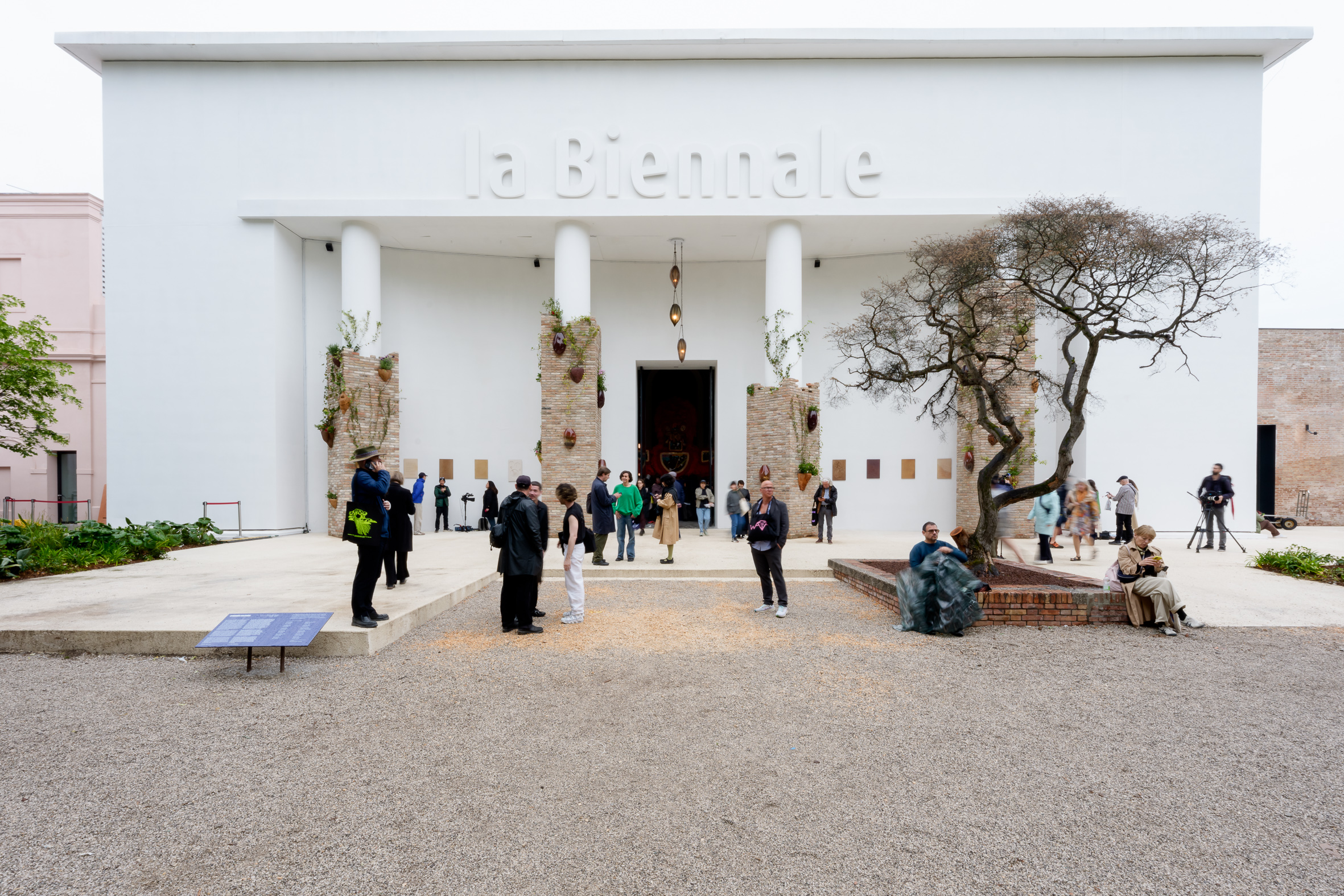
The 61st International Exhibition of the Venice Biennale, curated by Koyo Kouoh, took place against the backdrop of a turbulent and unsettled global historical landscape. The protests against the opening of certain national pavilions, such as Russia’s, carried out by Pussy Riot during the opening ceremony, and the mass resignation of the international committee responsible for awarding the Golden Lion, seem, however, to fit within the curator’s premise.
Even the entrance to the Arsenale opens with an invitation to breathe in and out. The poems printed on textile banners then accompany the viewer along the entire route, maintaining a meditative and serene atmosphere that pervades the exhibition. Rather than attempting to directly challenge the tensions, Kouoh has created a suspended, almost slowed-down space, where even the pace of viewing changes.
In the exhibition design by Wolff Architects of Cape Town, the doorsteps fully open up the Arsenale space, following the idea of a procession. Without dividing walls, the large indigo-colored banners guide the passageways and mark the thematic sections. Recyclable cardboard structures and platforms support the works at various heights, from floor level up to eye level, while monumental silhouettes, suspended canvases, and walk-through surfaces invite the body to move around the works. Even the informational displays and captions, made of cardboard, seem to fit into this logic of material simplicity.
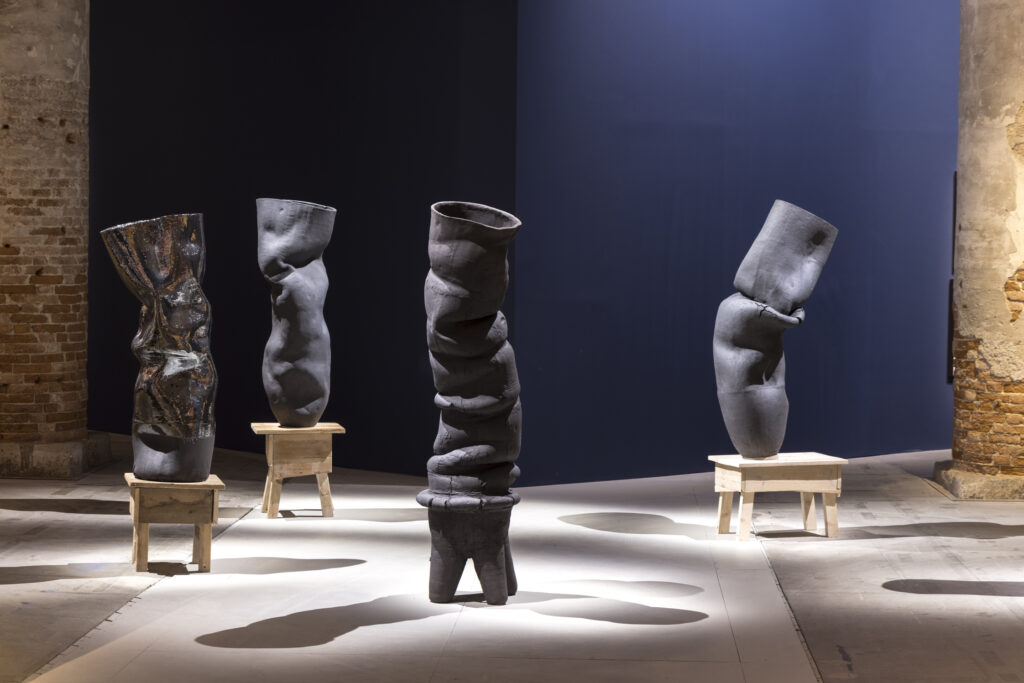
The exhibition layout conceived by Kouoh prior to her passing in 2025 is consistent with her curatorial statement: it is regenerative, sensory, and open to experience. The works seem to unfold in a fluid sequence, spanning reflections on the past, spirituality, femininity, contemporary uncertainty, geopolitical transformations, and the need to rediscover forms of belonging. A tension that also runs through the spiritual and religious consciousness of Ranti Bam, for whom sculptural creation becomes a process of fusion with the ancestral material of clay, inhabited by memories and spiritual presences.
Or through the monumental textile drawings of Kaloki Nyamai, who, drawing on the Kamba heritage and the teachings passed down by her mother and grandmother, claims a Black space embedded in the social, emotional, and political dimensions of domestic and community life in Kenya.
Sensory stimuli continuously permeate the exhibition space: from the olfactory experience of the immersive circular space blending video, painting, and scents in Khalil by Khaled Sabsabi—which offers a place of encounter and reflection on experiences of marginalization, forced displacement, and imposed silence—to the tactile works of Kader Attia. In Whisper of Traces, the visitor walks through a labyrinthine corridor of ropes and reflective fragments, where ritual elements and technology seem to merge in a dimension suspended between ancestral memory and the digital universe. It opens up the possibility of an invisible coexistence between spirits and technology.
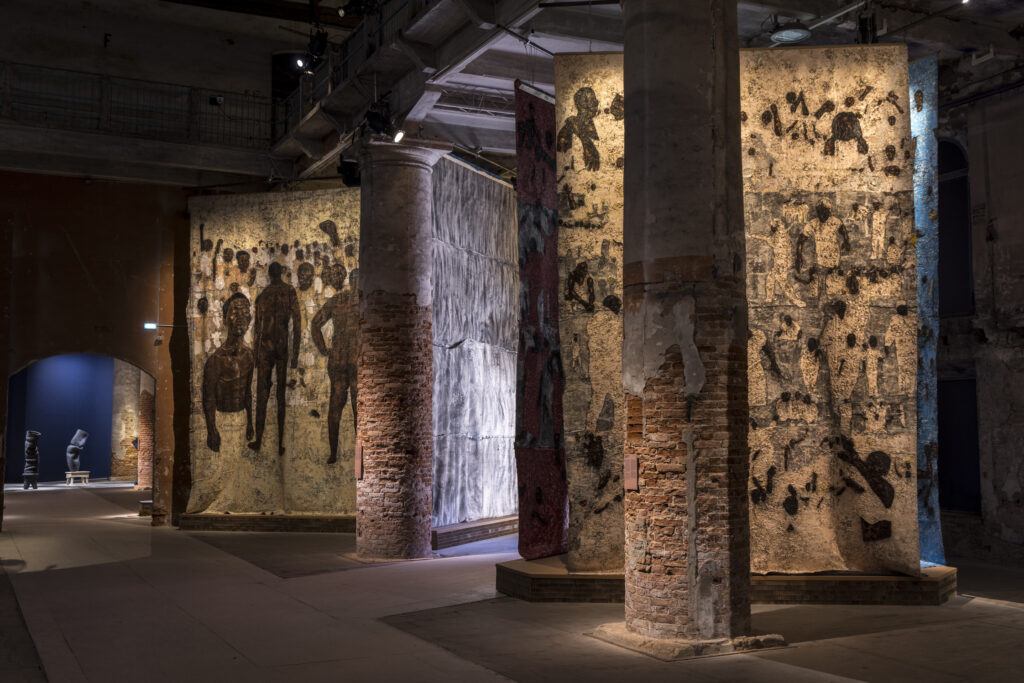
The Egyptian Pavilion in Giardini also operates within this physical and perceptual dimension: Armen Agop’s invitation to “touch” his granite sculptures leads visitors to engage directly with the stone’s concave and polished forms, transforming touch into an integral part of the experience of the work.
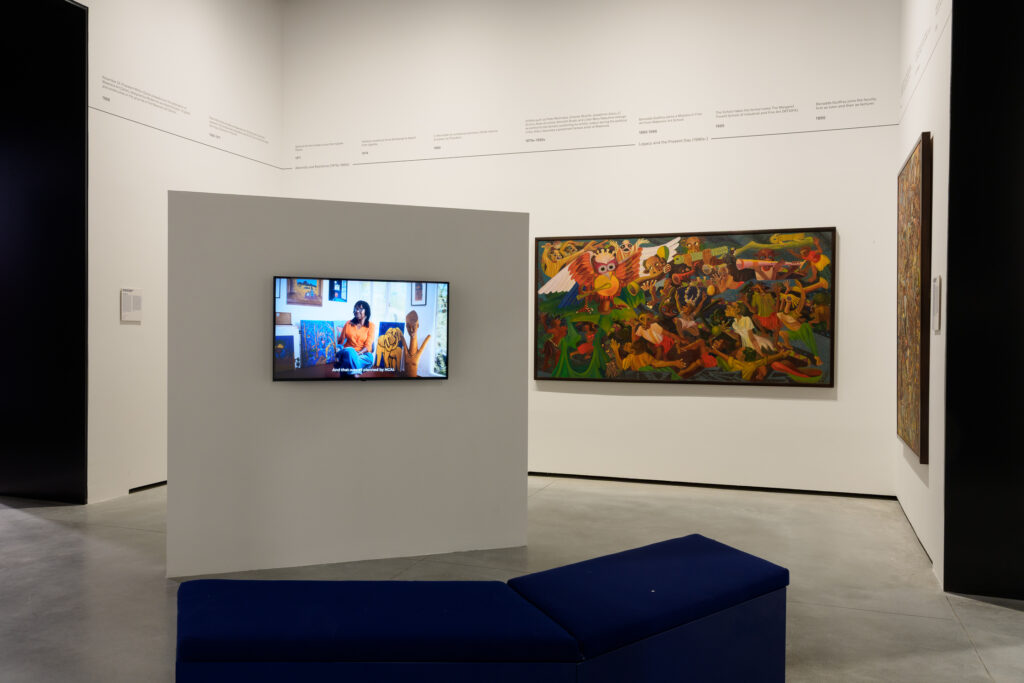
An underground connection between Arsenale and Giardini emerges through the schools located along the exhibition area: from the artistic-labor collective BLAXTARLINES KUMASI in Ghana, to the G.A.S. Foundation in Nigeria, to the Nairobi Contemporary Art Institute (NCAI), and finally to the RAW Material Company founded by Koyo Kouoh herself in Dakar. More than mere platforms, these projects appear as cultural and community infrastructures of the contemporary era.
The work of Issa Samb, co-founder of the Laboratoire Agit’Art collective in Dakar, also fits into this framework; for him, the artwork was meant to be traversed and experienced directly by the viewer. His suspended works, composed of notes and assemblages, seem to evoke the atmosphere of the Cour, his courtyard-laboratory that for years served as a meeting place and a crossing point for entire generations of artists.
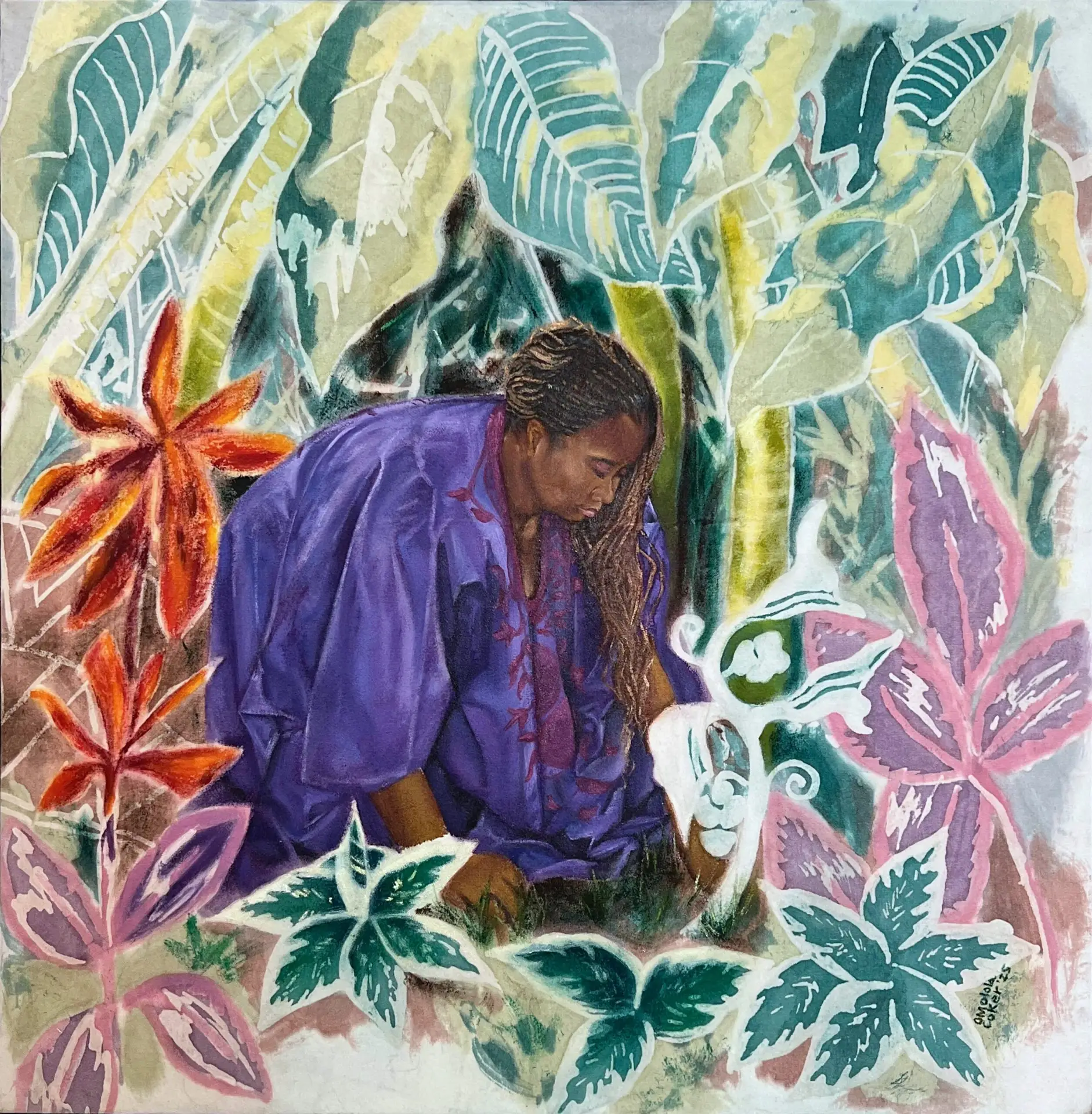
The textiles are also noteworthy: from Billie Zangewa’s use of raw Dupion silk to weave scenes of everyday Black feminism, to Amina Saoudi Aït Khay’s silk tapestries, imbued with the Moroccan and Tunisian landscapes of her childhood and her Amazigh heritage.
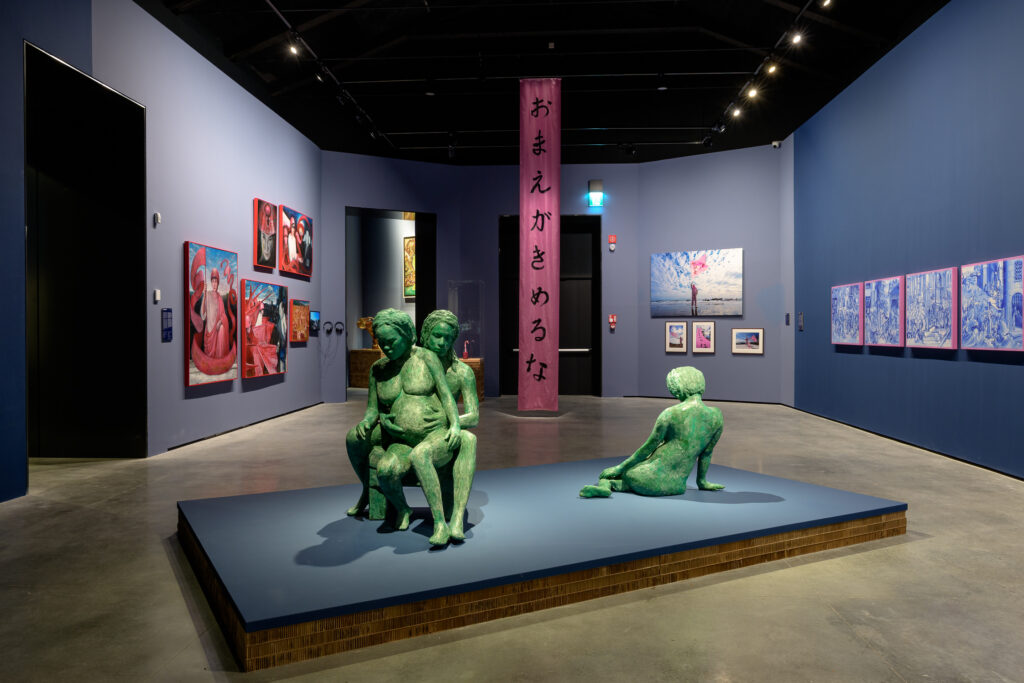
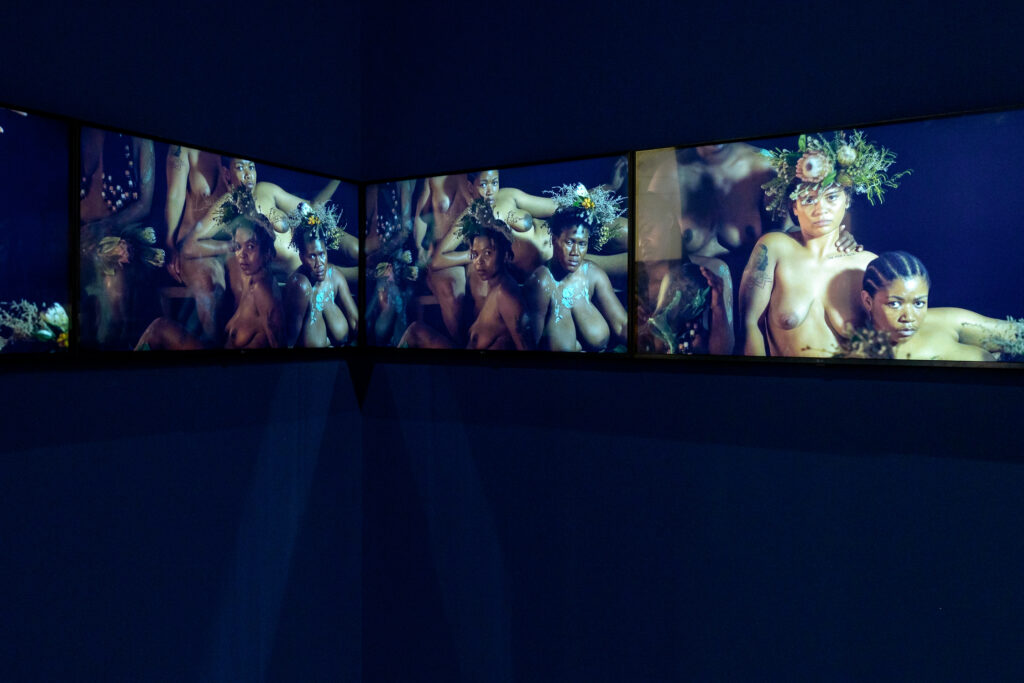
Buhlebezwe Siwani, a South African artist, traditional healer, and fortune-teller, welcomes visitors into a space dominated by the sculptures Zanenkosi and Ilifa lakhe, carved from green soap—a material instantly recognizable in low-income South African homes. This fragile, everyday material becomes a symbol of precariousness, inequality, and vulnerability, particularly in the figure of the pregnant woman. Standing close together, naked, adorned with colorful flower crowns, the women in the artist’s videos hold the viewer’s gaze with a silent, collective presence.
This tension also echoes Gabrielle Goliath’s Elegy Pavilion, a performance project that for years has visualized moments of shared mourning dedicated to women and LGBTIQ+ individuals victims of racial and sexual violence. In her performances, groups of singers hold a single continuous note together, passing their breath and voices to one another in a choral gesture of mutual support.
A song that travels through the space of the Biennale, remaining at once placid and deafening, intimate and immersive. It is precisely in this limbo between pain, memory, and the possibility of collective healing that Kouoh’s work finds its most powerful image.
Translation by Luigina D’Introno
61st International Art Exhibition – La Biennale di Venezia
In Minor Keys curated by Koyo Kouoh
09/05/2026 – 22/11/2026
Koyo Kouoh was an influential curator, cultural producer, and arts luminary known for her visionary work in contemporary African art. She served as the Executive Director and Chief Curator at Zeitz Museum of Contemporary Art Africa (Zeitz MOCAA) in Cape Town from May 2019 until her passing in May 2025. Prior to this, she was the founding Artistic Director of RAW Material Company, a centre for art, knowledge, and society in Dakar, Senegal. In 2024, Kouoh was appointed by the Board of La Biennale di Venezia, upon the recommendation of President Pietrangelo Buttafuoco, as Director of the Visual Arts Department to curate the 61st International Art Exhibition, scheduled for 2026.
Kouoh’s curatorial practice was distinguished by her commitment to meaningful and timely exhibitions. Among her celebrated projects were Body Talk: Feminism, Sexuality and the Body in the Works of Six African Women Artists, first shown at WIELS in Brussels, Belgium (2015); Still (the) Barbarians, the 37th EVA International, Ireland’s Biennial in Limerick (2016); and Dig Where You Stand, part of the 57th Carnegie International in Pittsburgh (2018), an exhibition that deeply examined the collections of the Carnegie Museums of Art and Natural History. She also initiated Saving Bruce Lee: African and Arab Cinema in the Era of Soviet Cultural Diplomacy, a research project co-curated with Rasha Salti at Garage Museum of Contemporary Art in Moscow, Russia, and Haus der Kulturen der Welt in Berlin, Germany (2015–2018).
A leading voice in pan-African and international art circles, Kouoh authored and edited numerous publications, including When We See Us: A Century of Black Figuration in Painting (2022), which accompanied the landmark exhibition at Zeitz MOCAA; Shooting Down Babylon (2022), the first monograph on South African artist Tracey Rose; Breathing Out of School: RAW Académie (2021); Condition Report on Art History in Africa (2020); Word!Word?Word! Issa Samb and The Undecipherable Form (2013); and Condition Report on Building Art Institutions in Africa (2012).
She also served as Curator of the Educational and Artistic Programme of the 1:54 Contemporary African Art Fair in London and New York (2013–2017) and contributed to the curatorial teams of documenta 12 (2007) and documenta 13 (2012). In 2020, she was awarded the Grand Prix Meret Oppenheim, the Swiss Grand Award for Art recognizing achievements in art, architecture, critique, and exhibitions.
During her tenure at Zeitz MOCAA, Kouoh’s curatorial focus centered on in-depth solo exhibitions of African and African-diasporic artists. Her projects included exhibitions with Otobong Nkanga, Johannes Phokela, Senzeni Marasela, Abdoulaye Konaté, Tracey Rose, and Mary Evans. The landmark survey exhibition which Kouoh co-curated with Tandazani Dhlakama, When We See Us: A Century of Black Figuration in Painting, resonated so deeply with audiences at Zeitz MOCAA in Cape Town (November 2022 – September 2023) that it subsequently travelled to KunstmuseumBasel in Basel (May – November 2024), and is currently on at Bozar in Brussels (February – August 2025) before travelling to Liljevalchs in Stockholm (October 2025 – August 2026). Kouoh lived and worked alternately in Cape Town, Dakar, and Basel. She leaves behind a profound legacy that continues to influence contemporary art discourse globally.

Alessia D’Introno is Editor-in-Chief of the African contemporary art magazine Equator Echoes, registered in the Special List of the Lombardy Journalists’ Association. She holds a Master’s degree in Visual Arts and Curatorial Studies from NABA, Milan, and has completed a postgraduate course in Demoethnoanthropological Heritage at the University of Milano-Bicocca. She has published articles in Juliet Art Magazine and ArtsLife. Her critical and curatorial research focuses on the deconstruction of classical art history and the decolonization of the contemporary European art system.
N. May 5, 2026