By Camilla Boemio
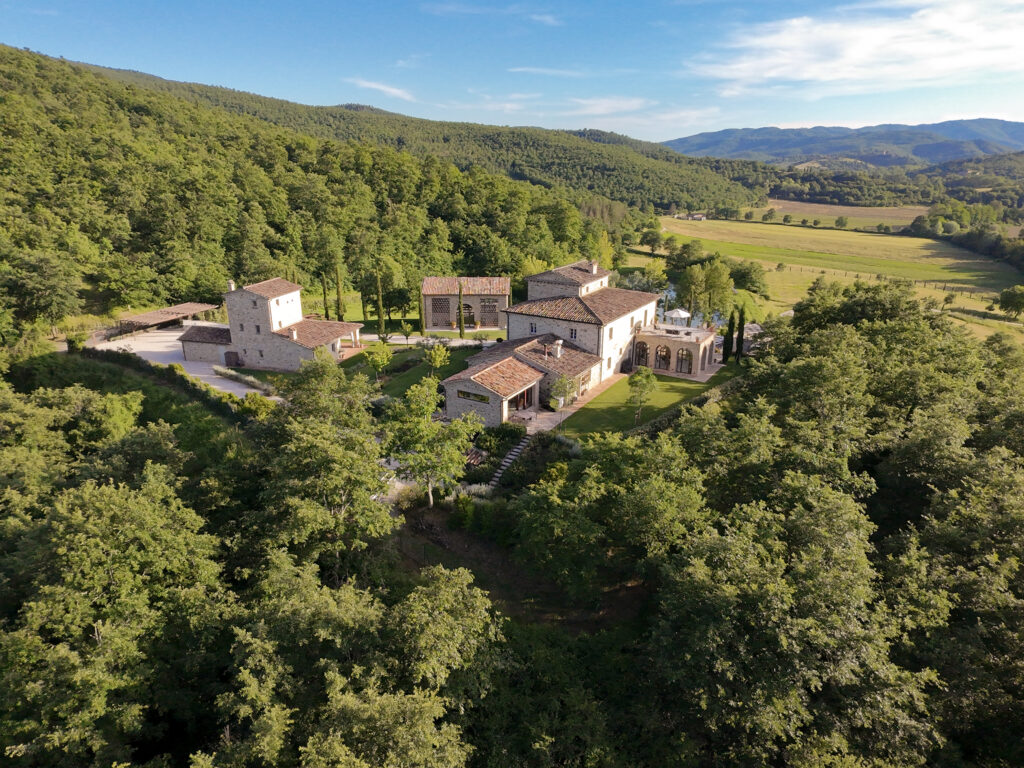
Several weeks ago I visited Tyburn Foundation with Verso Il Cielo permanent public commission in a relevant and poetic position of woods. Tyburn Foundation is a new foundation with a residency, open to African artists working across all media, beginning in early spring after the preview of Venice Biennale. During their time in residence, artists have the opportunity to immerse themselves in the rich artistic and cultural heritage of central Italy.
It comes as no surprise that the high profile historic centers of Rome and Florence are designated UNESCO World Heritage Sites in Central Italy along with renowned places such as the stunning Val d’Orcia and Chianti in Tuscany and the beautiful green Umbria with several remarcable towns like Spoleto; as well as less well known yet equally stimulating destinations.
The inaugural resident is Michele Mathison (b. 1977, Zimbabwe/South Africa), whose practice explores the intersection of contemporary sculpture and cultural storytelling. Mathison embarked on a large-scale public art project as part of the La Foce Residency. I started a conversation to him.
Can you introduce us to your artistic practice? How do you choose the materials for your artworks?
When I first began making work professionally, I was interested in found objects that had inherited meaning through social and political circumstance. The object itself often wasn’t remarkable, but through the way it was used it became loaded with significance. The jerry can during Zimbabwe’s fuel shortages is probably the clearest example. It transformed from an everyday utilitarian object into something that represented informal trade and survival. That shift fascinated me.
Over time my practice has evolved. I’m still interested in the way meaning becomes embedded in objects, but increasingly I’ve become interested in the materials themselves—their histories, their value, how they’re used, manipulated and understood across different periods of time.
I don’t usually begin with a narrative that I’m trying to illustrate. More often I begin with a material or an object and spend time researching it, drawing and modelling it. As I work, form becomes equally important. Through changes in scale, proportion, repetition and geometry, a material begins to move beyond its original function and starts to evoke something else. It’s in that dialogue between material and form that the work begins to find its meaning.
Whether I’m working with stone, steel or bronze, I’m interested in how a sculpture can retain traces of its history while opening itself up to new emotional or poetic associations.
Verso il Cielo is a new permanent public commission in Umbria. Can you describe how you developed the idea and the realisation of this poetic site-specific installation?
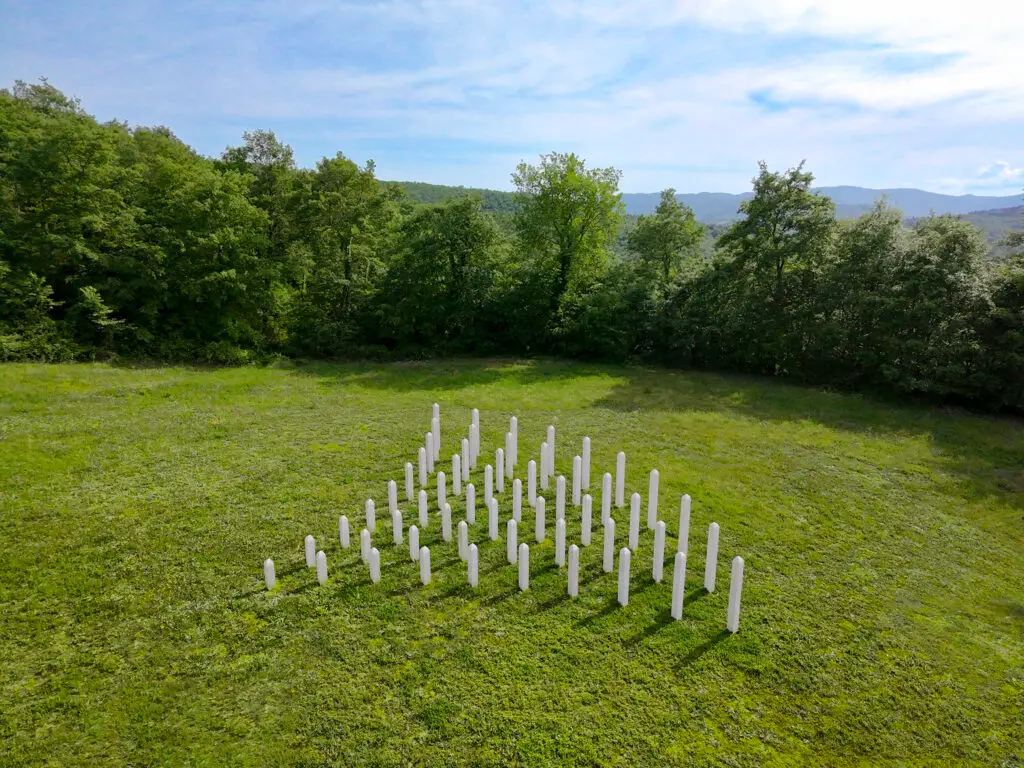
Verso il Cielo really began with a place. Umbria, the field and time. I spent days walking through the landscape before making any decisions. I wanted to understand the rhythm of the site rather than impose something onto it.
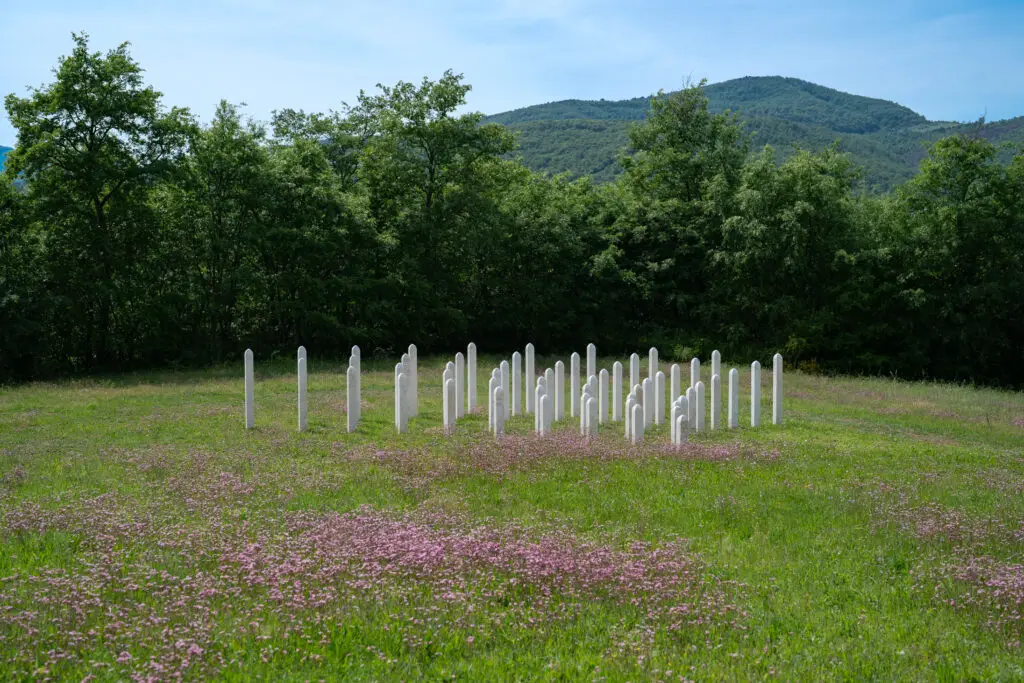
The clearing where the sculpture now stands already possessed a remarkable atmosphere. There was a quietness to it, but it was also full of life. You became aware of the birds, the insects, the movement of animals, the changing light and the Umbrian hills. It felt less like an empty space waiting for a sculpture than a place that already had its own identity.
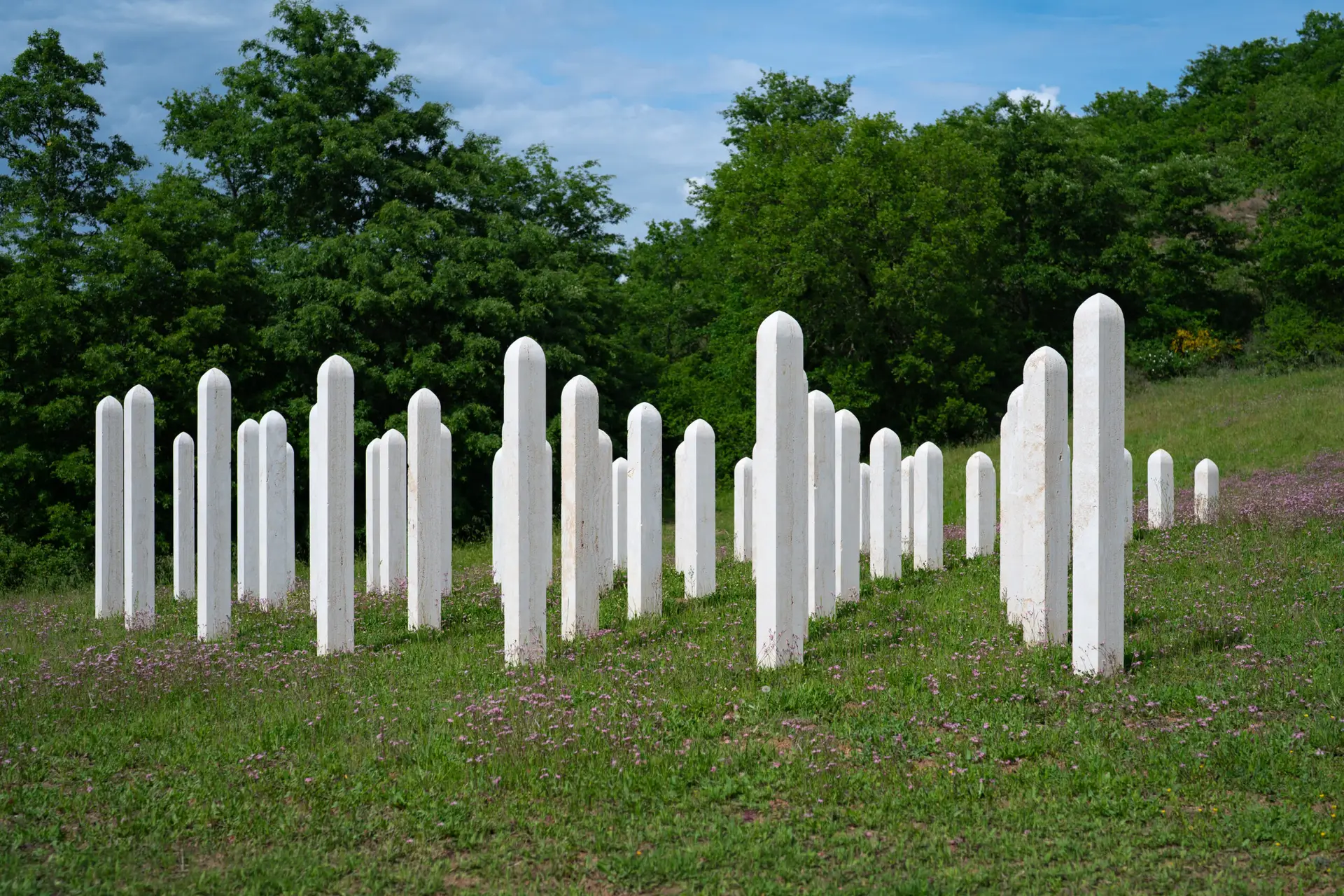
The work emerged through responding to those observations. The vertical forms follow the movement of the hill and gradually draw the eye upward towards the sky, which is where the title comes from. Working with travertine felt appropriate not simply because of its long association with Italian architecture and sculpture, but because it allowed the work to exist somewhere between archeology, landscape and geological formation.
There are reflections on the urban environment and memories of your childhood. Can you tell us more?
I grew up in Zimbabwe and have lived much of my adult life in South Africa but I have learnt more about my Italian blood through time spent in Italy. Through all of this has emerged interesting associations between the places. Especially the legacy of European architectural language on southern African urban environments. Whether through the legacy of colonisation or appreciation and appropriation
I’ve never really separated architecture from nature. They’re constantly influencing one another, and I’m interested in those moments where the boundary between the two becomes less clear, especially in historical or decaying sites.
What are some of the other considerations when realising work for a public space?
Public sculpture asks you to think on many different levels at the same time.
There are the practical realities—engineering, longevity, safety and construction—but there are also social and emotional considerations. A public sculpture becomes part of people’s everyday lives. It has to exist through changing seasons, changing communities and changing ways of using a place.
I enjoy collaborating with the patrons, engineers, builders and artisans because they bring an incredible depth of knowledge to the process. Those conversations often shape the work in unexpected ways.
At the same time, I think public sculpture benefits from a degree of generosity. I don’t believe it always needs to announce itself or explain itself immediately. Some works reveal themselves slowly through repeated encounters, and I think there’s something quite beautiful about that.
How is conceiving a work for the public realm different from creating other works in your practice? How do you approach issues relative to the landscape?
In many ways I approach them similarly because context is always important to me.
The difference is that public works become part of a place much more permanent way. They’re experienced by people who may have no interest in contemporary art, which I actually find exciting. The work has to communicate through experience rather than explanation.
Landscape is never just the backdrop. It’s one of the elements I’m working with. I spend a lot of time on site before I begin designing anything because that’s how I start to understand its scale, movement and atmosphere.
Ideally the sculpture encourages people to look at the place differently rather than simply look at the sculpture itself.
What do you see as some of the major issues of the art world? And in public art specifically?
It’s very rare to have this kind of opportunity to make a work that is purely for consumption and appreciation rather than financial gain. Sculpture is especially complex because of the high costs involved in making the work.
It is becoming increasingly difficult to have the freedom to create like this. Residencies and commissions such as this one should be appreciated and encouraged.
Public art encourages people to slow down, spend time in a place and gradually build their own relationship with it.
I enjoy these opportunities to spend time listening and observing a place, its objects and materials, its landscape and to the people I’m collaborating with, or to the history of a place. I don’t think public art should simply occupy a site. At its best, it helps us experience that site more deeply.
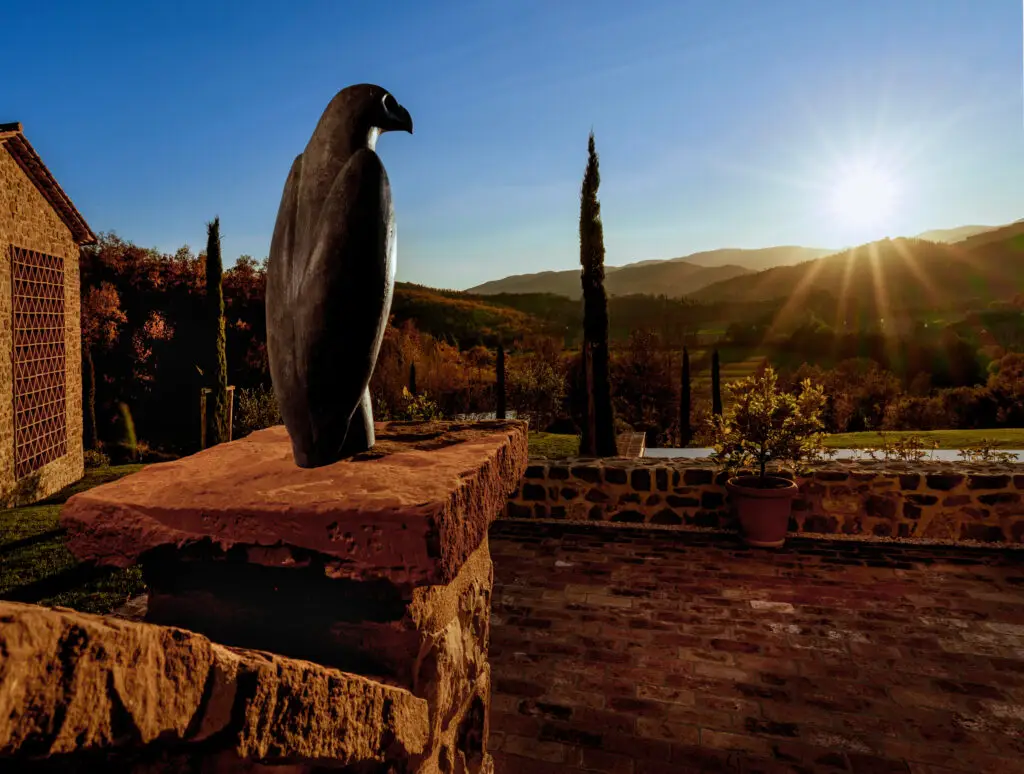
Michele Mathison. Verso il Cielo.
Public sculpture at La Foce, Umbria.
Born in South Africa in 1977 and raised in Zimbabwe, Michele Mathison explores Southern Africa’s shifting political, social, and economic dynamics through sculpture and installation. A 2000 BFA graduate from the Michaelis School of Fine Arts, University of Cape Town, Mathison has exhibited widely.
Key solo shows include CIVILIAN (2023), Over and Over (2021), and States of Emergence (2017) at WHATIFTHEWORLD, as well as Dissolution (2018) and Uproot (2016) at Tyburn Gallery, London. His Venice Biennale (2013) work Harvest was later showcased at the Zeitz MOCAA during its 2017 opening. Mathison’s notable public works include Parallax at Frieze Sculpture (2018) and Angular Mass (2017) for Zeitz MOCAA and the V&A Waterfront.
Residencies include time in Italy (2019), and in 2021, he completed major public sculptures for North-West University. Recent group exhibitions feature Fallow (Germany, 2024), That Hidden Thread (Johannesburg, 2021), and Inner Landscapes (Rome, 2019). Mathison’s work is included in notable collections, including the Norval Foundation’s Homestead collection, the Zeitz MOCAA permanent collection, the Leridon Collection, Spier Arts Trust, and the Standard Bank Art Collection.
Mathison is the inaugural recipient of Tyburn Foundation’s La Foce Residency.
Translation by Luigina D’Introno
N. August 3, 2026