By Lisa Bradley
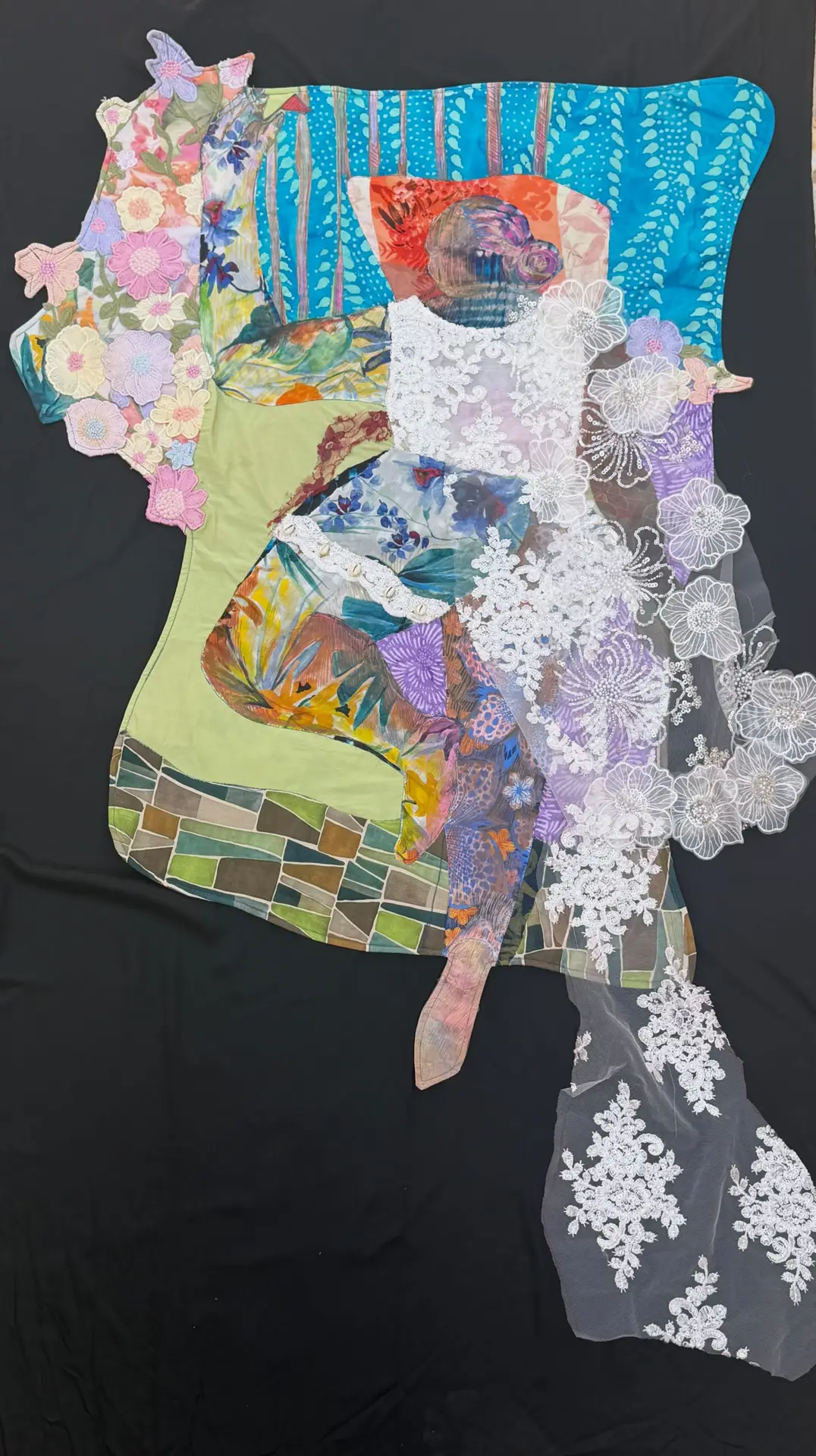
For over three decades, Angela Franklin has been building a body of work that refuses easy categorization. She works infibers and fabric, layering cloth the way other artists layer paint; however, she is quick to correct anyone who calls her a quilter. She does not make quilts. She paints. Her main medium happens to be fabric, stitched and stretched and built up, in the manner of a painter working canvas, and she calls herself, simply, a mixed media artist.
Her scenes center women. Women caught in the quiet, universal experiences that mark a life: caregiving, aging, longing, self-perception, loss. Lately, loss has moved from subject to source. Angela Franklin is the youngest of seven sisters, and in recent years she has buried five in just the past eight years. Grief and mourning now run through her work as both subject and structure, alongside an unflinching look at the labor of the caregiver-a role she has lived as much as depicted.
Her work also turns a steady eye toward the politics of Black women’s beauty, particularly the fraught, complicated relationship to hair that she witnessed and absorbed during years spent living in West Africa. That chapter is one of several: her life has carried her from Abu Dhabi to Senegal to the United States to the Marshall Islands, a nomadic path she describes with dark humor as one where COVID seemed to follow her at every stop. That restlessness- displacement, migration, the search for footing in unfamiliar ground-runs underneath much of what she makes.
Through it all, her work stays rooted in a distinctly Black American sensibility, even as it travels the world to find its material and its meaning. In this interview, Angela Franklin speaks about grief, beauty, movement, and the stubborn, insistent work of making art out of a life lived across continents and through love, loss, and the pleasures of artmaking.
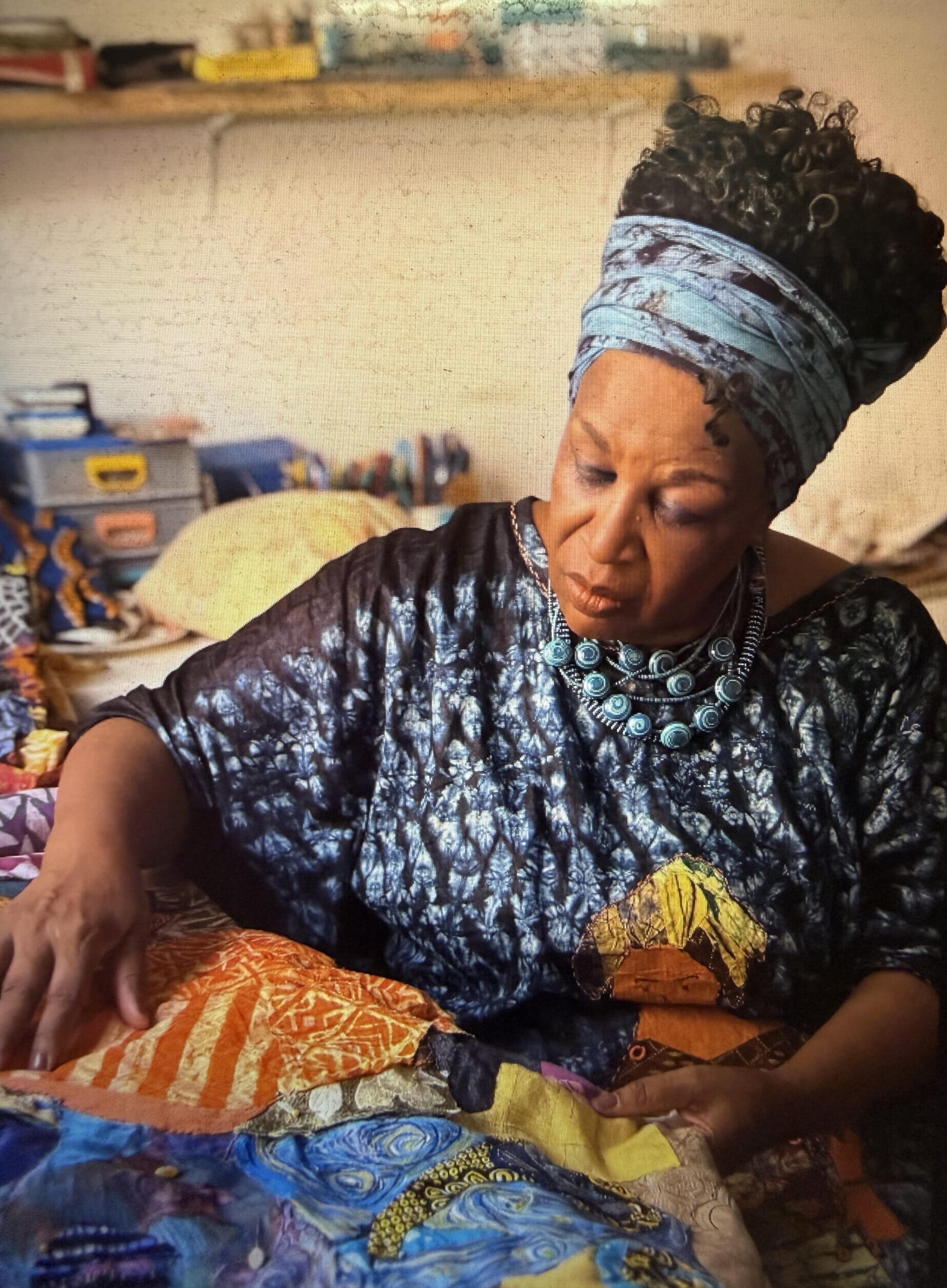
So I’m here with Angela Franklin in her Dakar studio. We are viewing several different pieces that cover the floor with layers of color, and strips of painted fabric. Angela, tell me what you’re working on right now.
Well this was for an exhibition with the Dakar Women’s Group, and the theme was ’A Taste of Senegal’. So I created this with a focus on water, as well as elements of the foods that nurture us, like the peanuts and the peppers and the rice, spices. And then the cowries, as a source of decoration and culture, black-eyed peas. I was really into creating something special for this exhibition, and there was a wonderful response to the piece.
Exciting. Describe the details for us.
Sure. In her hand the woman holds a bowl, containing okra shapes. I used okra because it is the foundation of a favorite dish in Senegal called Soupe Kandia. Also, stewed okra, fried okra and gumbo with okra is native to many popular dishes among the African American community. The collar the woman wears is adorned with peppers, black eyed peas, cracked corn, rice and peanuts. I love the design pattern it comes together to create what sustains us in all its glory. And always there is water, because the water here in Senegal, as well as the Ohio River, the Atlantic and Pacific Oceans have all sustained me on this life journey. They literally provide sustenance. This was one of the few times I’ve created based upon a theme: rather, a theme determined by something or someone, outside of myself. But here I was excited about the possibility of working within certain confines. And I worked to the end because it was a good challenging exercise for me to create something so specific. It was very special.
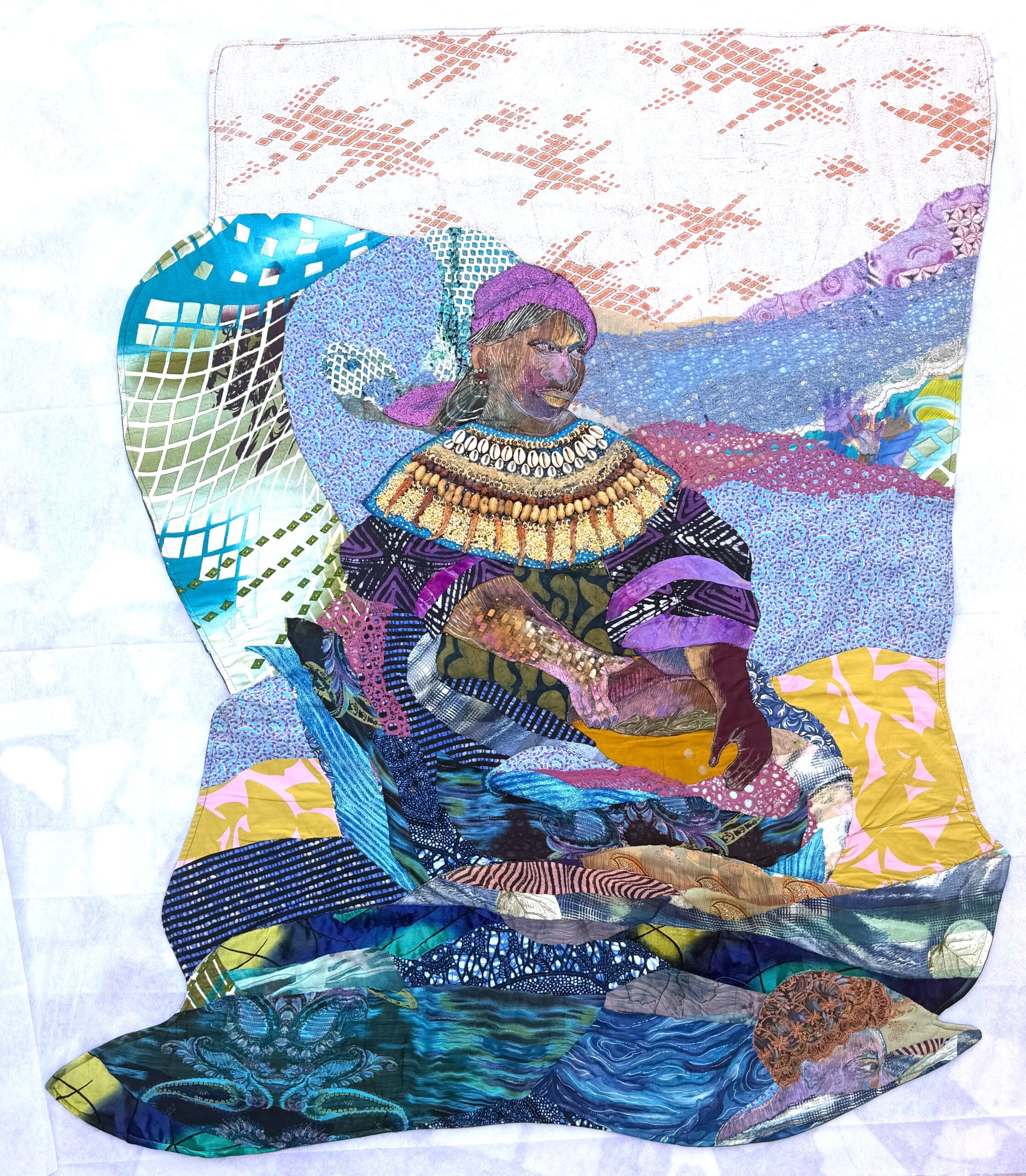
So that’s ‘All That Sustains Us’. We spoke earlier about another work called Forever Following. The title is so compelling that I can’t wait to have a look and hear about the process of creation…
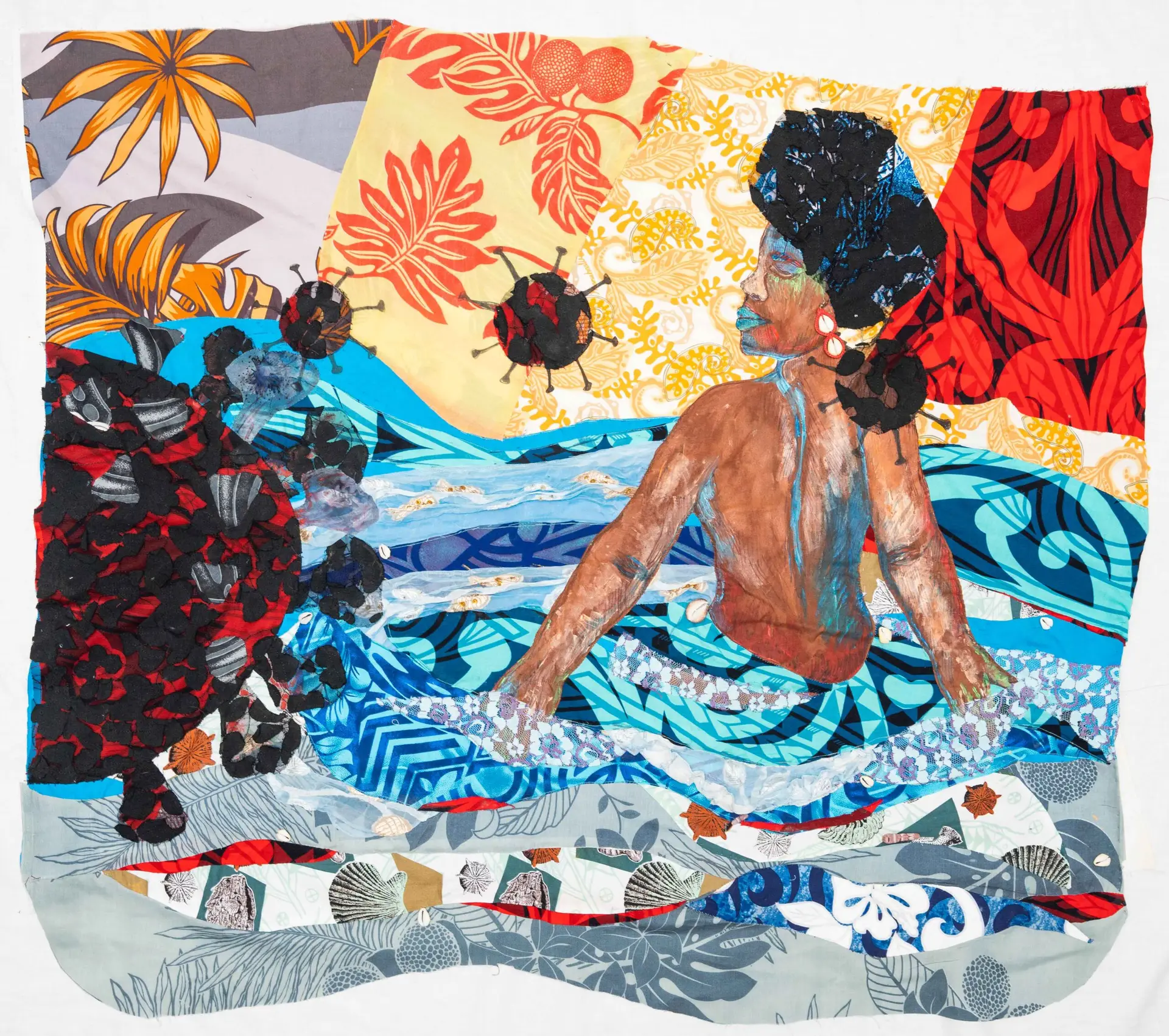
This piece is titled ‘Forever Following’, because I experienced COVID in four nations. I left UAE February 8, 2020 just as it was arriving from Asia, but we weren’t feeling its effects yet. Then I travelled to Cincinnati in early February to care for my sister, who was gravely ill. That week, I set up my sister’s house for care and got it COVID-ready. And by the end of February, COVID hit the city in full force.
I was in Cincinnati as an artist in residence at Xavier University. By then, Xavier had sent their students home. I was making work, and wandering around this big empty campus with a few others in the same situation. I was stuck there until July (laughs).I couldn’t go back to the UAE, where I’d been living as the border was closed. I couldn’t return to Senegal because their borders were also closed. When Senegal finally opened, I returned there. So I was in Senegal dealing with COVID: vaccinations, social distancing, curfews, but all of this was without the U.S. hysteria.. Then I accepted a Deanship at a university in the Marshall Islands. The Marshall Islands was one of only 3 or 4 nations that didn’t have COVID. I went through 4 weeks of quarantine before I got there. After about a year there, Covid did arrive. My first thought was ‘Wow, this thing has followed me all over the world, and I almost out-ran it!’ So the piece I made chronicling this journey is called ‘Forever Following’.
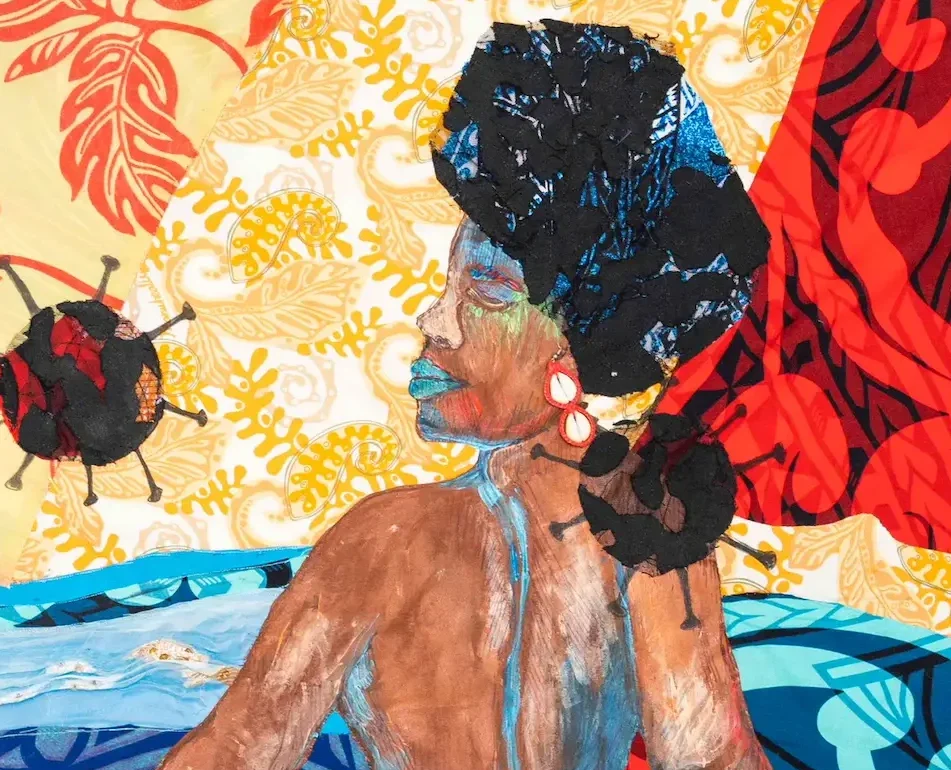
That’s pretty amazing. ‘Forever Following’: it’s got so much symbolism and the surfaces are incredibly rich. Tell me about this black lace. The shape looks familiar. Is it what I think it is?
Yes. That lace shape there, that’s the SARS symbol. That’s COVID.
Incredible as an object, as an illustration. It’s actually beautiful; especially for it to be so deadly. Forever Following’ has such a painterly feel to it. Where’s your point of entry with something like this? Are you making little painted maquettes first?
I start with a little research, and a black and white drawing. Once I did a black and white drawing, I normally do a color study. And once I do the color study with marker, crayon, pencil, then I start pulling out the fabrics that are going to be a part of it. The actual fabrics that go with those colors that will be part of the piece.
I see. So once you’ve moved into the selection of fabric in this process, what are the requirements you’ve set for it?
Do you mean in terms of the compositions already being mapped out? Well, I like a lot of patterns. But I have to match the pattern with some breaks. Like small patterns break big patterns. Some solid areas break. But I like a lot of patterns.
The fabric can be anything. When I was learning quilting, they kept saying, ‘you know, you want to work with cotton’. But I let cotton go a long time ago. If it’s cotton, it’s cool. If it’s not cotton, oh well. So I wasn’t that interested in being a cotton owner (laughs). So if there’s a color study, the fabric needs to have the background color. And even that isn’t a hard and fast rule: it can have a design on top of it as well. That doesn’t bother me.
And truly: water, water, everywhere. Does water hold symbolism for your work?
Oh yes. So that’s why when you look at the different visuals of water in the images, you know that they mean movement. Again, almost everywhere I’ve lived is surrounded by water. For me, it’s symbolic of journey, transitions, and traveling. We even became Americans by living near water and crossing water. It’s always been significant to me and to my work. I love water in my work.
Earlier, you’d mentioned a project you completed last year for an exhibition at the Camp Gallery (the Contemporary Art Modern Project) in North Miami. What was the theme again?
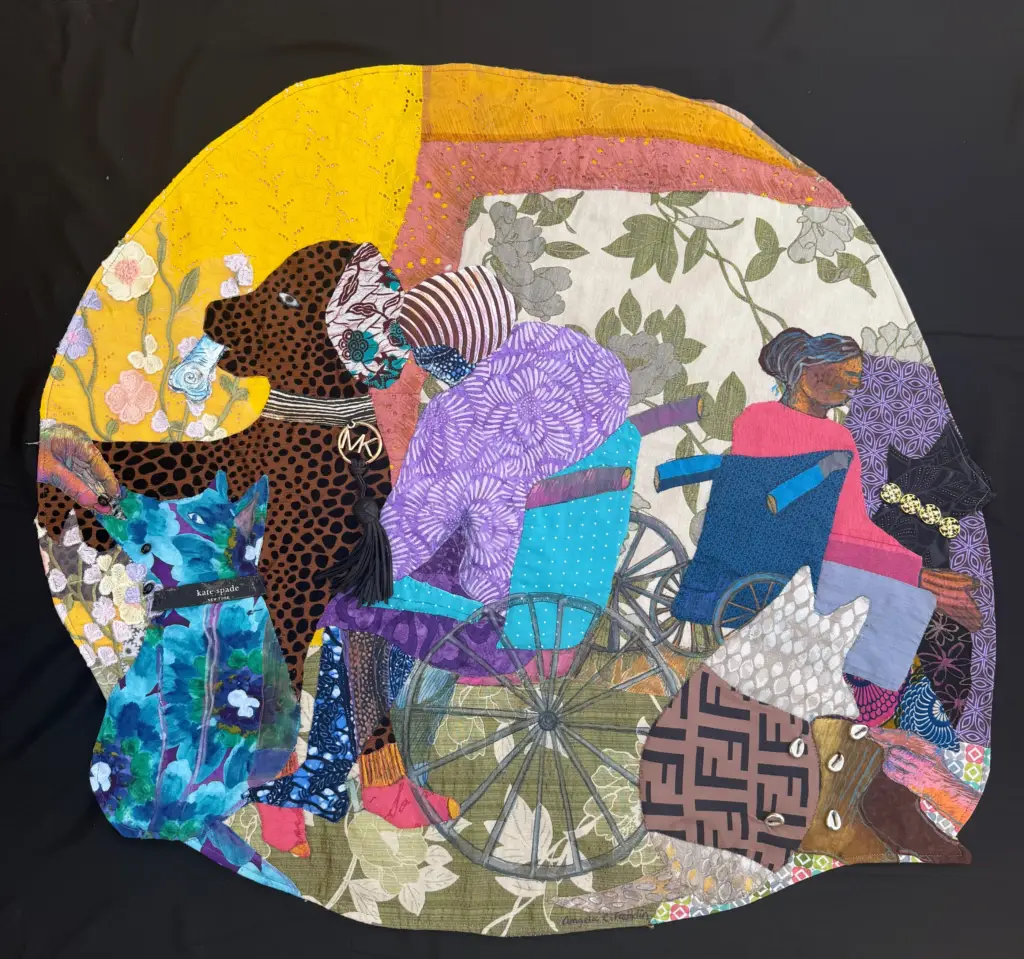
Oh that was an exhibition entitled: ‘Women Pulling at the Threads of Social Discourse: Don’t be Absurd’. It was an exhibition of textile artists engaging with ideas of the absurd. We were invited to read one of several essays shared with us by different philosophers. I selected The Stranger by Albert Camus. The title of the piece is ‘Poochie’s Ok, but what About Big Mama”; It talks about the differences between how we treat vulnerable humans vs the privilege we grant to our pets.
II was in California, the summer of 2003 or 2004, we were at a hotel. The hotel accepted animals, everyone seemed to have a dog, sometimes two. Everyone was traveling with a pet, but I didn’t notice people traveling with older people in the family. I like animals too. But I started noticing a pattern where we have this tendency to treat our animals with such love and care-so Poochie is ok. But I don’t know if we provide the same element of love and care to the elderly and the seniors in our home and community.
Tell us about the visual elements here.
So you see the one dog with the Michael Kors necklace. And then this one is wearing Kate Spade. And then another with a diamond collar and little Fendi jacket. But after closer look, we see the women; people slumped over in wheelchairs. But what about Big Mama? That we cannot speak on. That’s a social issue that I haven’t seen many artists take up. I feel like I haven’t seen them talk about it. In any case, it’s an unspoken issue. One thing society is beginning to do is address a lot of concerns around caregiving. Caregiving is very hard with little support. And it really, it shortens the lifespan if the proper support isn’t given. So, who cares for the caregiver? The whole scene struck me as quite absurd when we contrast animal care vs human care. The figure I refer to as ‘Big Mama’ is often a caregiver too-before she herself begins to need care.
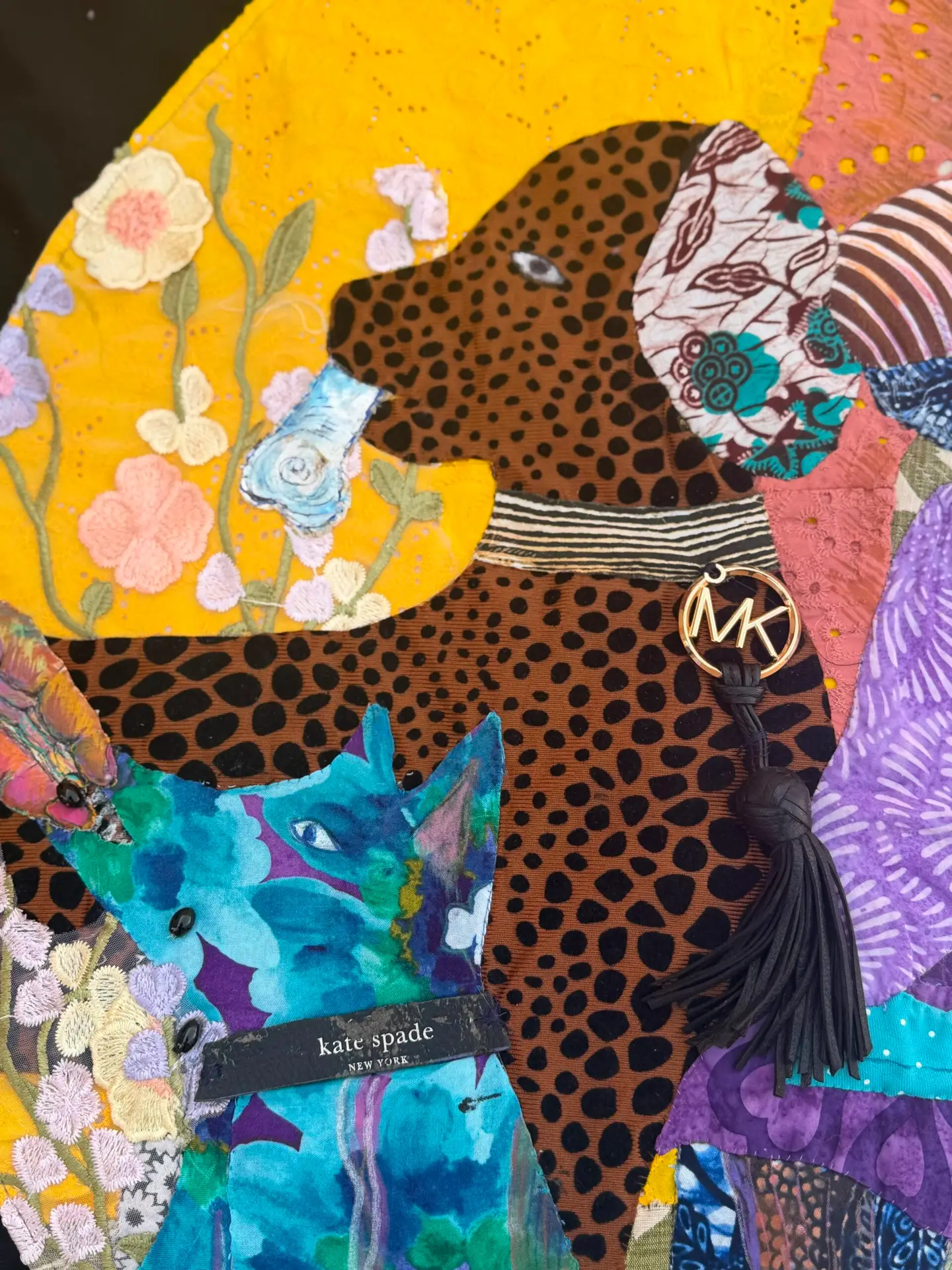
I think this is the absolute first time I’ve seen an artist address this issue. Absurdity, indeed! Tell me what’s next for you and your work. Are there other social issues that your work is grappling with these days?
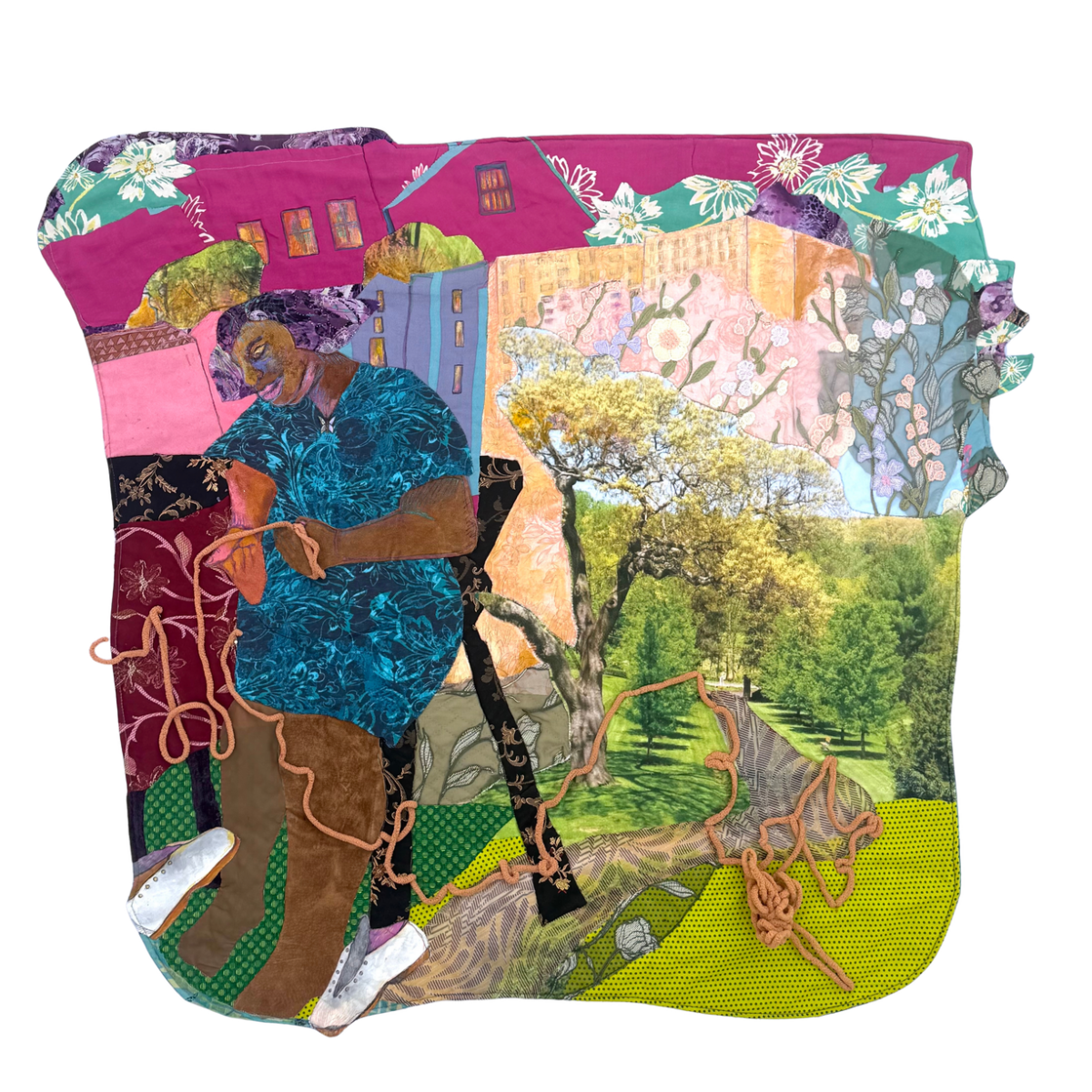
I’m presently working on a series about femicide. It’s something we don’t always want to talk about or give a name to. And I feel like if you don’t want to talk about it, then maybe through the images and the arts, you’ll be forced to confront it and explore it a little more.
That makes sense. Will this be a single piece, or a group of works?
I finished one piece, but this will be a series of works. And when I do a series, I like to have at least, minimum, eight to ten pieces that tell the story. So that’s next for me, in terms of creating. This subject is timely. Femicide is not specific to the U.S. It’s a global issue. I think there’s more emphasis on supporting women who are going through it. or alerting young women about what are the signs of what’s about to happen. But I really think it’s the access to the internet, and that has changed the tide.
So in terms of the imagery around that, what will you show us?
It doesn’t have to be graphic to talk about something like that. I prefer the pieces being reflective and kind of examples of how women should support each other, how women survive, how women learn when to run, and not go back. And maybe sage wisdom, like there were things maybe your mother or grandmother told you about men and domestic abuse. I want to use those types of topics, those ideas to create the works and exhibit them altogether. I think it will be a moving story that brings people into the gallery space. I always say that when you see art, you can just brush by and say, ‘oh, that’s pretty’. But for me, I want my work to speak. What art says to you and what it says to another person, that’s two different things. I definitely think it should speak, or should resonate with you in some way. Even abstraction can resonate with you. Maybe one person sees clouds, but maybe you see a woman’s body. So that’s what I look for-something that will engage the viewer, bring them in. And then once you bring them in, there’s a story there.
Speaking of abstraction, I’m reminded of painting. Does your practice have a relationship to painting? Did you study painting in college?
No. I did my B.A. in art; I did make lots of paintings, but I also did a lot of craft. I did batik, and I did enamel design, in my early work, and some textiles. When I began traveling, I decided that I would work with what was at hand. And what I found at hand, wherever I went, Senegal, UAE, Marshall Islands, was always textiles and textures and found objects.
So there was a natural transfer of your abilities that brought you right over into textile work from where you were.
Right, but not from the background of a quilter, but just moving into doing with textiles, what I would have done with paint. So yes, I see myself as a storyteller, and I like that. I always wanted to make work that if my parents saw it, if my mother or my older sister saw it, I wouldn’t have to be there to explain it.
They would know what it was. And that’s appealing to me, to create something- I won’t call it simplistic, but certainly narrative and symbolic enough that they might recognize the references.
How exciting! I can’t wait to see the work from the Femicide series. In conclusion, can we talk about the work you’re making for an exhibition here in Dakar?
There’s the Dakar Biennale in November 2026. My proposal for the Dak’Art OFF 2026 was accepted so I am very busy with this. The OFF exhibits occur throughout Senegal and I to the various regions of Senegal. It runs alongside the Dakar Biennale. Several museums, galleries, individual artists submit proposals to exhibit in Senegal. I wanted it to be a public art piece; but I didn’t want it to be within the confines of a gallery or a building. I wanted the work to be available for all to see. It’s a very external piece. I’ve done smaller public art works but this will be something you can’t miss, and also very absorbing. I believe this piece is one of the largest and most intentional things I’ve done, in terms of public work.
What form will this work take? Please tell us a little more about the piece itself.
Yes, I’m looking at a business that has a wonderful billboard on top of their roof. Big billboard. It’s kind of in an L shape. There’s a front view and a side view. And the title is ‘Angela Franklin, the Storyteller’. It’ll be in English and French with art depicted on each side. Viewers can access more of the work via the QR code and my Instagram that leads them to a landing page. Here they can see the same pieces, additional works encompassed with poetry, verse, short videos, a musical playlist and more.
ART WITH NO WALLS | ANGELA FRANKLIN
Art belongs in the everyday life of a city
Dak’Art Biennale OFF 2026
NOV 19 – DEC 19, 2026
At Labo Photo Alizé, Ouakam. Dakar, Senegal
A native of Cincinnati, Ohio, Angela Franklin creates between Baltimore, Maryland and Dakar, Senegal. She has also lived and worked in the UAE, Nigeria, and the Marshall Islands. She has earned a BA in Art from Xavier University, Cincinnati, Ohio, her MFA from Bradley University, Peoria, Illinois and her Master of Educational Leadership from Hamdan Bin Mohammed Smart University in Dubai.
Her commissions include four large-scale works for the Stained Glass Initiative (SGI) at Xavier University, Cincinnati, Ohio; the YWCA Hamilton for the Our Soul to Keep: Legacies of Healing, Restoration and Community project organized by Phyllis Jeffers Coly, founder/owner of Diasporic Soul. At present, she is finalizing the third large-scale commissioned work for, Acres of Ancestry Initiative/Black Agrarian Fund that speaks to the experiences of black farmers, the urgency of reparations and the legacy of African American people as land owners. Recent exhibitions include: “Shall We Gather at the River,” Spiralis Gallery, Easton, MD; Musee Theodore Monod de l’Ifan a Dakar; and the “Don’t Be Absurd,” at The Camp Gallery, Miami, Florida.

Alessia D’Introno is Editor-in-Chief of the African contemporary art magazine Equator Echoes, registered in the Special List of the Lombardy Journalists’ Association. She holds a Master’s degree in Visual Arts and Curatorial Studies from NABA, Milan, and has completed a postgraduate course in Demoethnoanthropological Heritage at the University of Milano-Bicocca. She has published articles in Juliet Art Magazine and ArtsLife. Her critical and curatorial research focuses on the deconstruction of classical art history and the decolonization of the contemporary European art system.
N. October 17, 2026