By Alessia D’Introno
Amoako Boafo’s portraiture is striking for its colour, the intensity of his subjects’ gazes, and their self-assurance. At the Palazzo Grimani Museum, this time, it is above all the textures of the garments he paints that surprise us. The Ghanaian artist, in Italy for the first time with It Doesn’t Have to Always Make Sense, on display in conjunction with the 61st International Art Exhibition of la Biennale di Venezia, is invited to engage with Venetian Renaissance tradition and portraiture.
Even from the titles chosen for the site-specific works, we sense that the focus shifts to the clothing. However, the power these figures radiate remains intense, captivating, and incomparable even against a neutral background. The patterns chosen for the garments evoke damask, lace, and embroidery, further weaving the dialogue with Venice and rendering the garments harmonious, textural, and rich in detail. Through the paper transfer technique, a recent technique developed by the artist, Boafo imprints decorative patterns and textures directly onto the canvas, accentuating their tactile presence.
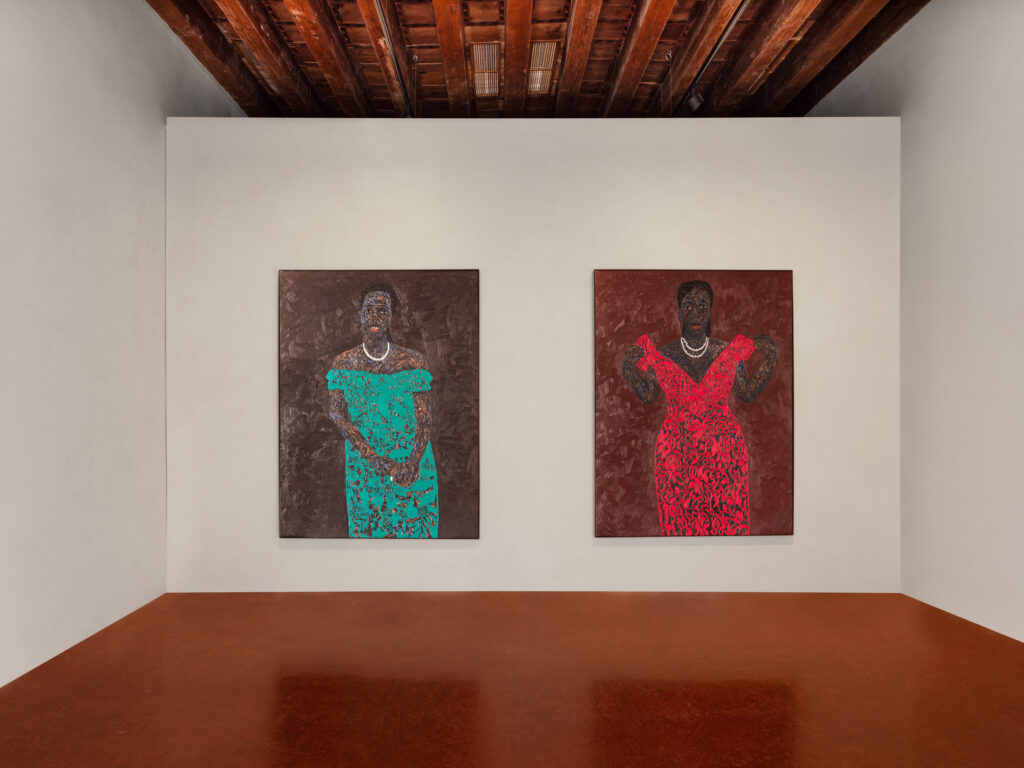
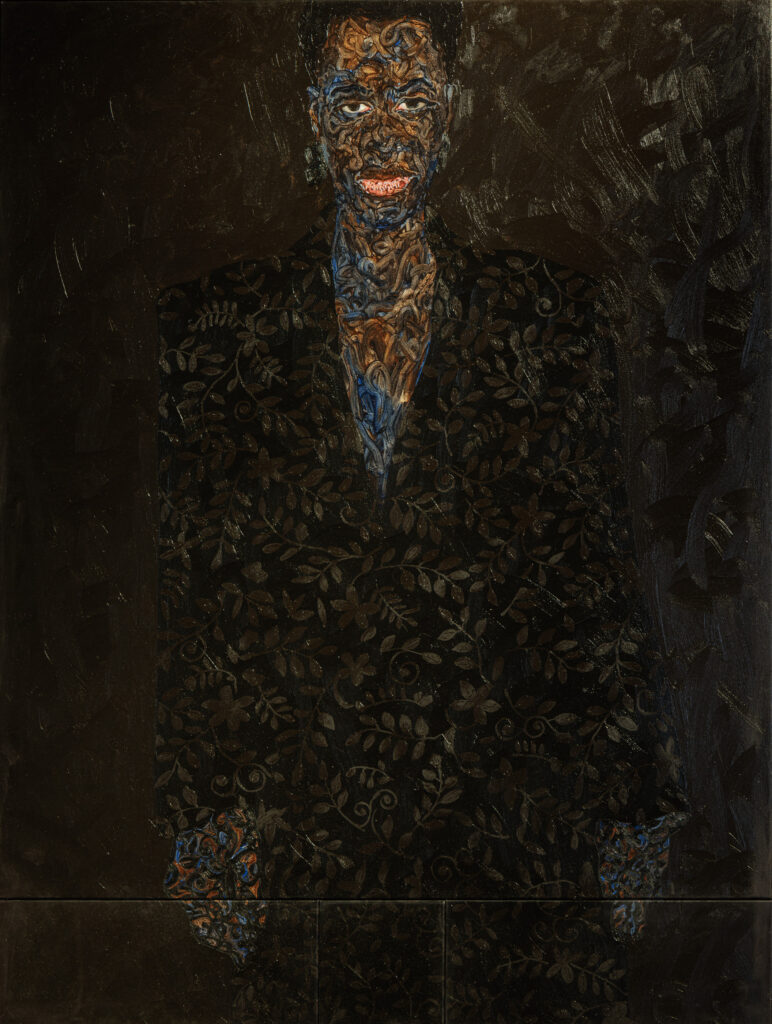
As for colors, few if not rare, darkness prevails, such as in All Black, 2026. Despite the dark tones, the subject curiously stands out for his luminous skin and elegant suit with floral motifs. The man in All Black as in most of this series for Palazzo Grimani, stands with his hands at his sides, while in the first rooms, we admire portraits that are closer to the subject.
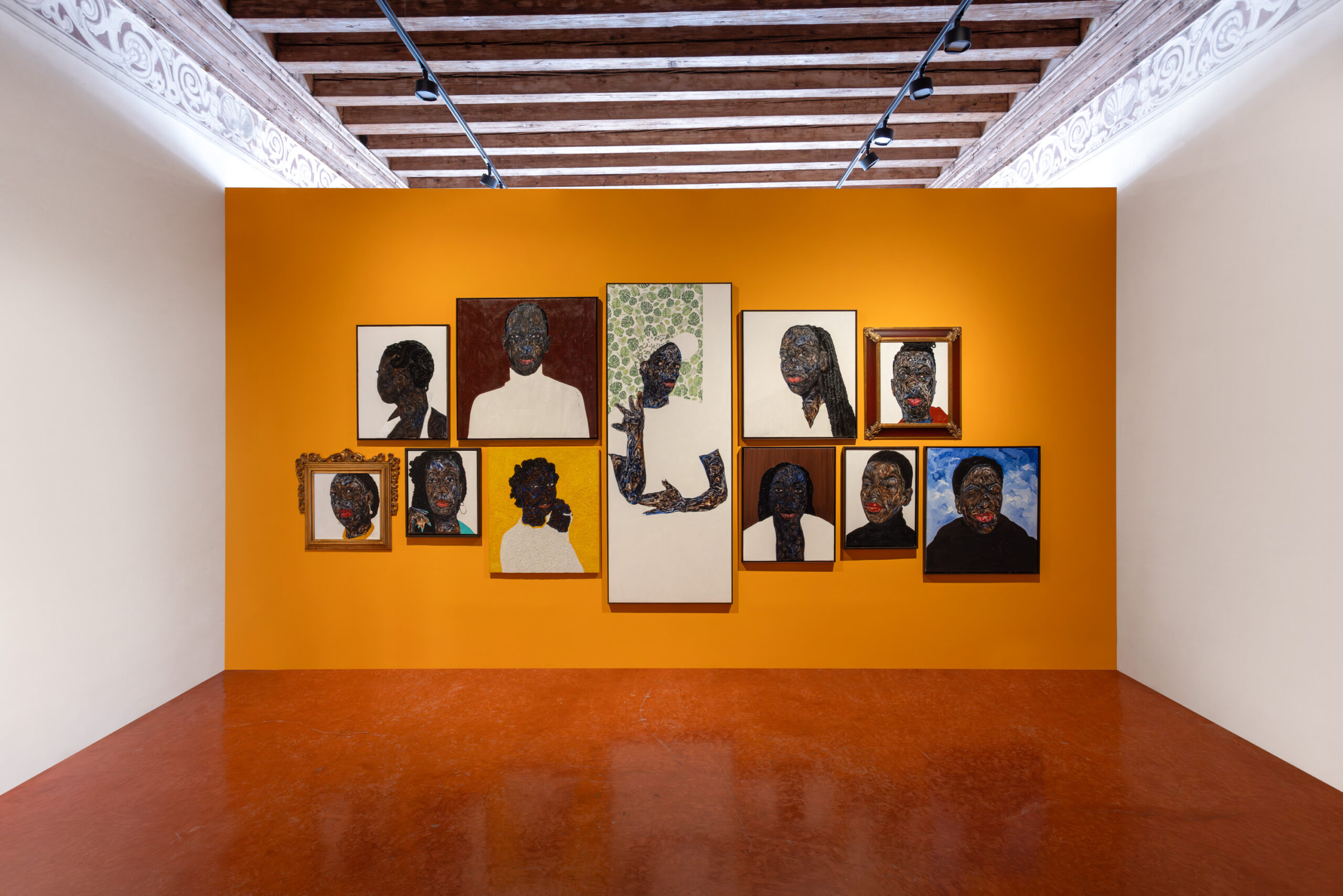
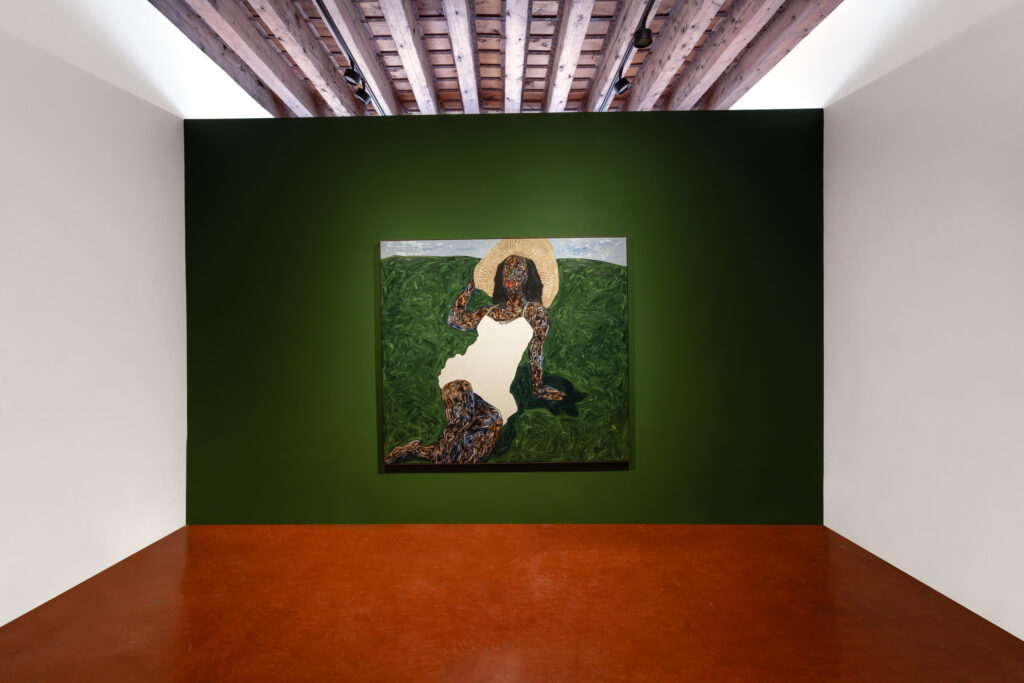
The yellow wall hosts a selection of paintings as if it were an archive of faces, stories, and memories. Often dressed in white, or set against equally light backgrounds, the subjects retain their distinctiveness, their energy, seriousness, and, at times, liveliness. The environment surrounding Amoako Boafo’s work serves as a counterpoint, altering the perception of the piece by adding or subtracting color. He uses the colors of the Ghanaian flag to create a symbolic link between the host country and his country of origin. Green reappears on the wall, echoing the painting’s background, almost blending into it and transforming into a meadow for the female figure reclining in a relaxed pose. The large hat and white dress stand out.
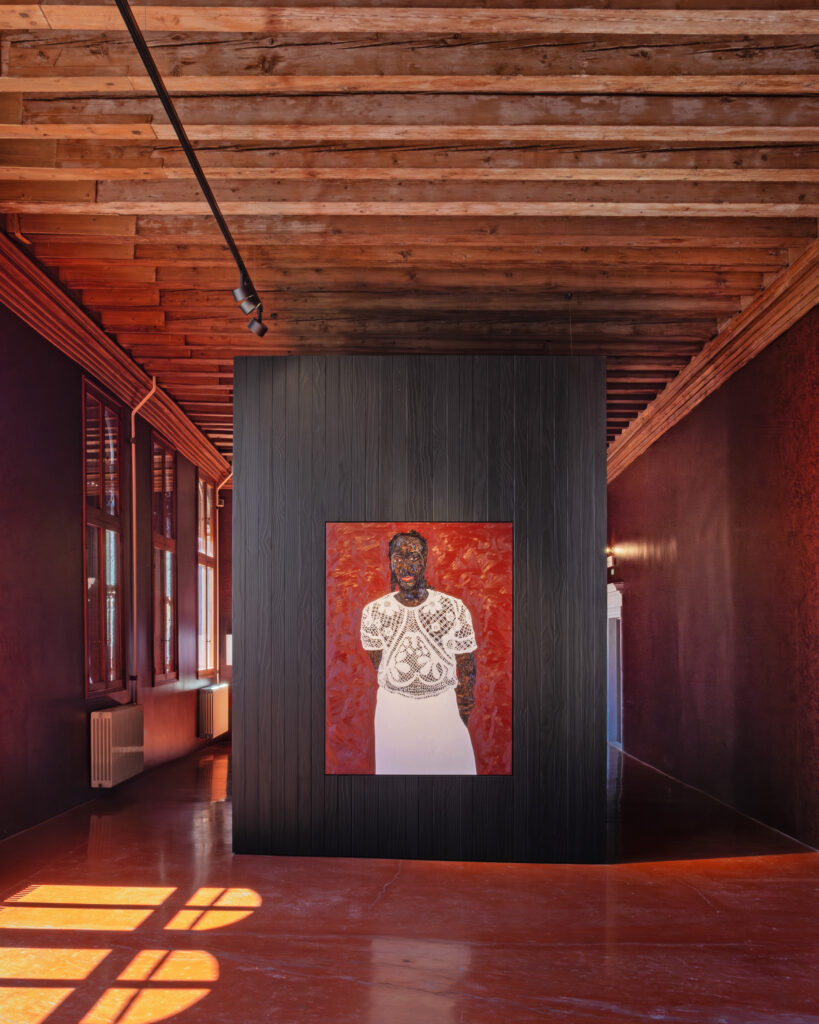
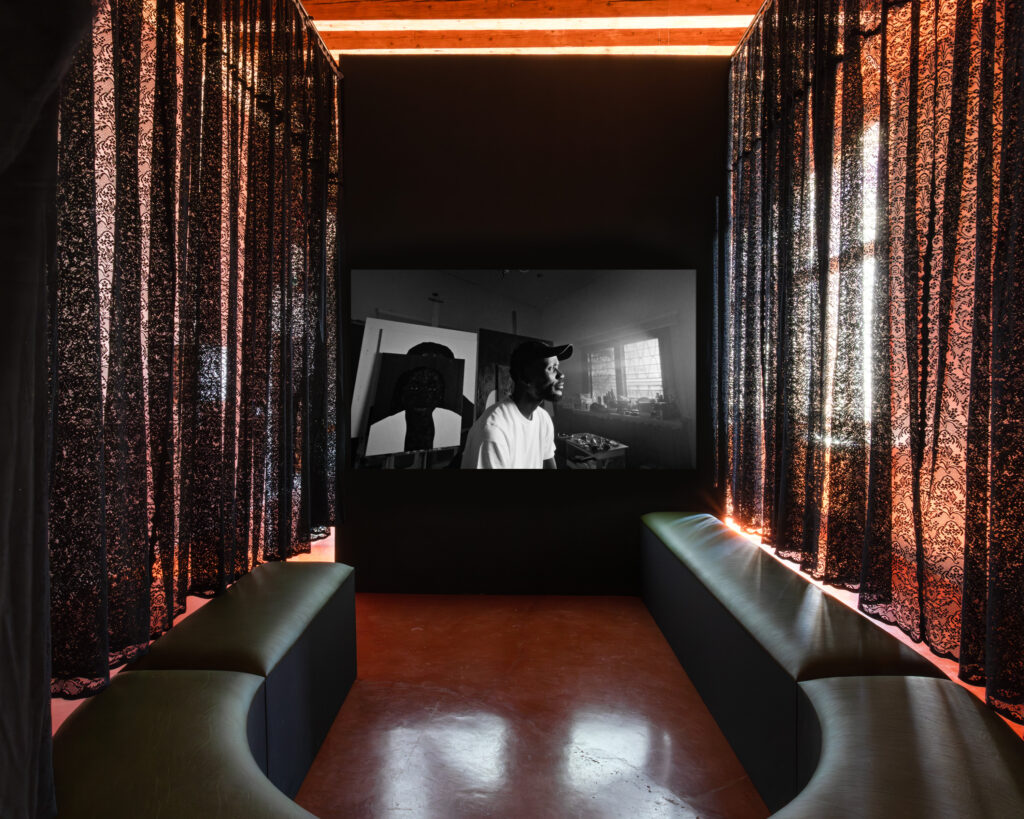
In Mozzarella White Lace Top, 2026, it is the dress that makes an immediate impact, while the work is housed within a black wooden structure, typical of Boafo’s solo exhibitions, which further echoes the palette of the Ghanaian flag, even in the red outlines of the walls. Within it, he creates an intimate space where a video silently recounts the artist’s practice, his energy, his expressions. It is the video that shows us his studio, but his world already shines through the canvases, without the need for emphatic statements.
Often, in fact, Boafo’s subjects are people close to him, dear to him, faces that inspire him. Black faces and bodies, sometimes depicted for the first time as central figures, are proud and self-assured. Faces he looks upon with admiration, faces that bring value to Blackness, a theme he also explores through dot.ateliers, the artistic space founded by Boafo himself in 2022. A place of passage and inspiration for Ghanaian and international artists, it includes a gallery, a studio, an art library, a café, and a garden. A space designed to offer growth opportunities to local artists and committed to providing an eco-sustainable solution right from its construction, overseen by architect David Adjaye OBE. The artist’s uniqueness lies precisely in transforming an artistic practice that already speaks of community into something concrete for the local community.
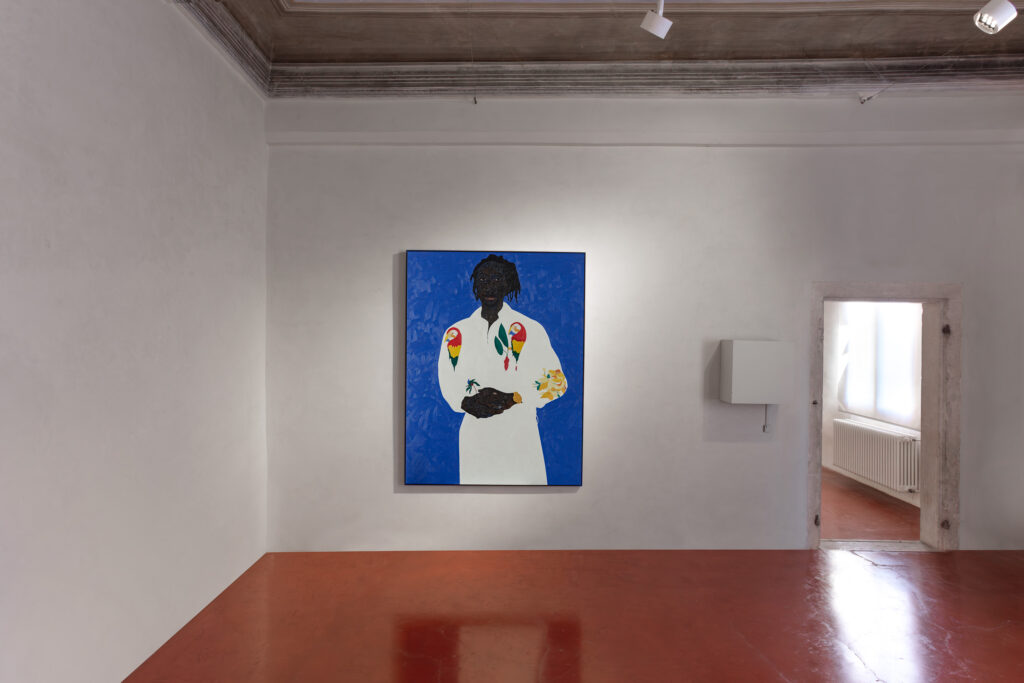
The strength of Boafo’s work lies precisely in the way that, through portraiture, he shifts the perspective and always brings us back to the simple yet powerful idea of being present, of occupying space without having to justify it. His faces are not on the margins, but in the center, with naturalness and pride. This stems above all from the direct gesture of his finger-painting, which thus bridges the gap. In this way, his art intertwines intimacy and visibility and reminds us that telling our story can be both fragility and power, everyday life and naturalness that become presence.
Amoako Boafo was born in 1984 in Accra, Ghana, where he currently lives and works. After teaching himself to draw and paint as a child, he pursued various professions in his early career, most notably semiprofessional tennis. He graduated from Ghanatta College of Art and Design in Accra in 2008, winning the college’s award for best portrait painter that year. In 2013, Boafo relocated to Vienna, and with artist and curator Sunanda Mesquita founded WE DEY, a center for exhibitions, workshops, and community programs that advocated for artists of color and LGBTQ+ voices.
Boafo was awarded the Walter Koschatzky Kunstpreis in 2017 and the STRABAG Artaward International in 2019. He completed his MFA at the Akademie der bildenden Künste Wien in 2019. The same year, he was the artist in residence at the Rubell Museum in Miami, with the works completed during his stay comprising the museum’s inaugural single-artist exhibition. Soul of Black Folks, a traveling solo exhibition of over thirty portrait paintings, was organized in 2021–22 by the Museum of the African Diaspora, San Francisco.
Intrigued by fashion as a mode of self-presentation, Boafo collaborated with designer Kim Jones on Dior’s spring/summer 2021 men’s collection. Incorporating the textures and patterns of his portraits, the clothing was advertised entirely with Black models. In August 2021, he completed three paintings on the parachute panels of a Blue Origin rocket that was launched into space and returned to Earth. The first project in Uplift Aerospace’s Art × Space program, Suborbital Triptych included a self-portrait, a painting of Boafo’s mother, and a painting of the mother of fellow artist Otis Kwame Kye Quaicoe.
In December 2022, Boafo opened dot.ateliers, a space intended to strengthen and advance the cultural ecosystem of Accra. Housed in a three-story structure designed by architect David Adjaye, it features a gallery, studios, an art library, and a café, and offers exhibitions and residencies that encourage creative experimentation and support bold expression.
In 2024, Boafo cemented his commitment to Ghana’s cultural ecosystem by also establishing a residency program for writers and curators, dot.ateliers | Ogbojo, in the Greater Accra region. That same year, the Belvedere in Vienna presented Proper Love, the first major European museum exhibition of his work, which celebrated the development of the artist’s aesthetic since his time studying in Vienna.
Translation by Luigina D’Introno
Amoako Boafo, It doesn’t have to always make sense.
Musei archeologici nazionali di Venezia e della Laguna
Museo di Palazzo Grimani, Venezia.
06/05/2026 – 22/11/2026

Alessia D’Introno is Editor-in-Chief of the African contemporary art magazine Equator Echoes, registered in the Special List of the Lombardy Journalists’ Association. She holds a Master’s degree in Visual Arts and Curatorial Studies from NABA, Milan, and has completed a postgraduate course in Demoethnoanthropological Heritage at the University of Milano-Bicocca. She has published articles in Juliet Art Magazine and ArtsLife. Her critical and curatorial research focuses on the deconstruction of classical art history and the decolonization of the contemporary European art system.
N. May 5, 2026