By Shammah Phiri
What if Adam and Eve never left the garden after the fall? What if they continued to live there, surrounded by its decay and increasingly volatile state after they ate the forbidden fruit that brought about the downfall of man? This exposition of ‘what ifs’ is not hypothetical; this is what Lawrence Chikwa’s newest collection wrestles with in this sequel to Lost Garden & Eaten Apples. Chikwa examines the ‘what now’, as we, a modern-day society transposed on the First Man, are trapped in a garden of our making. As technology increasingly takes over life and meaning and creates new ways of ‘thinking’, impressed upon us by tech company’s ruthless march, what now? How do we continue to remain connected to what is human, African and truly ours? How do we avoid eating the fruit again as it taunts us once more?
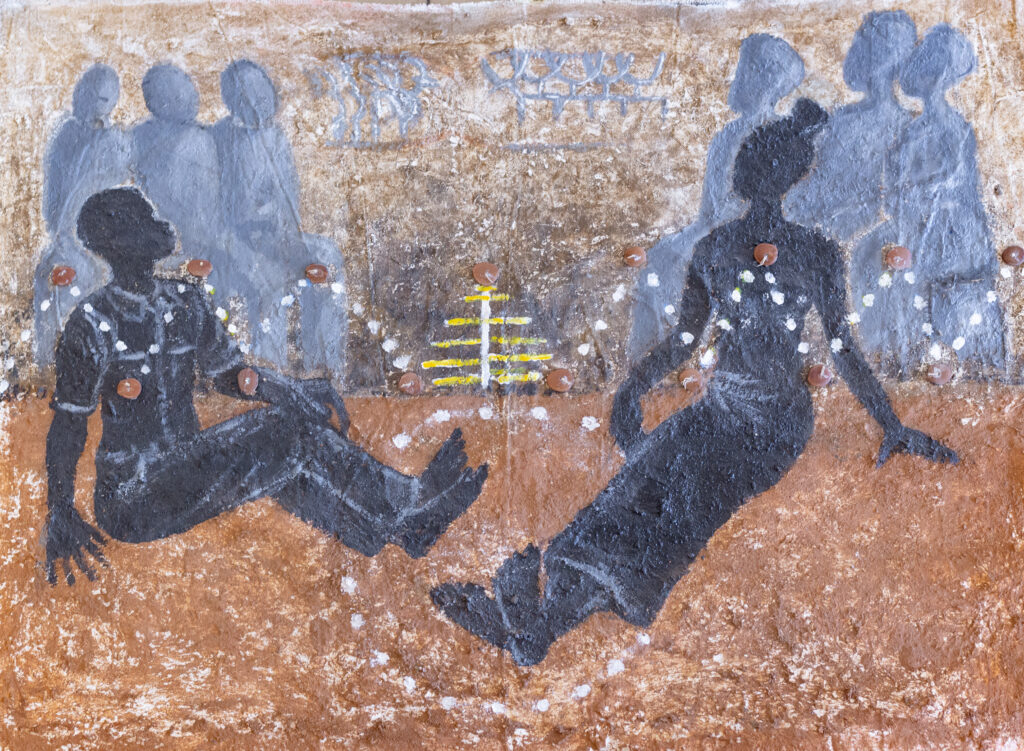
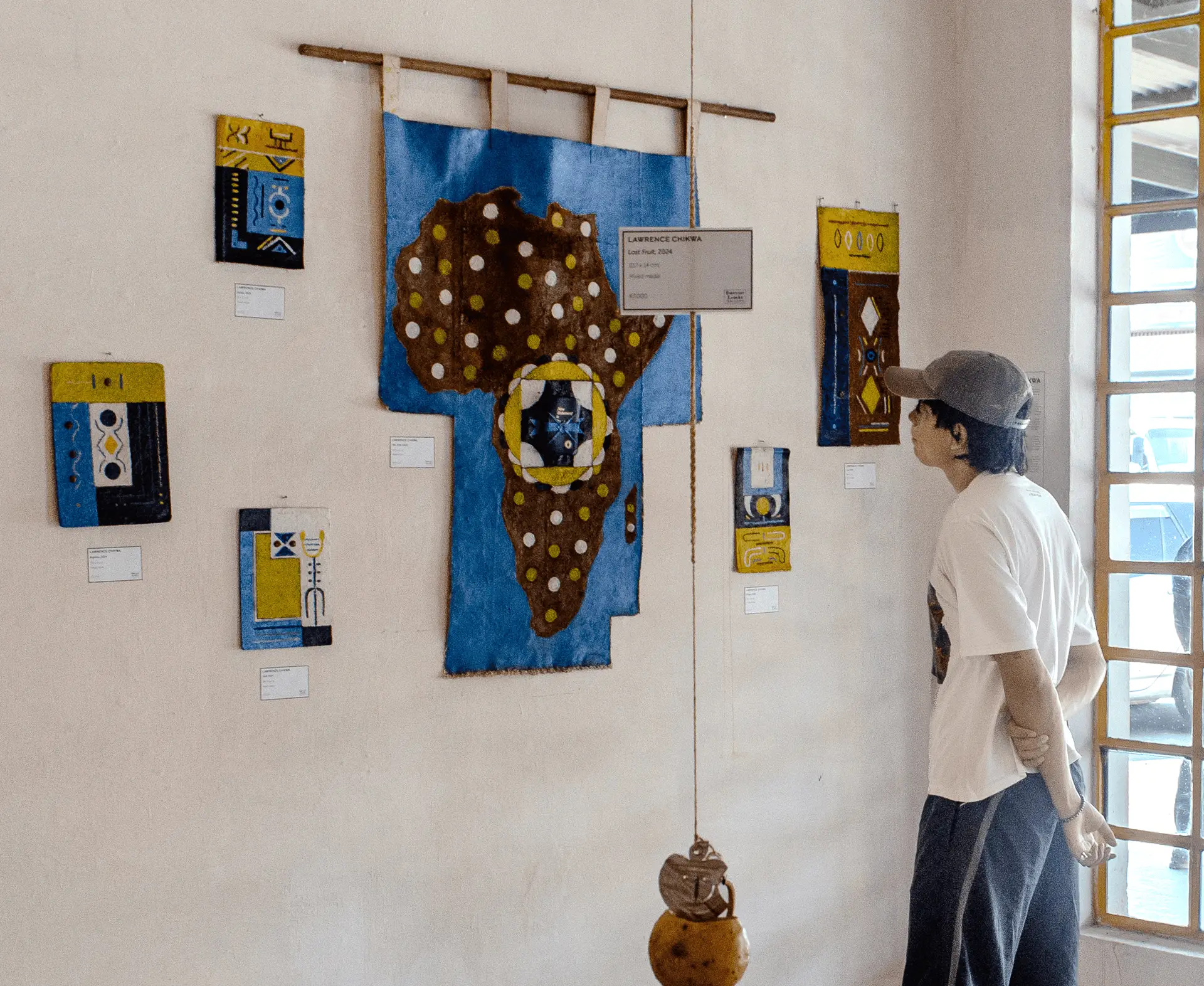
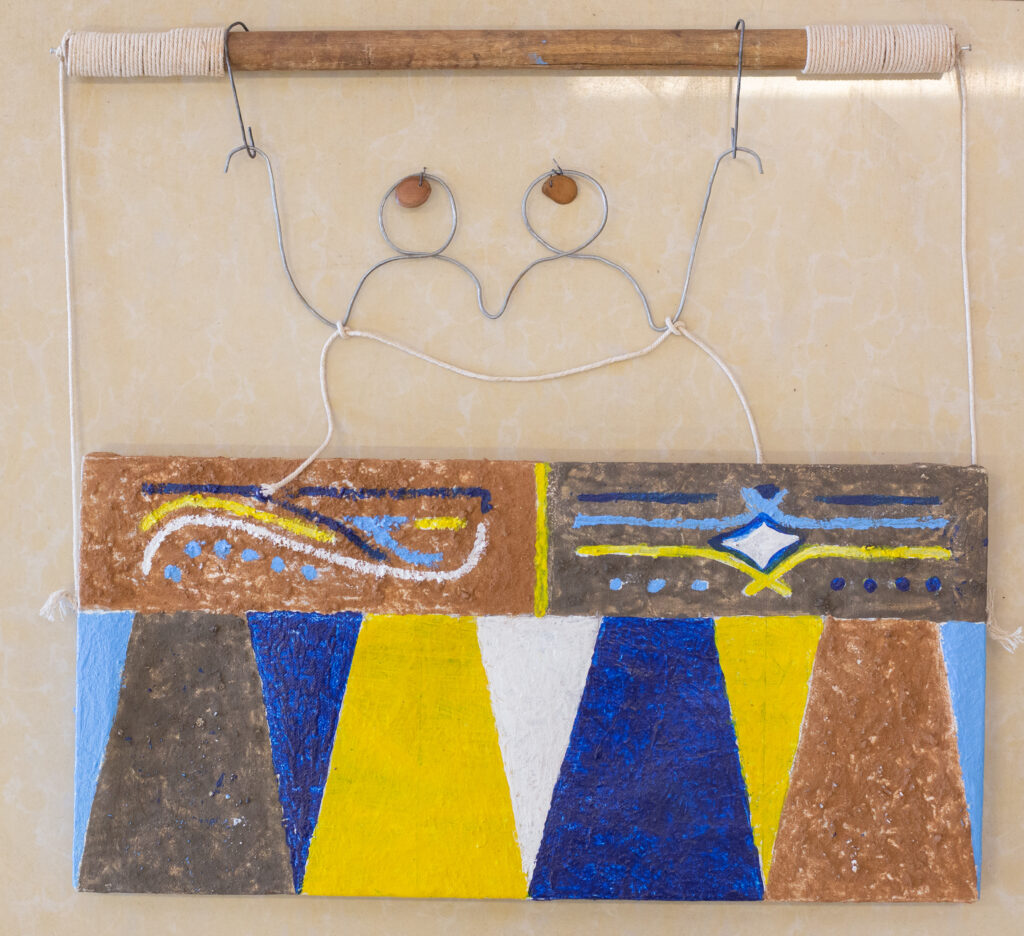
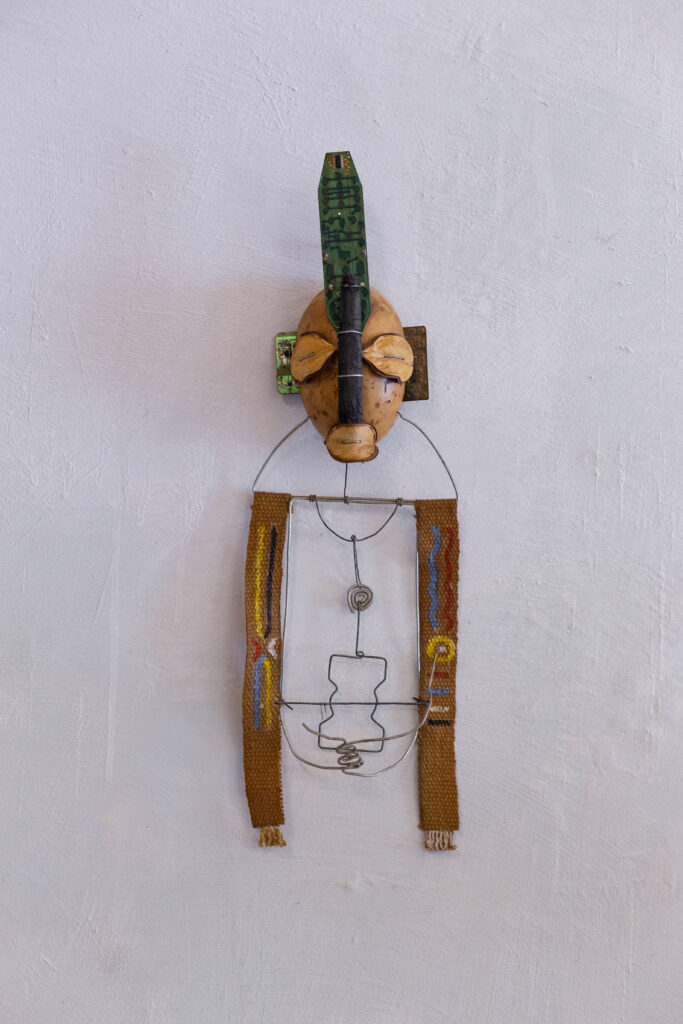
Gifts as Guiding Light continues where Lost Garden & Eaten Apples left off. Where Lost Garden questions the past, Gifts interrogates the present and its consequent future. Chikwa employs an array of media, including organic materials such as pods, seeds, wood, and cotton string, juxtaposed with motherboards and electronic circuits to demonstrate the simultaneous coexistence and tension between modern (power-hungry) knowledge systems (technology) and ancestral knowledge. Western art has names for what the artist does: ‘found object’, ‘readymade’, ‘mixed media’. However, for Chikwa, the wire, seeds, masks and salvaged objects are chosen deliberately, because each component arrives already carrying meaning. While the uninformed eye files them under materials, the works ask to be read as knowledge.
To the occidental eye, Africa and Chikwa’s methodology belongs to an ‘informal society’, but it is relevant to localised ways of making, living and thinking. These methodologies employ their own code to interpret themselves, and an outside methodology cannot make sense of this coded indigenous language.
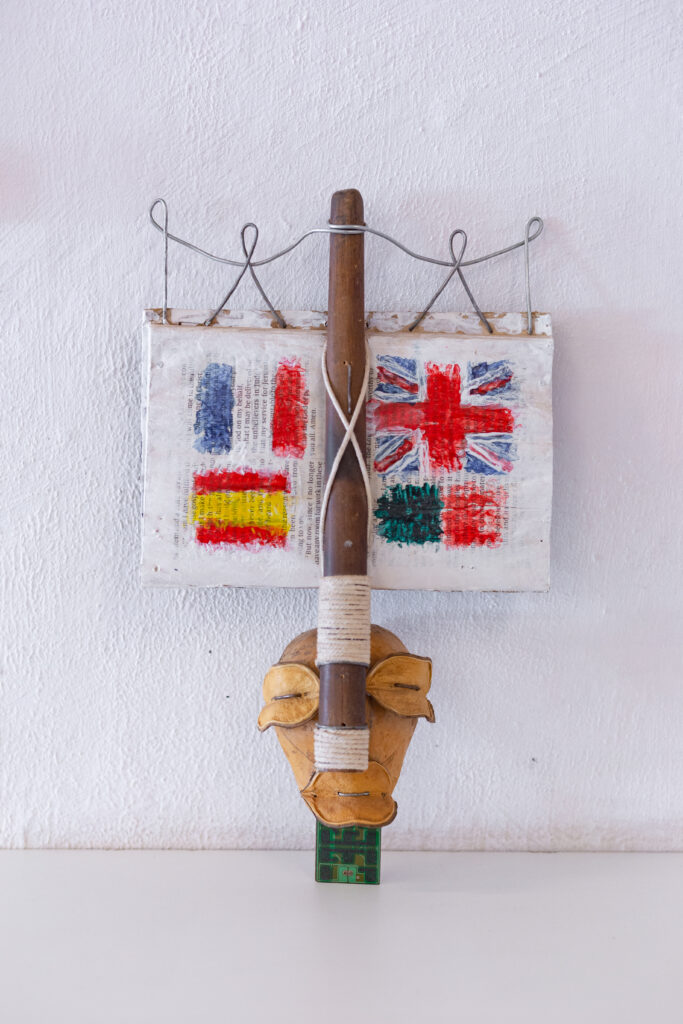
As with Lost Garden, Gifts carries an undertone of Biblical themes which surface throughout the works. Strings of Empire and Book Face both employ holy texts in their use, and Chikwa settles them in an uneasy contradiction, alongside indigenous spirituality. Two ways of making sense of the world, at war with one another. Perhaps this tension mirrors his own relationship with Christianity–he believes in God and the works of Christ, a practice infused in his upbringing, one he cannot separate from, and he does not attempt to do so. Instead, he employs ancestral knowledge to make sense of it, and shares that sense with society.
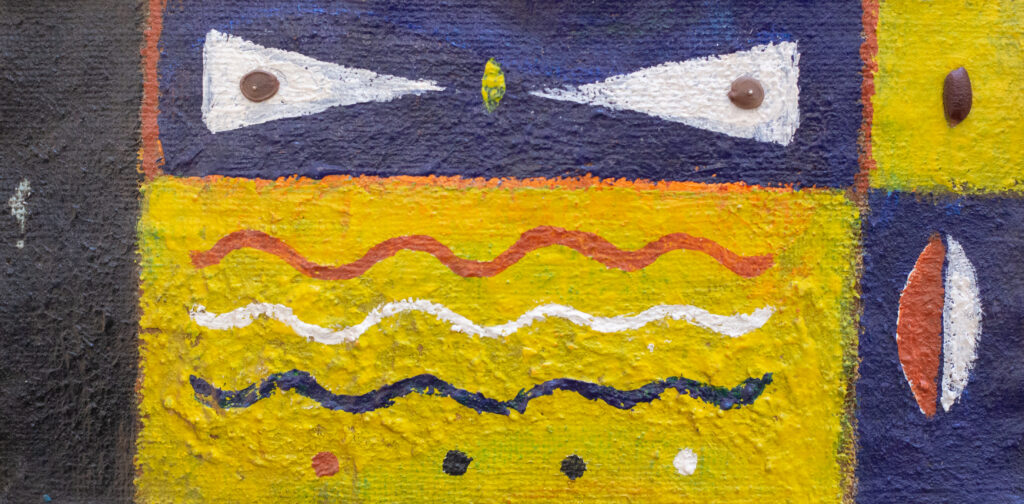
Chikwa’s works employ a methodology that transmutates ancestral and elder knowledge into a body of work that imbues those who are willing to ‘taste and see’ this knowledge. Each pattern, each stroke, each found object is symbolic of a different kind of ancestral knowledge. Bemba by tribe, no flourish of the brush is ornamental. Chikwa employs various symbologies in these works; a common shape may appear unobtrusive, but it is a portrayal of nembo, protection. These codes are ‘hidden’ throughout Chikwa’s work; they are a knowledge system, but without an interpreter, their presence replicates the ambiguity that newer generations face: how to ‘know’?
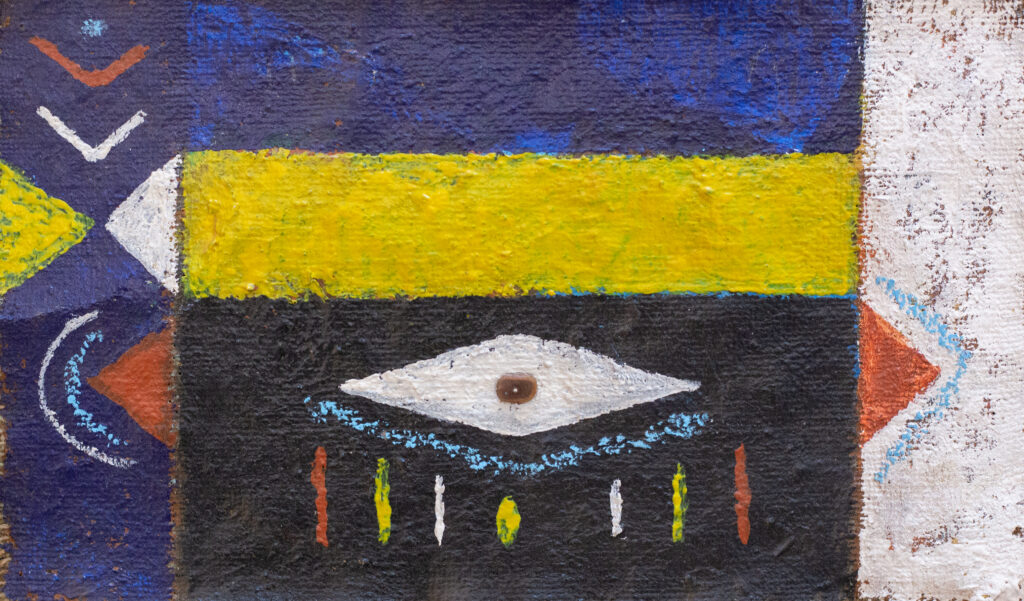
As the divides between older and newer generations continue to multiply, Zambian and even African societies expect subsequent generations to just ‘know’. Know their culture, know their roots, know the expectations, sometimes in the absence of intentional dissemination of cultural knowledge. But perhaps that is exactly the reason why the code is employed in Chikwa’s work. It is an invitation to tap into this knowledge, to seek and find, to intentionally connect and plant the seed of relationship, to ask of the elder at the well for a drink of the water from which one would never thirst again. To understand the language and the knowledge held in each work is to speak to the artist, to seek him out, to create dialogue, ask, and then receive.
As the line is drawn, and the string is cast, the Gifts of ancestral knowledge are shown to be the way out of this decaying garden. It whispers throughout the work, and one who has ears will hear it. This string tied to a length of wire may be interpreted as ‘mixed media’, but it is an umbilical cord, depicting the connection between two beings: mother and child / ancestor and descendant / God and man / phone and self / asking the question, ‘Are you on line?’
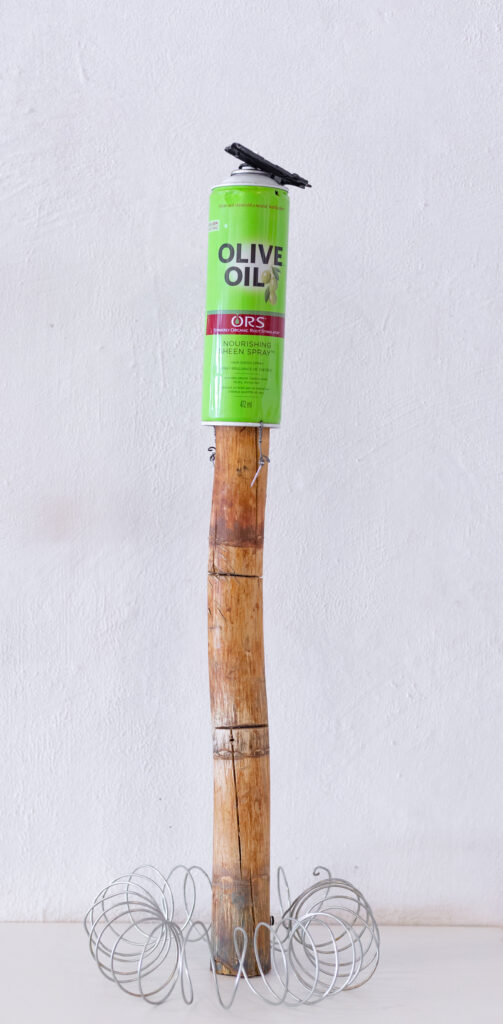
Lines continuously appear in Chikwa’s works, encompassing all the interpretations a line could possess in this context. Here a line is a genealogy, there a line is an inheritance, whether biological, attained or learned. In The Cost of Olive, the line rises from the ground, defiant as it questions the inequalities of capitalism, it is ‘a lone reed, standing tall, waving boldly in the corrupt sands of commerce’ and, in yet another, it is the language of ancestral communication, connecting a past generations to one another.
But, as a generation becomes increasingly connected, it simultaneously disconnects, not only from physical relationship, but from itself as well, and creates a projection of a new self in a brightly lit device but inches from its face. The ‘twin flame’ is replaced with another twin, one that is confined within four corners of a 6-inch screen; on which the soul is now transcribed: thoughts, identity, emotion, and even memory are conscripted to this new twin inside this decayed garden. As the self attempts to reconnect with knowledge or the analogue (depicted by the book), the projection (portrayed by a circuit board) simultaneously burns our minds, commanding thought, movement, and capability, creating a single line of sameness.
Chikwa is radical in this display. In ‘Followed Lineage’, he does not sidestep the realities of the ‘re-transcription’ of what information is passed down and what experiences a system override. The first in a generation is a simply carved mask with ears and eyes wide open. The generation right after develops blindfolds in the form of seed pods. The final generation has lost its mouth and ears which one could interpret as censorship or the interruption of freedom of speech, or expression that some groups and ethnicities worldwide experience. Coincidentally, the eyes of this generation have been reduced to slits, almost as if they are blinded and blindly follow what is put in front of them. Dumb, deaf and blind, this generation grasps a Bible, a form of analogous knowledge, attempting to reconnect with what is passed down; culture and tradition, spirituality and Christianity, but a panel of circuitry obscures it’s perception. Technology, once again, filters what is received
But where there is hope there is a way. There exists another garden, one not yet fallen into decay. Inside it, another tree still grows, one that may be misconstrued as a new tree because, despite eating of its fruit, the Bible never tells us what happens to the original tree in the garden: did it disappear or did it live on? In this alternative, unaltered Eden, the tree is still at the centre and is one to be sought after. The command now is no longer, ‘you shall not eat of it, lest you die’, but it is imperative, nearly life-saving, that the fruit is eaten, so that ‘your eyes shall be opened and you shall know good and evil and live’.
Lawrence Chikwa (b. 1973 Chingola) is a dynamic artist whose practice spans Zambia, the African continent, the United States, and Europe. He established Inter Art Studios in Lusaka in 2007, cultivating a professional discipline that attracts local and international collectors. He continues to work in his studio in Chongwe, Lusaka, collaborating with art galleries and cultural institutions. His work is celebrated for its ability to bridge local and global narratives, making him a significant voice in contemporary African art. His latest work touches on the topic of independence, on which he shares observations about national history and trajectory to the future.
Gift as Guiding Light. A Unison Touch. Lawrence Chikwa
Curated by Sana Ginwalla
10/10/26 – 21/11/26
Everyday Lusaka Gallery
Ew Tarry Building, Shop °5, Kalundwe RD, Off Cairo RD North End
Lusaka, Zambia
N. November 1, 2026