By Arianna Maria Leva
From the results of the fair’s 21st edition to the research of Zana Masombuka, presented by Cellar Contemporary: an exploration of the cultural narratives that cross borders and rewrite the way we observe the world.
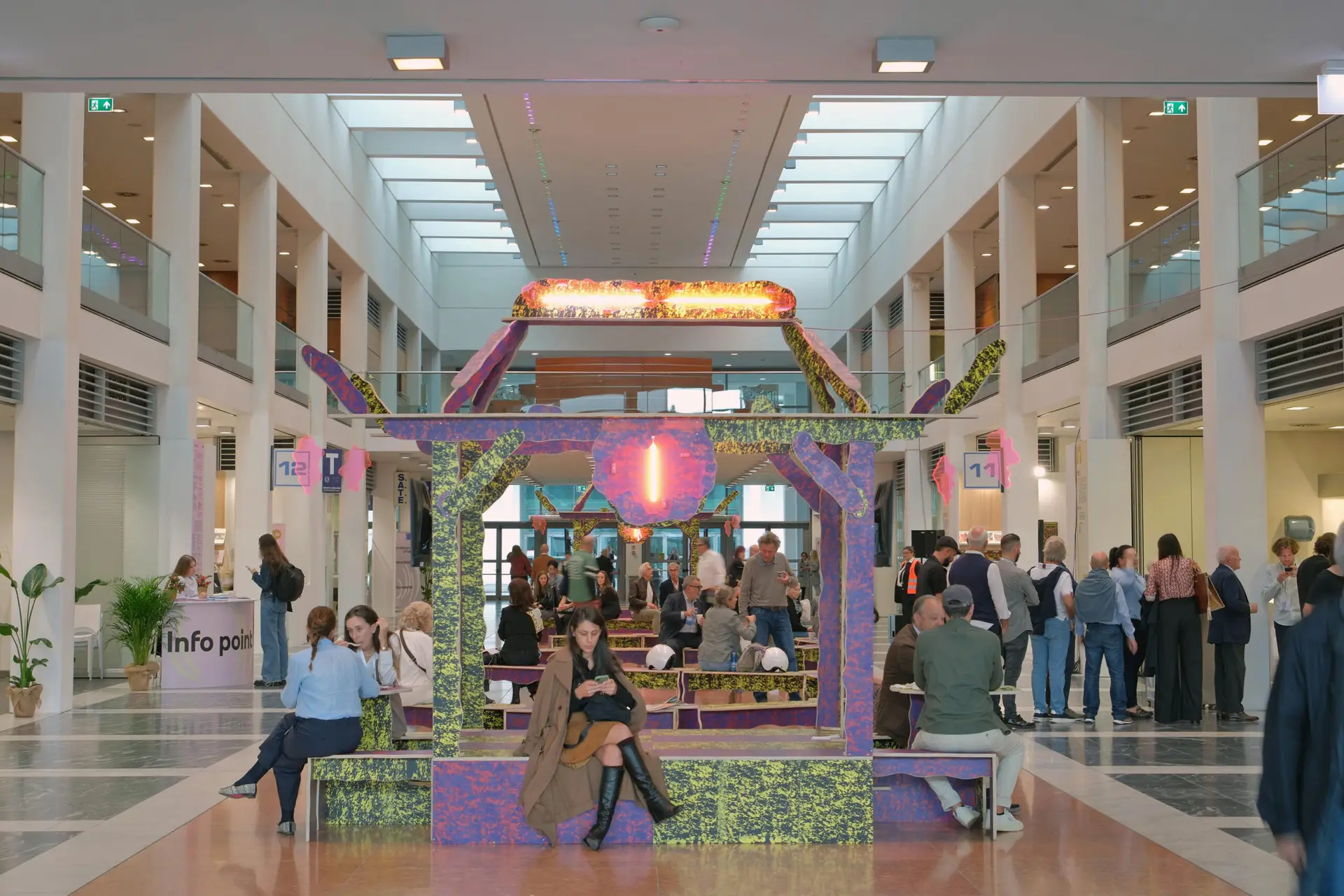
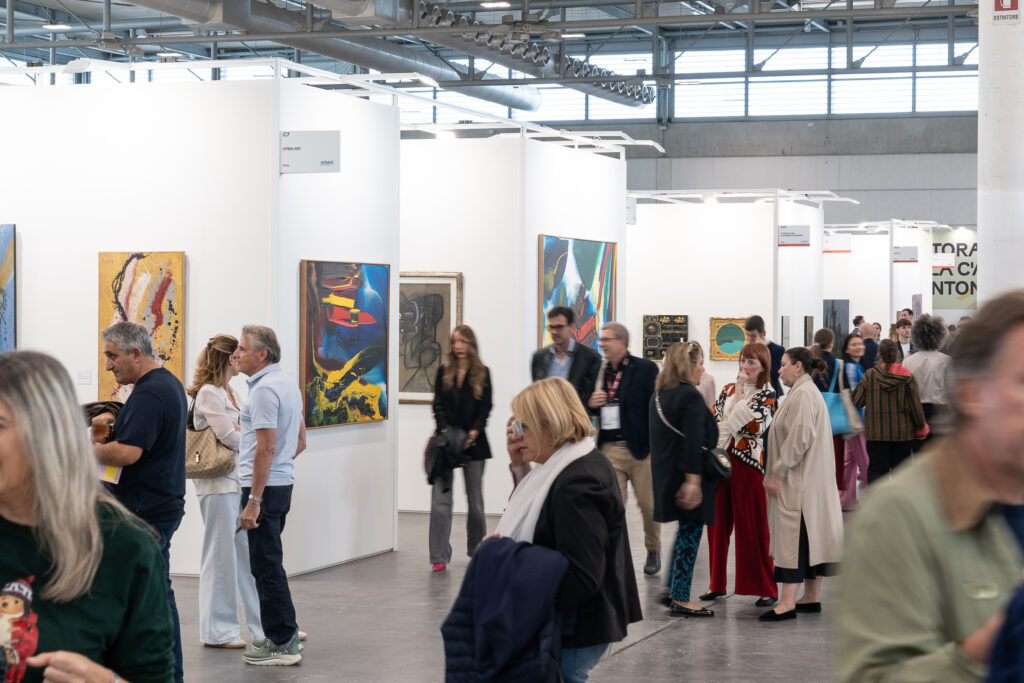
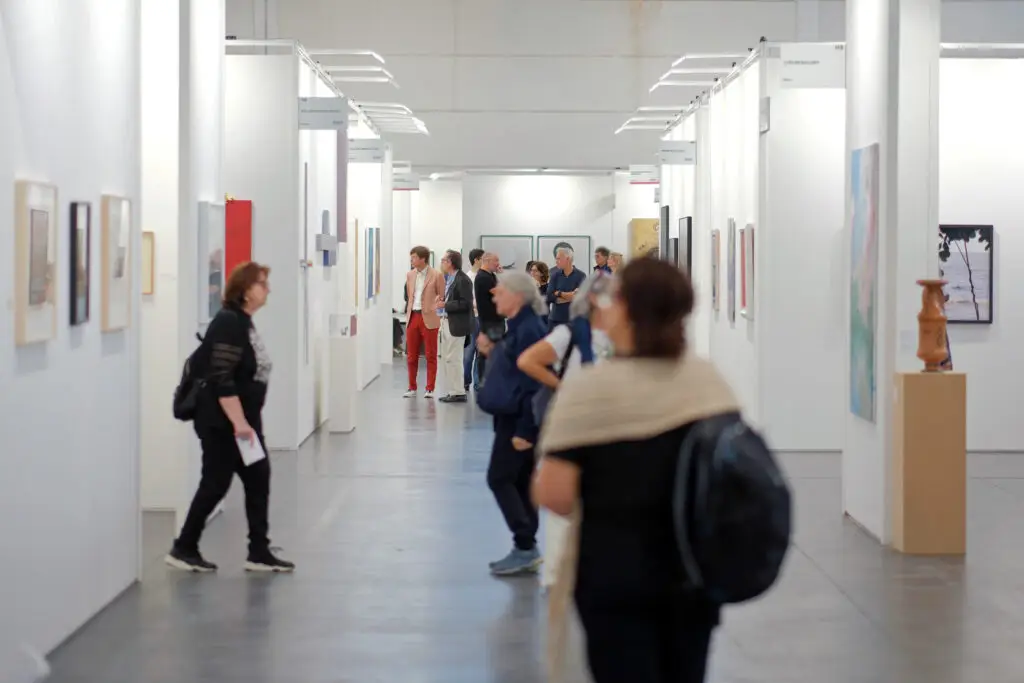
The 21st edition of ArtVerona concluded on October 11, recording a 17% increase in visitors compared to 2025 and featuring 137 exhibitors, including 122 galleries. This result confirms the event’s prominent role in the Italian modern and contemporary art landscape, bridging the market, research, and new opportunities for international dialogue. Organized by Veronafiere in collaboration with ANGAMC, the fair took place from October 9 to 11 in Halls 11 and 12, under the artistic direction of Laura Lamonea.
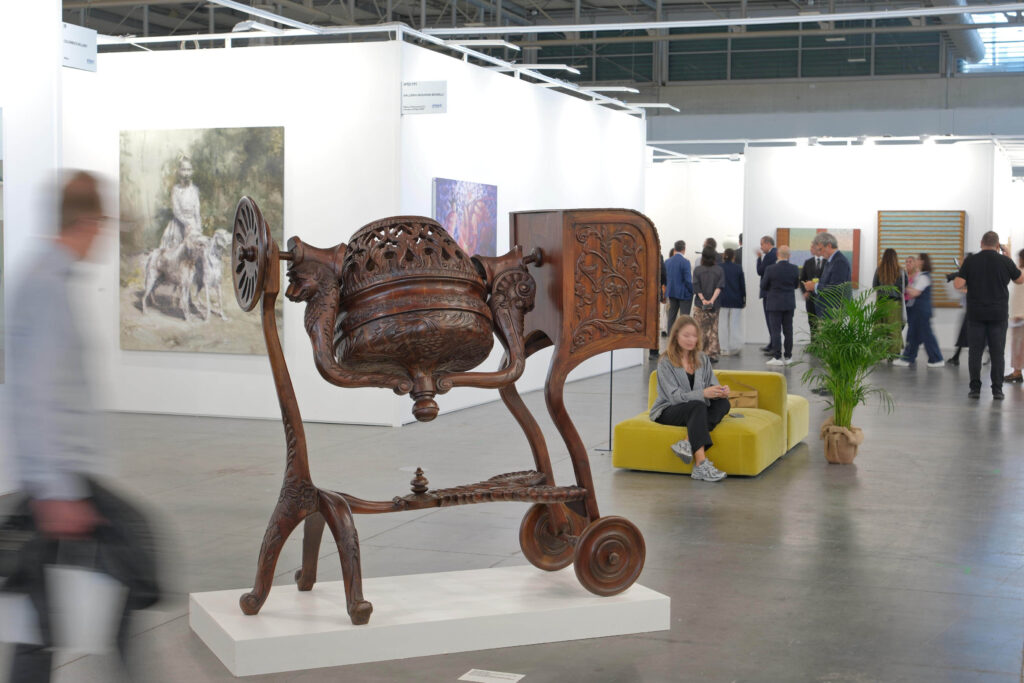
The theme chosen for this edition, Tra parentesi (“In brackets”), invites us to pause and focus on what occurs between the actors of the art system: artists, galleries, collectors, and the public. Brackets are not merely a pause, but a space where unexpected relationships, hybrid languages, and perspectives that defy standard categories can take shape. This approach is also reflected in the desire to broaden international dialogue, marked by the participation of galleries from Korea, China, and India, as well as the Focus Corea project dedicated to the modern and contemporary Korean art scene.
However, looking beyond geographical borders also means questioning who tells the stories of various cultures, which narratives find space within art institutions, and how identities evolve over time. From this perspective, it is worth examining some of the artistic research presented at the fair—works capable of shifting attention away from Europe toward other cultural heritages, viewing them not simply as territories to be discovered, but as origins of autonomous visions of the present.
Beyond Europe: Who Narrates Their Own Origins?
To speak of migration in contemporary art does not necessarily mean focusing on travel, exile, or the experience of displacement. It also means observing how cultures circulate, how traditions are transmitted, and how artists reclaim their own histories to free them from external interpretations.
Artworks can serve as tools to challenge a worldview built predominantly through a Western lens, restoring space to memories, rituals, and symbolic systems that possess their own internal complexity. In this sense, the international openness of an art fair is measured not only by the number of countries represented, but by the opportunity to encounter distinct perspectives without reducing them to mere exotic curiosity.
Among the participants at ArtVerona 2026, the project presented by Cellar Contemporary offers a compelling starting point to develop this reflection. The Trento-based gallery participated in the Main Section (Hall 12, Stand F5) with a curated selection of artists including Zana Masombuka, Solomostry, Tommaso Buldini, Simone Tribuiani, Erik Foss, Melissa Brown, Bruno Fantelli, Margherita Paoletti, and Daniele Tamagni.
Within this showcase, the research of Zana Masombuka brings a precise question to the fore: What does it mean to tell the story of one’s own culture from the inside, using the tools and languages of contemporary art?
Zana Masombuka: Ndebele Culture Told from the Inside
Born in 1995 in Siyabuswa, South Africa, Zana Masombuka is a visual artist working across photography, sculpture, and beadwork compositions. Her research centers on Ndebele culture, a South African community with a striking visual identity renowned for its bold geometric patterns, vibrant colors, and craft traditions passed down through generations.
In 2017, Masombuka founded Ndebele Superhero, a platform through which she explores the history, present, and potential future transformations of her community using photography, film, and sculpture. The project goes beyond merely documenting a cultural heritage: it strives to imagine its evolution, bringing collective memory into dialogue with the lived experience of a young 21st-century Ndebele woman. This distinction is crucial. In her work, traditions do not appear as static relics of a past to be preserved untouched. Instead, they are living systems capable of evolving and communicating with the present. Masombuka does not simply represent her culture for an external audience; she reinterprets its codes from within, creating images where symbols, materials, and gestures maintain a profound connection to the community from which they originate.
Her research thus joins a broader discourse on cultural representation—focusing not only on who is represented, but on who holds the tools to tell a story and reshape its meaning.
Ukuthebulwa KweThoro: Between Photography, Beadwork, and Memory
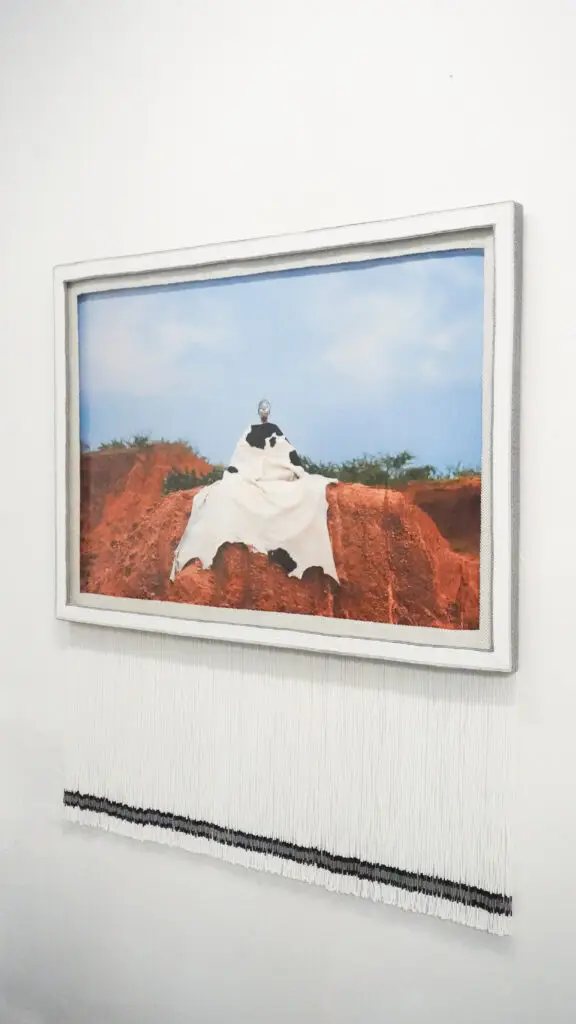
This body of research finds one of its most articulated expressions in Ukuthebulwa KweThoro – Possession, Stillness and Sitting with Symbolic Symphonies, a project developed starting in late 2024 and presented by Cellar Contemporary in a solo exhibition opening on October 1, 2026.
The project bridges two seemingly distant mediums: photography and manual beadwork. In her self-portraits, Masombuka constructs compositions where the body becomes part of a symbolic environment, surrounded by materials, adornments, and structures that reference Ndebele culture. Rather than simple documentations of objects or attires, the photographs function as visual spaces in which the artist stages an interplay between identity, spirituality, and memory.
In Begin with the Heart, for example, a large black bead curtain extends beyond the traditional boundaries of the photographic frame to become an architectural structure. The artist’s body, embellished with gold coins, interacts with this space, while her lips remain the only clearly visible feature of her face. Gold—a material historically linked to colonial exploitation—is stripped of its purely economic value and woven into a composition that prompts viewers to reflect on the relationship between wealth, legacy, and identity.
Beads also take on a meaning that transcends mere decoration. Assembling them requires time, precision, and repetition; each piece becomes part of a larger structure following sequences and geometries that build a distinct visual language. In Masombuka’s work, this craft practice interacts with photography through a shared goal: capturing a moment, preserving its memory, and transmitting it through time.
Women as Guardians of a Living Memory
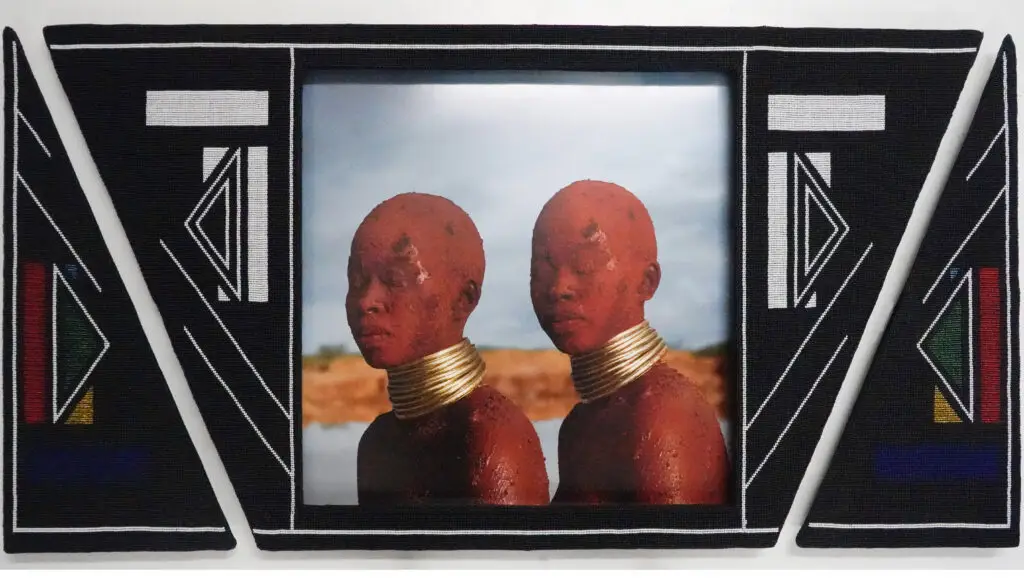
Another central pillar of the project is the role of Ndebele women in transmitting knowledge. In the exhibition, beadwork is connected to married women—the guardians of intergenerational memory and lore passed down from mother to daughter.
This dimension allows the artworks to be interpreted beyond their aesthetic qualities. The repetitive labor, choice of materials, and construction of symbolic motifs become forms of knowledge and cultural continuity. Through her practice, Masombuka assigns value to gestures that risk being marginalized compared to institutional art forms, transforming them into tools of contemporary artistic inquiry.
Her perspective does not divide cultural heritage from the possibility of innovation. On the contrary, it demonstrates how tradition can generate new artistic languages precisely when observed, questioned, and reinterpreted from within by those who understand its deepest meanings. A relationship with nature also permeates the project: several works incorporate natural materials and sacred objects, suggesting a connection to the environment rooted in reciprocity rather than resource exploitation. In this context, wealth is not measured by what can be accumulated or possessed, but by the capacity to recognize the intrinsic value of what sustains life.
An Art Fair as a Meeting Place for Diverse Perspectives
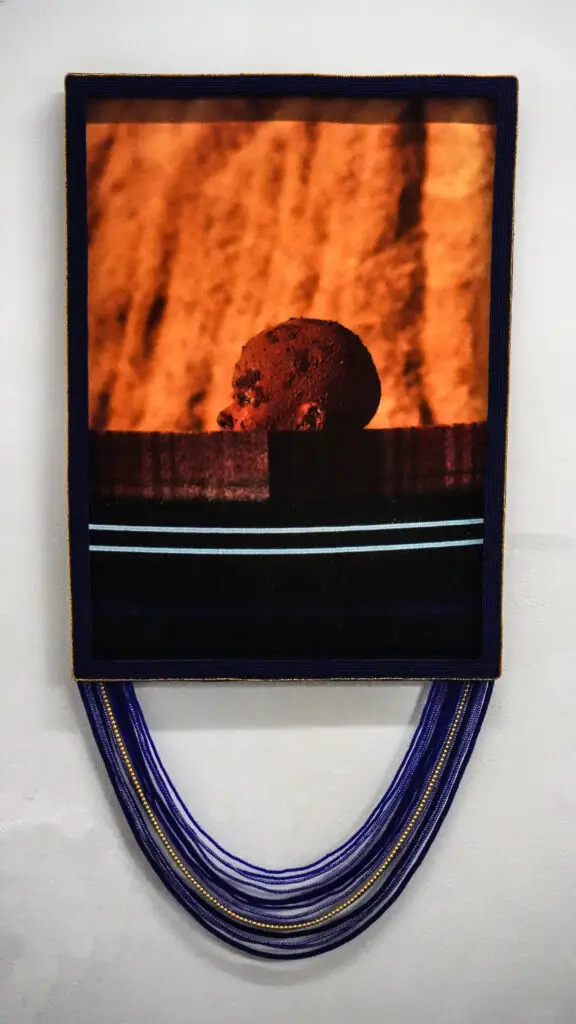
Cellar Contemporary’s presence at ArtVerona brings these reflections into a broader context. An art fair is inherently a commercial venue where works are displayed, evaluated, and acquired. Yet, it is precisely through the curated work of galleries that artistic research can reach new audiences and find opportunities for dialogue across different cultural frameworks.
Masombuka’s project highlights how vital it is for this encounter to extend beyond the mere circulation of images. To look at an artwork means engaging with the knowledge system that generated it, acknowledging its complex references, and allowing it to challenge our visual habits. The overall outcome of ArtVerona 2026 reflects a growing event with increased attendance and a higher presence of qualified collectors, according to data released by the organizers.
During the fair, twelve awards were presented to support artists and the collecting ecosystem. Among these, the Premio Fondazione Nadia Zenato is dedicated to contemporary photography. Masombuka, presented by Cellar Contemporary as the winner of the 2nd edition of the Zenato Academy Award for Contemporary Photography Under 40, had already earned this milestone in her career.
Ultimately, the goal is not merely to bring works from other geographic regions into Europe, but to create the conditions for them to be understood without losing the intricate stories they embody. Zana Masombuka’s research suggests exactly this: a culture is not a static image on display, but a dynamic web of relationships, gestures, and knowledge in constant transformation. And an art fair achieves true significance when it enables these stories to engage in a meaningful dialogue without flattening their uniqueness.
Zana Masombuka holds a Bachelor of Arts degree in International Studies from Stellenbosch University in the Western Cape, South Africa, a certificate in Transnational Education in Plural Thinking from the University of the Underground in association with the Hannah Arendt Centre at Bard College which took place in New York, as well as a certificate in Art Training from the CAP Institute of Contemporary Art Practice in Pretoria, South Africa.
She was also selected as part of the top 20 World Design and Art graduates of 2019 by Dutch Design Week in association with Design Indaba to be part of the speakers at the Antenna Festival in Eindhoven, Amsterdam during the annual Dutch Design Week. She recently became the recipient of the Zenato Academy Prize which took place in ArtVerona, Italy, in 2025.
ArtVerona 2026
Veronafiere, V.le del Lavoro 8, 37135 Verona
N. October 2, 2026