By Carol Kagezi
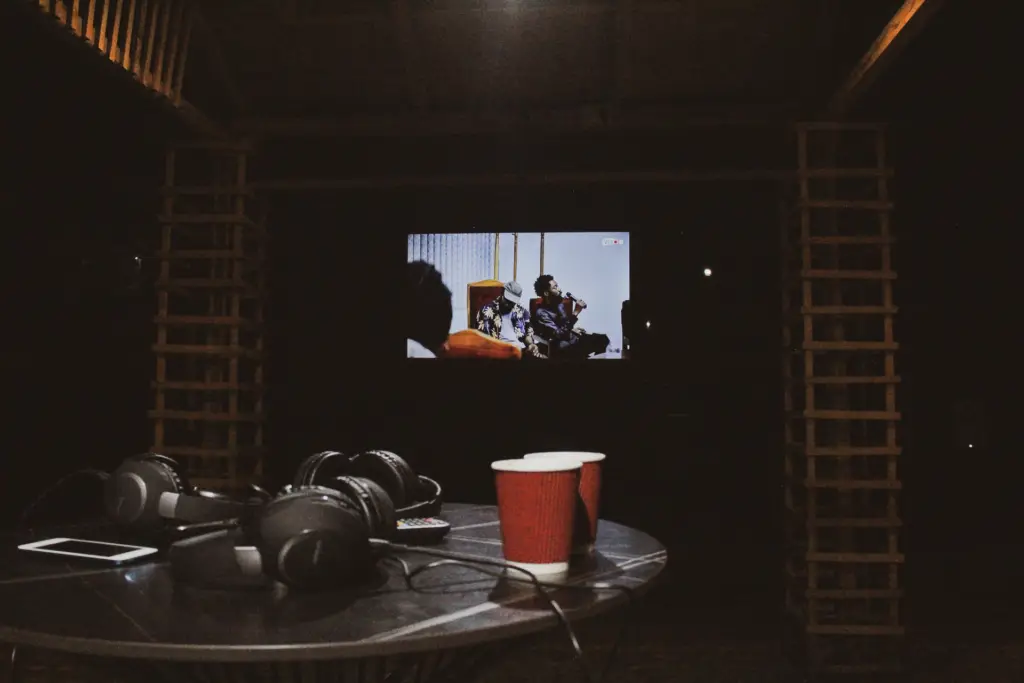
For many years, the Venice Biennale has functioned as the symbolic centre of the contemporary art world. Every two years, artists, curators, critics and collectors converge in Venice, reaffirming its position as a site where artistic legitimacy is produced, circulated and consumed. The Kitawuluzi Pavilion, conceived and curated by Vodo Arts Society in collaboration with blaxTARLINES, proposes a compelling interruption to this geography of power. Positioned as a satellite pavilion in Kampala, it seeks to decentralise access to Venice through broadcasts, public dialogue and community participation while drawing on the traditions of deliberation and reconciliation of the Baganda people.
The curatorial statement describes the Kitawuluzi Pavilion as a “parallel centre,” challenging Venice as the unquestioned source of artistic value. Drawing on Michel Foucault’s notion of heterotopia, it imagines the pavilion as a counter-site where multiple realities coexist: Venice and Kampala, the sacred and the everyday, the local artisan and the international curator. Rather than accepting Africa’s role as a supplier of cultural content to institutions elsewhere, the pavilion proposes that meaningful artistic discourse can emerge from the communities that produce the work itself. Yet this proposition raises an important question: can decentralisation be achieved simply by expanding access? The pavilion promises to livestream exhibitions from Venice, undoubtedly making one of the world’s most influential art events more accessible to Ugandan audiences. But access alone does not redistribute power. If Kampala merely receives conversations initiated elsewhere, Venice remains the centre and Kampala its audience. Decentralisation cannot simply be declared; it must be enacted. It is precisely this tension that makes the Kitawuluzi Pavilion so compelling. Its greatest contribution lies not only in its architecture or programming but in the questions it provokes about the role of art within Uganda. Who is contemporary Ugandan art ultimately accountable to? What responsibilities do artists have beyond representing the nation on international stages? And what is lost when cultural production becomes increasingly oriented towards global visibility before local meaning?
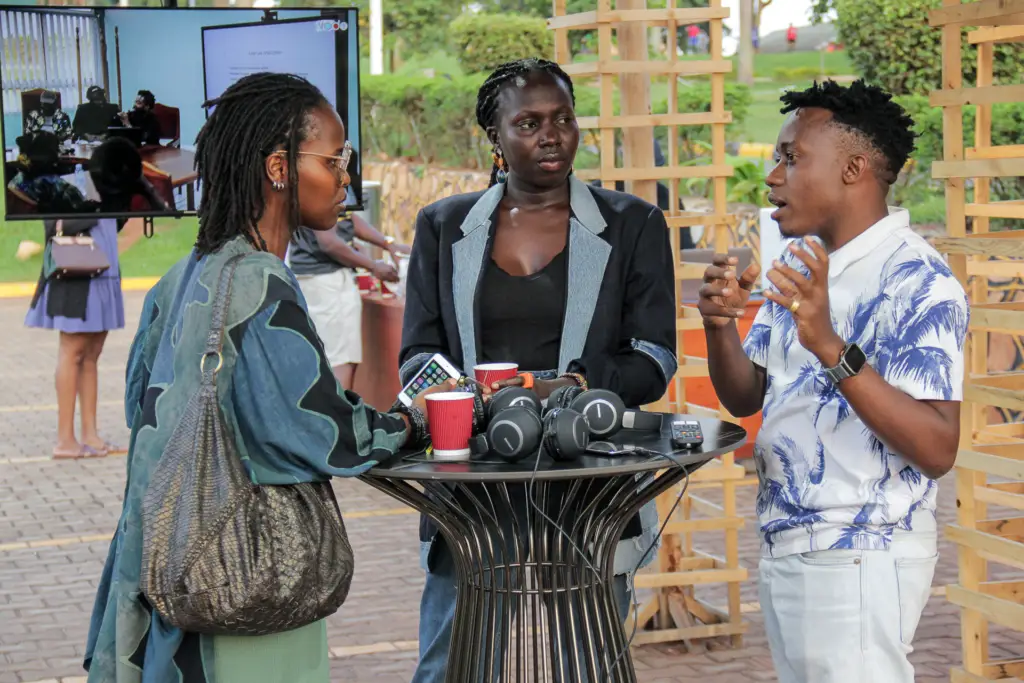
The pavilion hints at one possible answer through its programme of mediated discussions, artisan workshops and community forums. Through Tristan Zitoni Kayonga’s curatorial framing, the pavilion shifts from being a satellite of Venice to becoming a site where the politics of artistic legitimacy itself can be publicly debated. These activities suggest that the pavilion is not intended merely as a place to watch Venice, but as a place where Ugandans collectively interpret, contest and reshape the ideas emerging from it. The more significant challenge, however, is whether Uganda’s artistic institutions are prepared to imagine themselves not as extensions of global art circuits but as intellectual centres in their own right. Perhaps the most compelling aspect of the pavilion is its invocation of the Kitawuluzi, the traditional Baganda parish court where disputes were not merely judged but collectively deliberated. In Luganda, okutawulula signifies reconciliation through dialogue rather than victory through argument. This historical reference transforms the pavilion from an exhibition space into a civic space where art is not simply an object to be admired but a catalyst for conversation. This distinction is important because contemporary exhibition-making often privileges spectatorship. Audiences are invited to observe, interpret and move on.
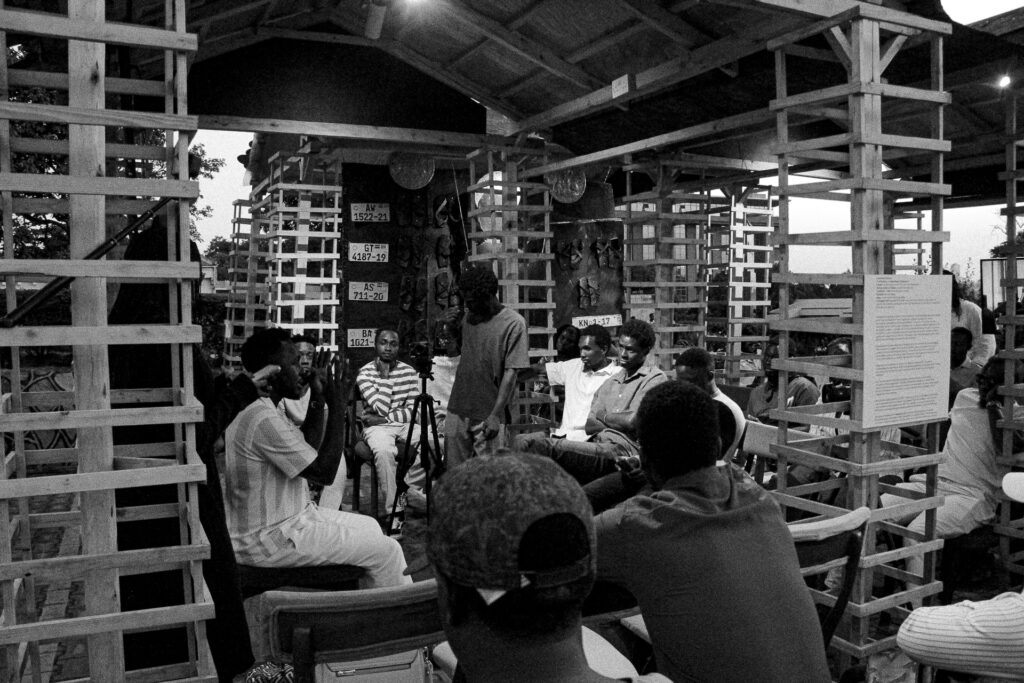
The Kitawuluzi instead invites participation. It suggests that the value of art lies not only in aesthetic experience but in its capacity to convene people around difficult questions of labour, value, identity and belonging. In doing so, it quietly redefines the role of the artist. Too often, discussions about African contemporary art reduce artists to cultural ambassadors responsible for representing national identity to international audiences. While international visibility remains important, this expectation risks positioning local communities as secondary audiences. Ugandan artists become fluent in explaining Uganda abroad while increasingly detached from the social realities that first inspired their work. The Kitawuluzi Pavilion quietly challenges this logic. Its location at the National ICT Innovation Hub is symbolically significant. Rather than occupying an elite gallery removed from everyday life, the pavilion inserts itself within a public institution associated with innovation, technology and civic participation. The implication is profound: artistic practice is not separate from public life but integral to it. This raises an uncomfortable but necessary question. Outside the frameworks of biennales, residencies and international exhibitions, what work are Ugandan artists doing for Ugandans? This is not a demand that artists abandon global conversations. Rather, it is an invitation to reconsider where artistic responsibility begins. Art does not become less significant because it serves local audiences. On the contrary, its international relevance often emerges precisely because it speaks honestly from a particular place. Jennifer Nansubuga Makumbi has consistently argued that African societies must learn to tell their own stories on their own terms rather than through inherited colonial frameworks. That insight resonates powerfully here. Before art becomes an export, it must first function as a language through which communities understand themselves. International recognition should not be the starting point of artistic practice but one possible consequence of work that is already meaningful at home.
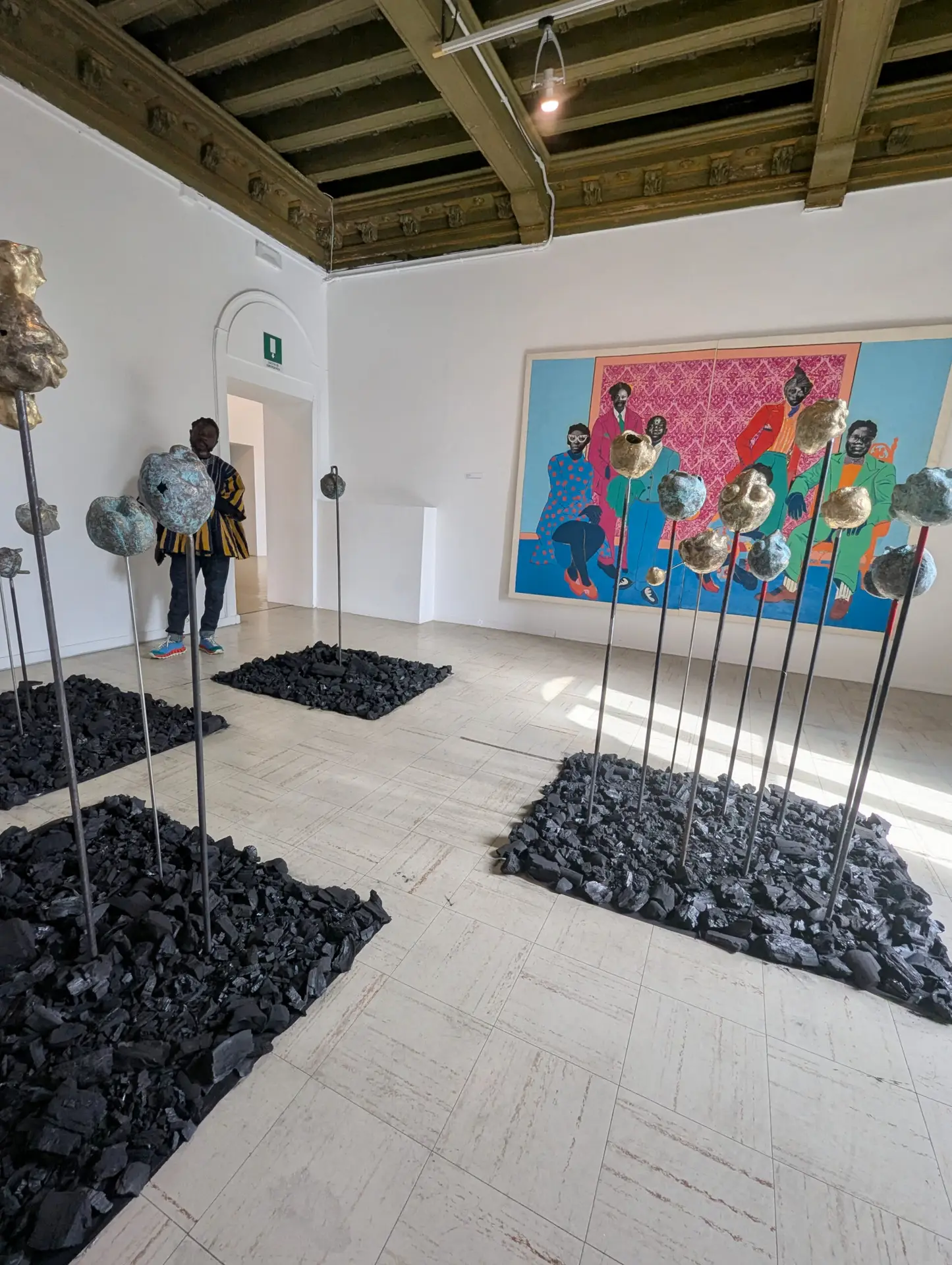
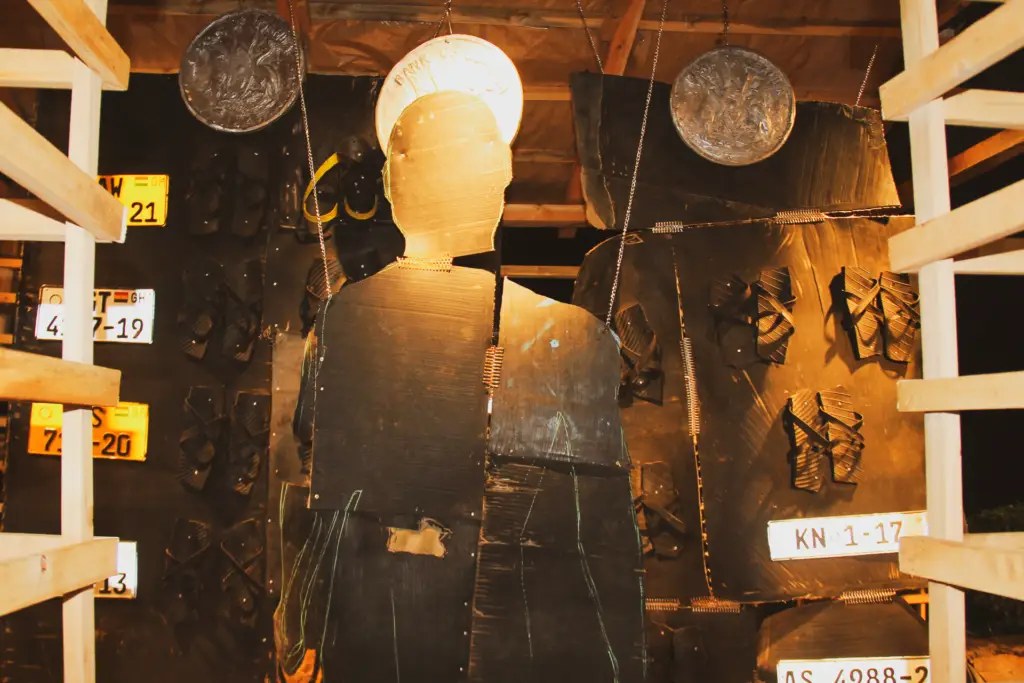
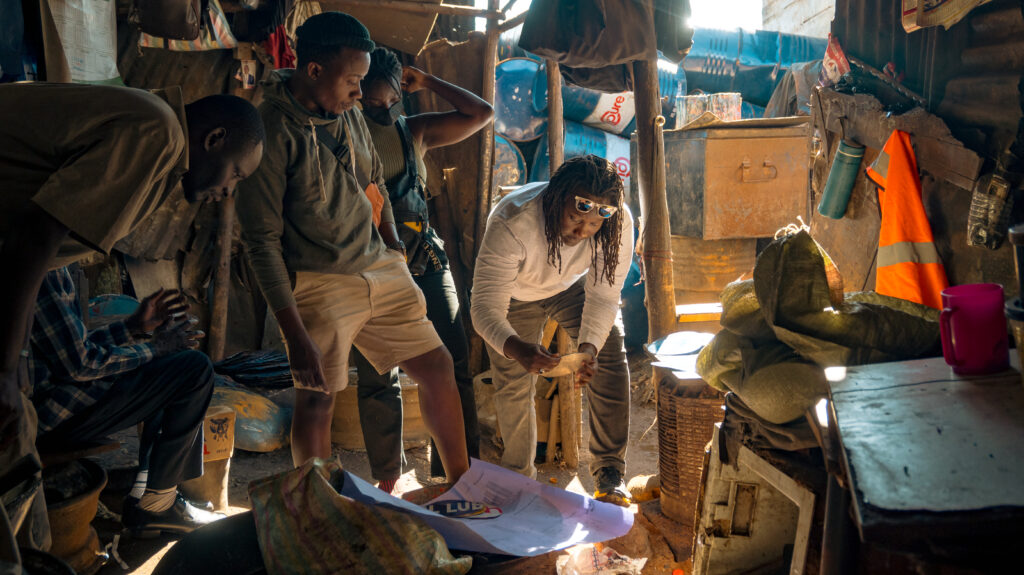
This aspiration resonates strongly with kąrî’kạchä seid’ou’s philosophy of art as a gift rather than a commodity. Art, in this formulation, is understood less as an object for market exchange than as a social practice grounded in reciprocity. This philosophy finds its clearest material expression in Wamala Kyeyune Joseph‘s installation, Zilugabile Ze Shadows Za Ubiquity. Monumental coins fashioned from salvaged metal and tyre sandals invert conventional understandings of currency. Rather than celebrating exchange value, the work honours forms of labour that often remain unseen within Kampala’s informal economy. The installation asks a deceptively simple question: whose labour counts? By monumentalising everyday materials, Kyeyune refuses distinctions between the artist and the artisan, between creative labour and manual labour. The tyre sandal maker, metal worker and street fabricator become central figures rather than peripheral ones. In doing so, the work aligns with the pavilion’s broader attempt to challenge dominant systems of value. Yet another tension emerges. Can art genuinely escape commodification while remaining embedded within global exhibition economies? Even exhibitions explicitly critical of market structures often depend upon the symbolic capital generated by international recognition. The desire to circulate globally can inadvertently reproduce the very hierarchies it seeks to dismantle.
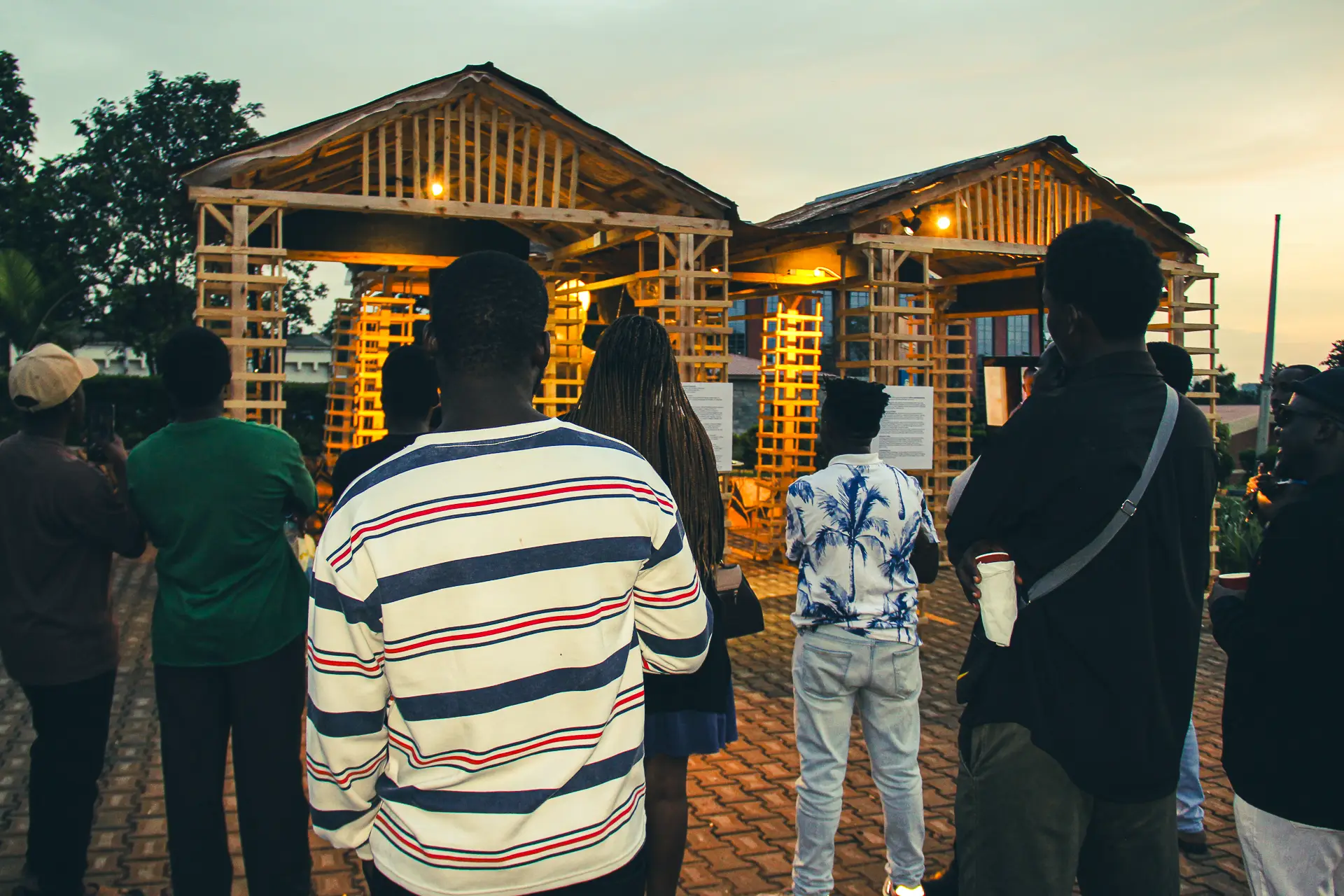
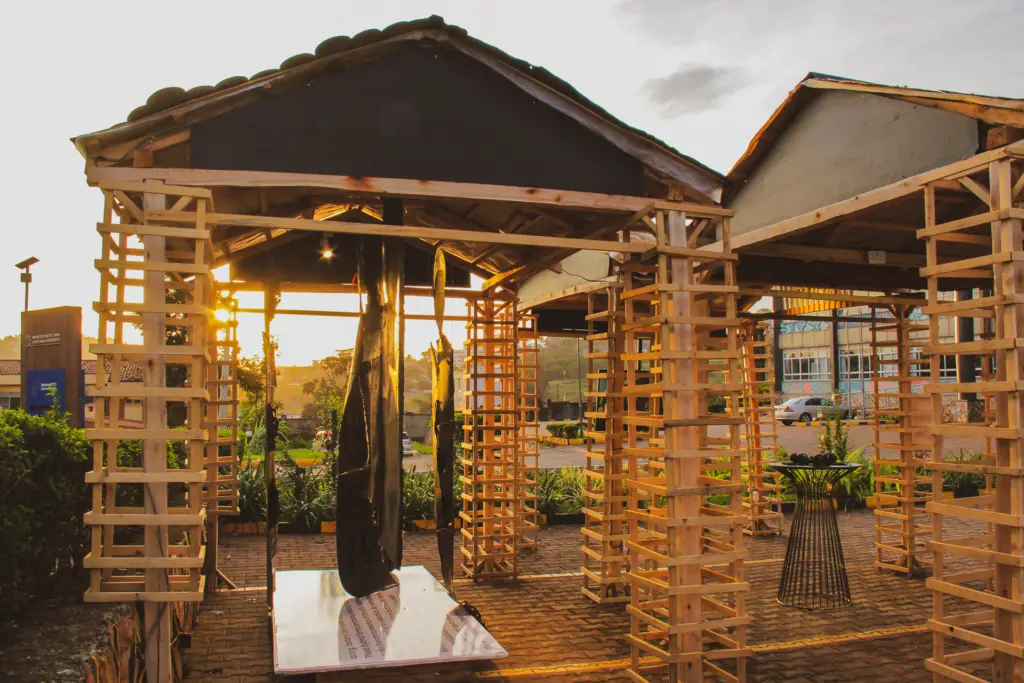
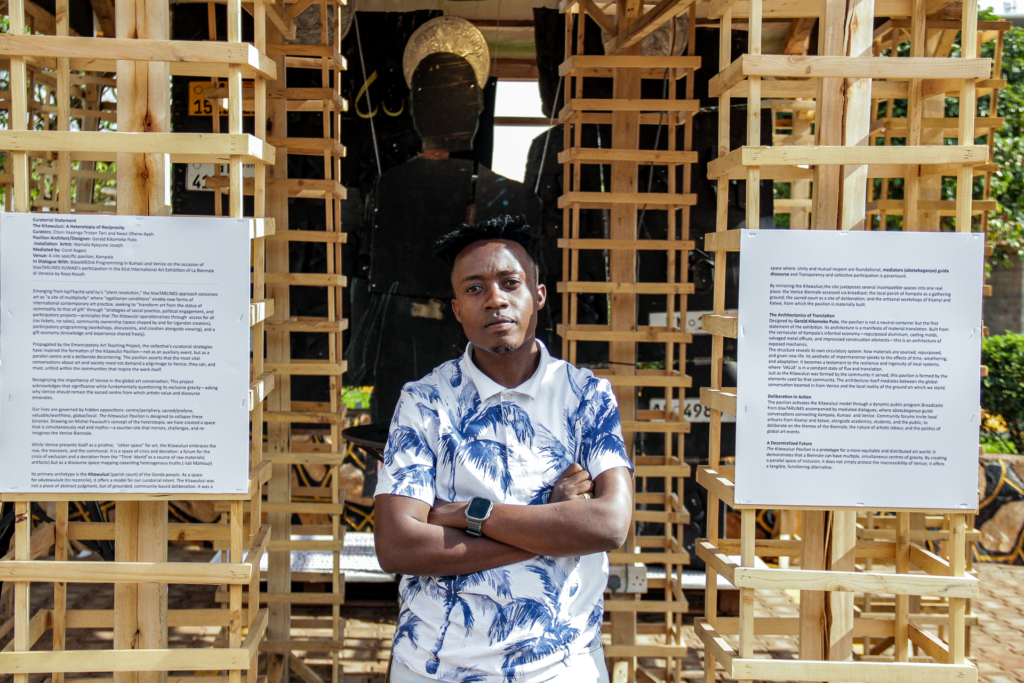
The Kitawuluzi Pavilion does not fully resolve this contradiction, nor should it. Its strength lies precisely in making this tension visible. Rather than presenting decolonisation as a completed achievement, the pavilion reveals it as an ongoing negotiation between local accountability and international visibility. Perhaps this explains why the pavilion’s architecture is so significant. Engineered and designed by artist Gerald Kikomeko Puto, the pavilion refuses to function as a neutral container for art. Constructed from recycled petroleum drums, salvaged metal and found industrial materials, the structure exposes rather than conceals its own making. Rather than masking the processes of fabrication, Puto’s design foregrounds them, transforming the pavilion itself into an argument about labour, resourcefulness and material translation. Before a single conversation takes place or artwork is encountered, the structure communicates the exhibition’s central concerns: reciprocity, adaptation and the possibility of building new cultural infrastructures from the materials and histories already at hand. It refuses polished monumentality in favour of adaptation, improvisation and reuse. The building itself becomes a metaphor. Just as discarded materials acquire new meanings through transformation, so too can inherited institutional forms. The pavilion suggests that new cultural infrastructures need not emerge from imported models. They can be assembled from existing local knowledge, histories and practices.
In this sense, the Kitawuluzi is not simply an exhibition venue but a proposition. It asks whether cultural institutions might function less as destinations and more as sites of continuous civic labour. Reflection becomes labour. Listening becomes labour. Disagreement becomes labour. The pavilion is not primarily a spectacle designed to attract visitors but a place where communities undertake the difficult work of interpreting themselves. If communities leave the pavilion having simply watched events unfolding in Venice, little has changed. If, however, they leave having encountered one another differently— questioning inherited assumptions about value, labour, artistic responsibility and collective memory—then the pavilion will have achieved something far more consequential. The Kitawuluzi Pavilion therefore invites us to rethink what contemporary African art can be. Rather than asking how Uganda might enter global conversations, it asks how global conversations might become accountable to Uganda. Rather than positioning Kampala as a recipient of cultural legitimacy, it imagines it as a site where legitimacy is continually negotiated through dialogue, reciprocity and public reflection. Ultimately, the pavilion reminds us that the most important stories are not necessarily those that travel furthest. They are the stories communities learn to tell about themselves before asking the rest of the world to listen. If the Kitawuluzi Pavilion fulfils this promise, it will not merely decentralise Venice. It will remind us that the centre of artistic life has never been a city, an institution or a biennale. It has always been wherever people gather to deliberate, reconcile and imagine new futures together.
Kwasi Ohene-Ayeh, Ph.D., is a curator, critic, and teacher based in Kumasi, Ghana. He belongs to the blaxTARLINES KUMASI coalition of co-workers and is inspired by the collective’s precept to “transform art from the status of commodity to gift”. Ohene-Ayeh has [co-]curated SLOW DOWN: C̶A̶T̶T̶L̶E̶ BATTLE AHEAD, blaxTARLINES KUMASI’s exhibition at the 61st International Art Exhibition of La Biennale di Venezia by Koyo Kouoh (2026); Fragments of A World After Its Own Image (2025) at APALAZZOGALLERY, Italy; TRANSFER(S), Ibrahim Mahama’s site-responsive exhibition project in Germany/Ghana (2023); the 35th edition of the Ljubljana Graphic Arts Biennale in Slovenia (2023-2024) as a member of Exit Frame Collective; and the 12th edition of Bamako Encounters: Biennale of African Photography (2019-2020). His current research observes the exhibition as a pedagogical situation while positing the curator as a vanishing mediator.
Zitoni Kayonga Tristan Tani is a curator, filmmaker, and co-director at Vodo Arts Society and Lab Ltd in Kampala, Uganda. His practice centers on emancipated learning environments, research-based projects, and creation of inclusive platforms for artistic engagement. His notable works include 27 Guns (2018); This is Not Deene(2018), Dear Enemy(2018), Queen of Katwe (2015), UCLA Swarovski Water School Project and Sarah’s Notebook. He has served as art director, production designer, and coordinator on various films, commercials, and documentaries. Curatorial projects include Saints and Sinners by Wamala Kyeyune (July 2022), Zadde by Yiga Joshua (2023), Silent Invasions: The Art Of Material Hacking(2023), Nile’s Jewel by Vini Mercy(2024), and Fragments of A World After Its Own Image (2025) at APALAZZOGALLERY. He produced Amakowola(The Return) by Mordecai Buluma Ochungo(2024) and Ateker Ijasi Biyayi by Pamela Enyonyu (2024), and recently completed a curatorial residency at blaxTARLINES Kumasi. He is currently facilitating artist exchanges across Africa with blaxTARLINES, Vodo Arts Society and Underground Contemporary.
The Kitawuluzi: A Heterotopia of Reciprocity
Curated by Zitoni Kayonga Tristan Tani and Kwasi Ohene-Ayeh
27/06/2026 – 05/12/2026
NATIONAL I.C.T INNOVATION HUB NAKAWA
Kampala, Uganda
N. July 19, 2026