By Alessia D’Introno
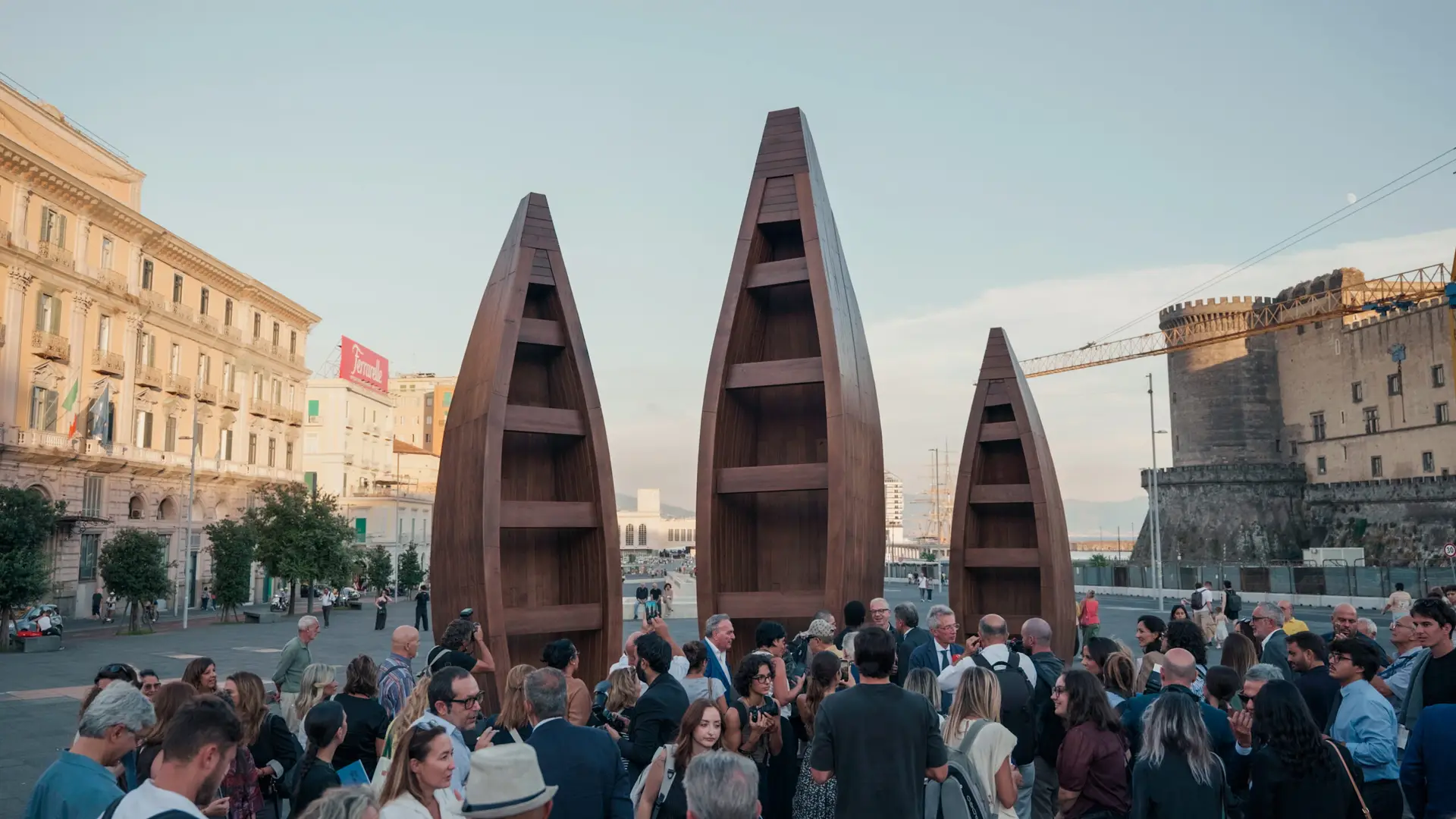
In Piazza Municipio in Naples, visitors can admire Voyageur, the new public art intervention by Ibrahim Mahama, curated by Vincenzo Trione, realized as part of the Napoli Contemporanea program. The work joins the pathway of public art that has previously engaged the square with interventions by Michelangelo Pistoletto (2023), Gaetano Pesce (2024), and Jaume Plensa (2025).
Voyageur consists of three monumental wooden boats, measuring approximately 5, 7, and 8 meters, constructed according to traditional Ghanaian models and techniques. Their presence in the Neapolitan square creates an encounter between different places and histories, connecting Ghanaian traditions with the memory of a city that has always been bound to the sea.
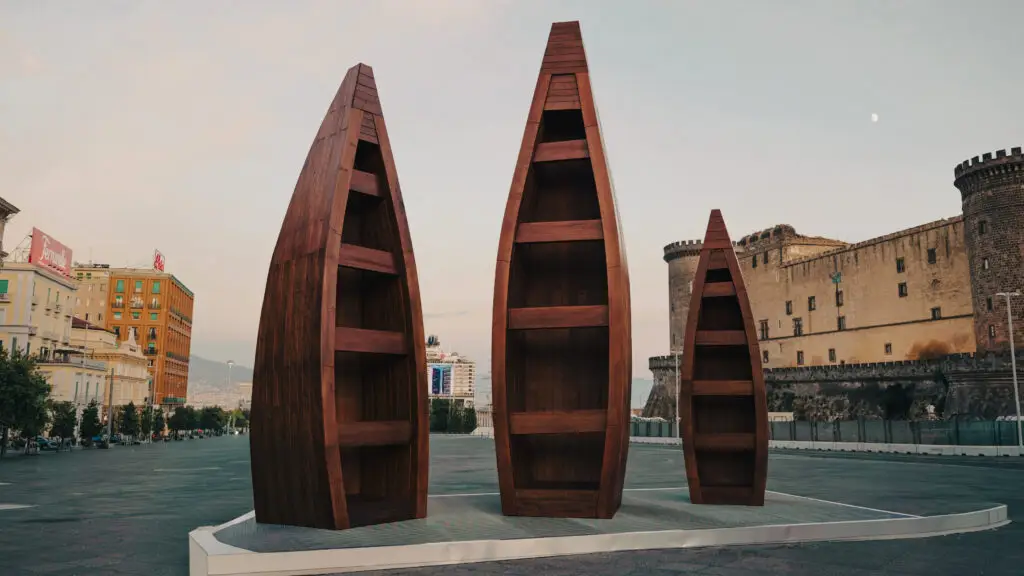
Photo credit Manuel Vitolo. Courtesy of the Artist, APALAZZOGALLERY and White Cube
Today, Ibrahim Mahama is a prominent figure on the international contemporary art scene. His work recently received institutional recognition: the honorary title of Chevalier de l’Ordre des Arts et des Lettres, conferred upon him by the French Ambassador to Ghana in recognition of his contribution to art.
Mahama’s broad and complex research traverses power relations, the social and political dynamics of Ghana, and their cascading consequences on people’s lives and economies. In his works, materials become concrete traces of this history. Such is the case with jute sacks, originally used to transport cocoa and subsequently reused by local people, which Mahama reclaims to demonstrate how objects retain marks of their past. The stains, stitching, wear, and accumulated traces over time recount stories of labor and circulation, as well as bodies and communities undergoing social and political transformations.
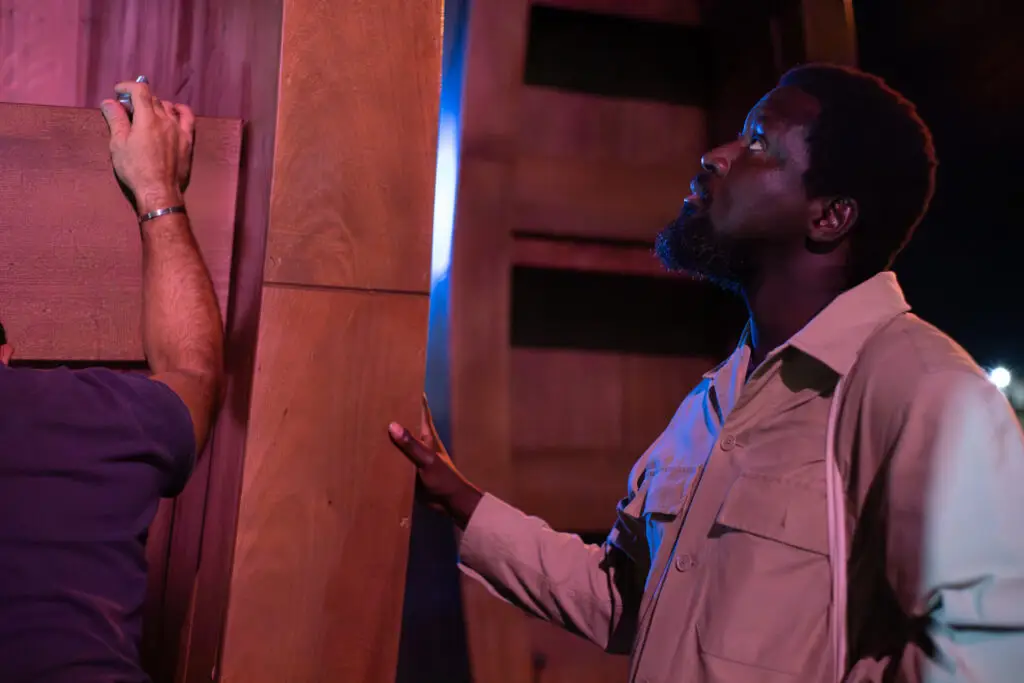
Photo credit Sonia Assanti. Courtesy of the Artist, APALAZZOGALLERY and White Cube
Another facet of his research emerges in the photographs documenting the practice of workers who left their villages to relocate and work in coal mines. Some of them had their bodies marked with references to their hometowns so that, in the event of sudden death, they could be identified and brought back to their place of origin. Behind every journey, Mahama narrates the conditions of labor, the ties to one’s community, and the imperative not to lose one’s history and identity. The three boats of Voyageur can also be viewed through this lens. Their presence connects Ghana and Campania, two geographies shaped by long histories of seafaring, commerce, migrations, and power dynamics that have helped define societies and economies. Thus, the boats evoke the sea as a passage and a site where traces of those who cross and remain in it are preserved.
This focus on the relationships between materials and traditions is also evident in other projects Mahama has undertaken in Italy. Among the most recent is A Shea Garden, presented at the Barovier&Toso pop-up gallery in Venice during the Biennale. In this work, Mahama creates a dialogue between the Ghanaian tradition of clay vessels, historically used for storing food and as perforated containers for poultry, and Murano glass craftsmanship. Different materials, techniques, and functions give rise to a connection where respective traditions become opportunities for dialogue.
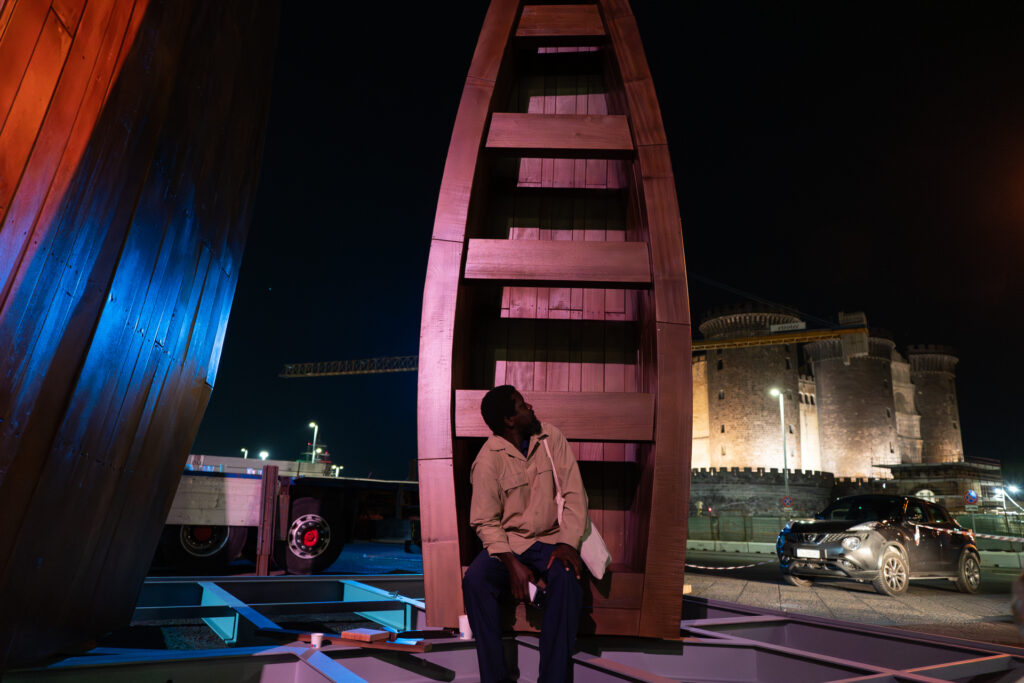
This ability to connect stories and traditions spans his entire practice, as confirmed by the boats in Voyageur. The three vessels, which appear to emerge from the earth, evoke the port of Naples, its seafaring history, and the crossings that continue to mark the sea. Their imposing presence evokes both contemporary migrations, with their departures and arrivals, and the lives moving from one shore to another, carrying languages, knowledge, and memories with them.
The boats thus become a meeting point between Ghana and Italy, between past and present, between distant places that the sea can both divide and bring closer together.
Voyageur invites us to recognize that every journey leaves traces on both shores. People on the move help transform the places they arrive in, becoming an integral part of their history. Just as boats cross the sea, the memories and experiences of migrants become part of the host societies.
IBRAHIM MAHAMA. VOYAGEUR
Curated by Vincenzo Trione
Naples, Piazza Municipio
21/09/2026 – 18/11/2026
Ibrahim Mahama (b. 1987, Tamale, Ghana) is one of the most influential voices in contemporary art and the first African artist to top ArtReview’s Power 100.
His practice centres on monumental, site-specific installations using materials of labour and trade – jute sacks, timber, and industrial remnants – to explore global economies, colonial histories, and the circulation of goods and people.
Living and working between Accra and Tamale, he is the founder of the Savannah Centre for Contemporary Art (SCCA), Red Clay Studio, and Nkrumah V olini. Mahama has exhibited internationally, including at Documenta 14, the Venice Biennale, Centre Pompidou, and with a forthcoming solo exhibition at Fondation Cartier, Paris (2026).
He is the recipient of the Prince Claus Award (2020), the Sam Gilliam Award (2024), and the Gold Award at the inaugural Art Basel Awards (2025). His work is held in major public collections worldwide, and he is represented by APALAZZOGALLERY and White Cube.

Alessia D’Introno is Editor-in-Chief of the African contemporary art magazine Equator Echoes, registered in the Special List of the Lombardy Journalists’ Association. She holds a Master’s degree in Visual Arts and Curatorial Studies from NABA, Milan, and has completed a postgraduate course in Demoethnoanthropological Heritage at the University of Milano-Bicocca. She has published articles in Juliet Art Magazine and ArtsLife. Her critical and curatorial research focuses on the deconstruction of classical art history and the decolonization of the contemporary European art system.
N. October 17, 2026