By Caleb Nii Asiamah Kwatey Quartey
For the 2nd exhibition held in conjunction with and celebration of the Nubuke foundation’s 20th anniversary, Frederick Ebenezer Okai with the curatorial direction of N’Goné Fall, held one of his most intimate exhibitions thus far with the given title Frederick Ebenezer Okai: Repair as an Ode to the Unearthed.
Intimate not solely because of the works that came to be hosted in the exhibition space of Nubuke but also because of the culmination of auspicious and nostalgic phenomena that took form on the opening day.
As was intended, there was to be a talk with the artist moderated by Kwasi Ohene Ayeh (PhD.). Who, alongside being a curator, critic and lecturer, shares a close friendship and professional relationship with the artist of about 17 years and is a member (or more accurately, a part of the family of Nubuke).
Through their conversation on that Saturday afternoon was a wide eye opening invitation to learn the depths to which Frederick Okai within his practice, has developed and reconfigured strategies, borrowed and collaborated with philosophies and methodologies of work. All these on his quest to engage his continuous inquiry into the subject of ceramics, pottery (drawing from both indigenous and localised practices and academic or educational undertones).
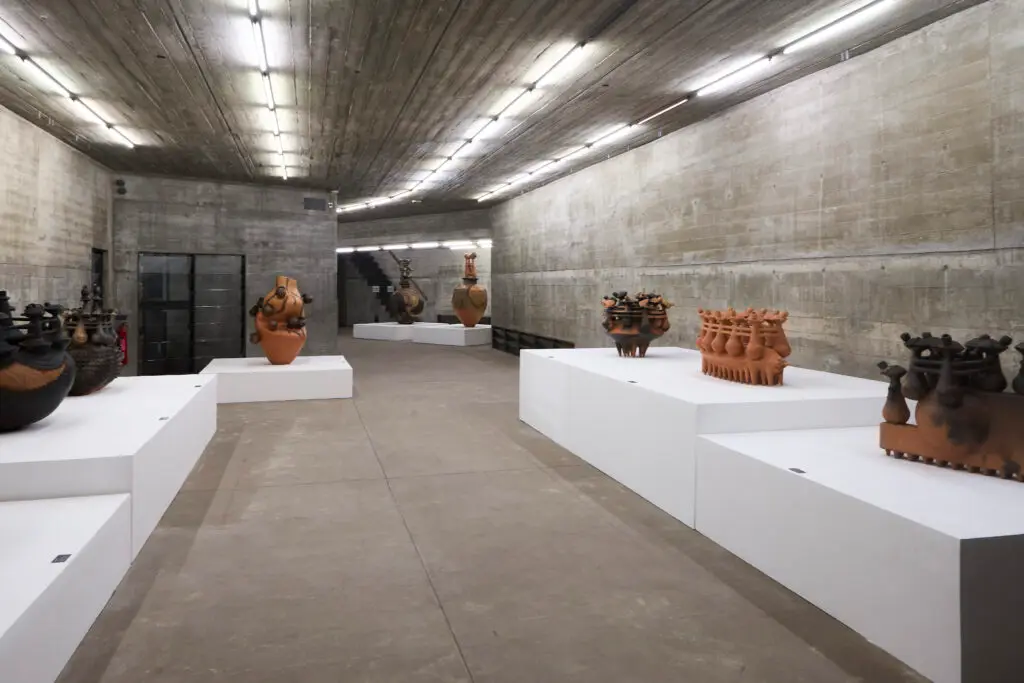
Beginning from the 1st work on the ground floor of Nubuke’s exhibition space, you are greeted by the semi floating ceramic pieces that are held up by an interlocked arrangement of metal rodes. With each piece distinct, fractured or textured in varied forms and sizes and dispersed to view, the base inquiry would be to find the relation. Mimicking the iron rods that stick out of concrete structures left halfway done or abandoned.
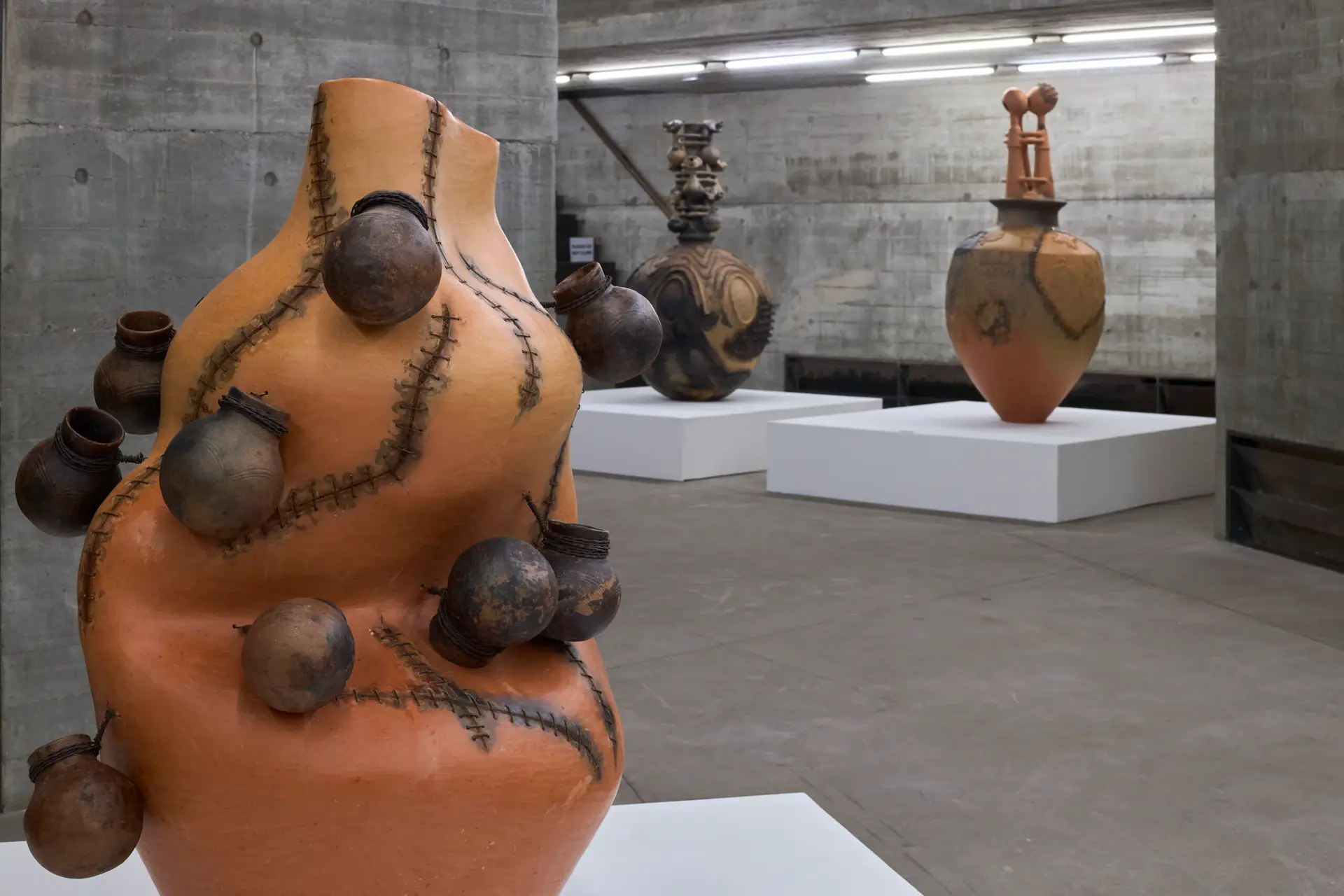
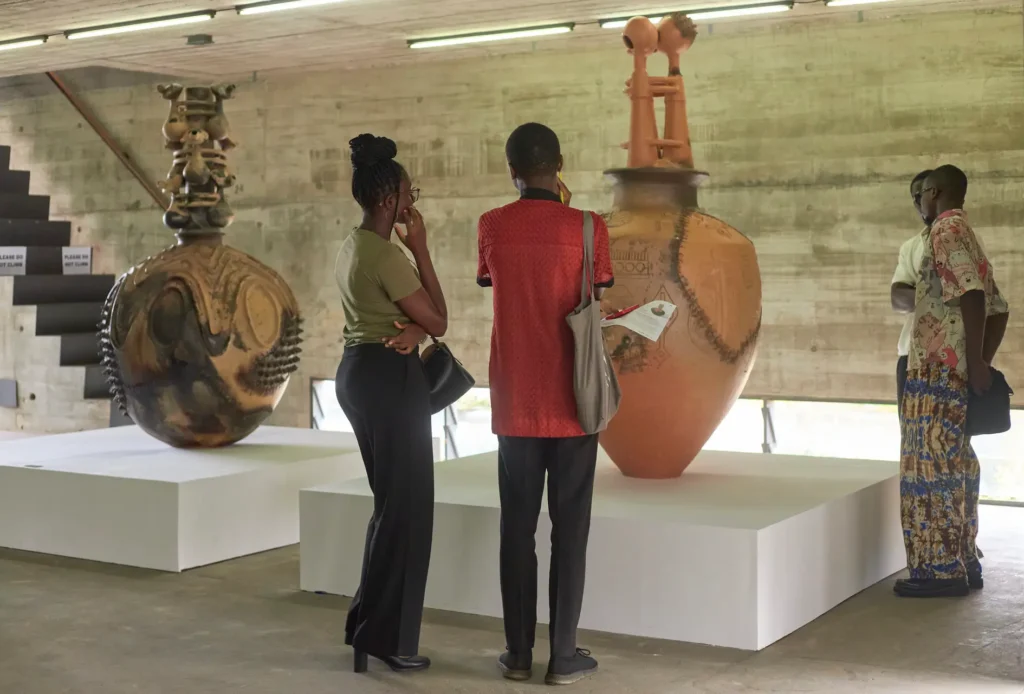
As you move upwards into the elevated exhibition room two massive works named Ewuradwoa and Birago.
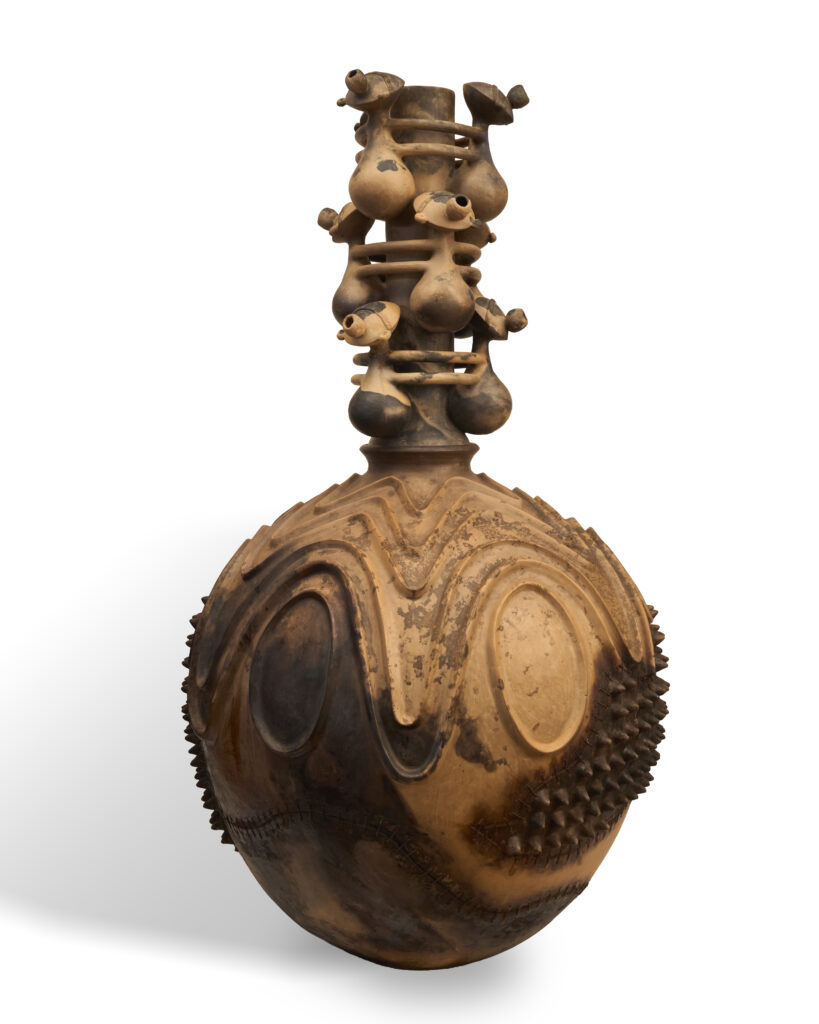
The best I could do textually would be to describe these as stories and dialogue given ceramic form.
According to the artist, due to his training in the academic way of ceramics, he picked up the habits of drafting the concepts of these form before working them into shape but yet still allows for the form to grow, change and become something that isn’t exactly as intended.
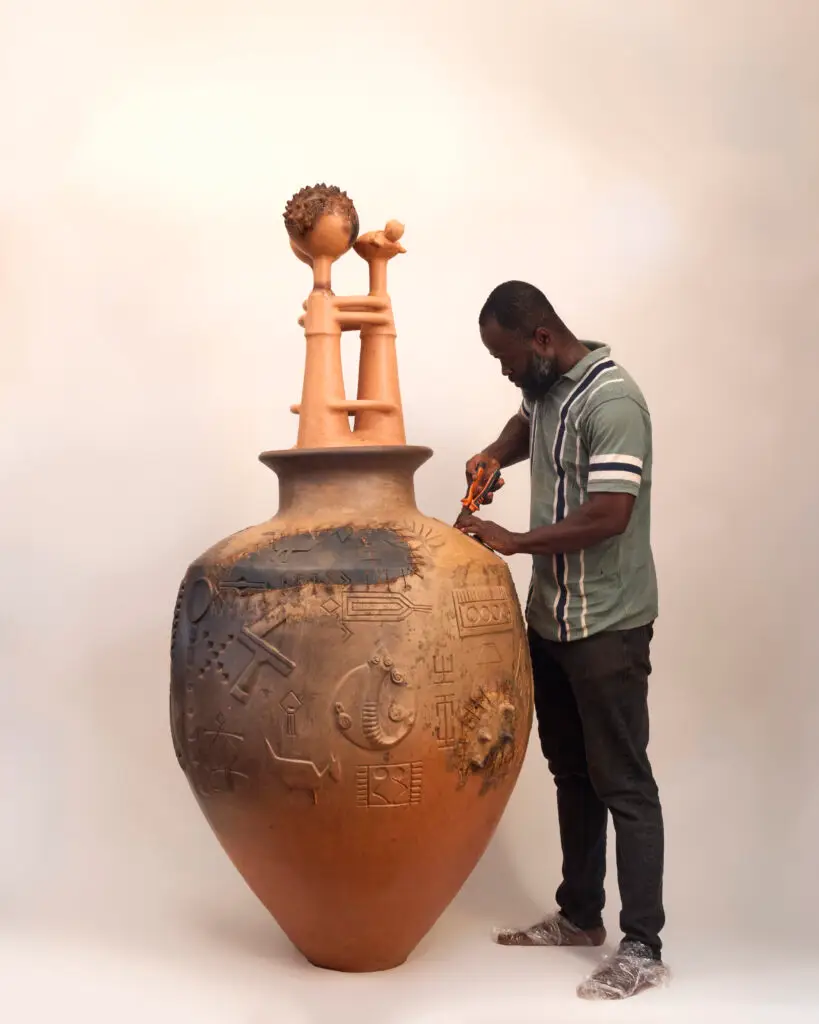
As one who heard his talk with Kwasi Ohene Ayeh (PhD), I recognise the dedication that has been taken to allow each work to embody varying contextual, symbolic and structural identities. The remaining works with their names (in order of my encounter with them) Obaapa, Nhyiamu Kɛseɛ VIII, VI, VII, V, I and IV, were placed on white elevated pedestals to allow us have a more comfortable view point to appreciate each work and the details in it.
In the naming of his works, is also noticeably the choice of feminine names or titles. Not in all but yet in some.
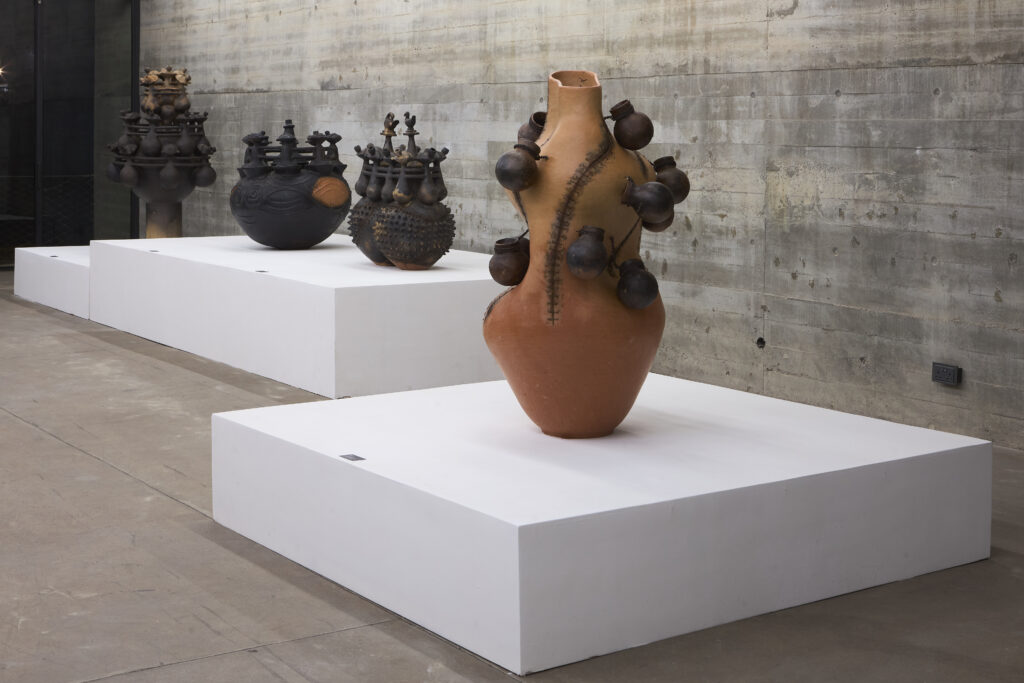
Having collaborated and trained with the local potters in parts of the country, the artist explained that he grew to appreciate and better understand the complexity of the craft of clay and saw how deeply necessary it was to involve the many characters that have contributed to this culture.
And although he has mentioned that he finds ways and strategies to give back to the communities he learns from, he expressed how these works and the multifaceted and intimate nature of his practice has in many ways, changed him.
In temperament and in thought processes.
It seems to me that he in many ways, accomplishes that attribute of an artist that creates works that are in many ways, extentions of himself and the many spaces he draws from.
As I engage these works in the elevated gallery overlooking the grassy fields on the opposite side of Nubuke’s gates, I almost find it easy to form a chain of thoughts and questions that help me deepen my appreciate for those little things that I see are painstakingly considering in the making of each work.
Frederick Ebenezer Okai- Repair as an Ode to the Unearthed
Curated by N’Goné Fall
Nubuke Foundation, Accra, Ghana
17/10/2026 – 17/04/2027
N. November 1, 2026
Frederick Okai is a multi-disciplinary artist who is also one of the outstanding ceramic artists practising in Ghana today. Having travelled through pottery communities across Ghana and West Africa, he has immersed himself in long-standing ceramic traditions, studying the techniques carrying cultural, spiritual and archival heritage. His work holds a rare balance between respect for tradition and a willingness to experiment.
N’Goné Fall is an independent curator and cultural policies specialist. She was the editorial director of the contemporary African art magazine Revue Noire from 1994 to 2001. She curated exhibitions in Africa, Europe and the USA. She is the author of strategic plans for national and international institutions. She was a professor at the Senghor University, Egypt; lecturer at the Michaelis School of Fine Art, South Africa and Abdou Moumouni University, Niger. She was the General Commissioner of the Africa2020 Season, a series of more than 1,500 cultural, scientific and pedagogical events in France from December 2020 to September 2021.