By Alessia D’Introno
The high quality of international contributions from Africa to the 61st International Exhibition of the Venice Biennale is already evident in the very act of presenting, within a global institution, their own ways of relating, identifying, and speaking about themselves.
Among the plausible explanations for continuing to maintain national pavilions in an exhibition of this magnitude firmly, there may be a desire to highlight unique identities, even though, for some pavilions, categorizations, preferential treatment, or greater visibility are often provided, depending on the geopolitical significance they acquire within a system that remains strongly ethnocentric. From this, for example, stem the logics that determine the presence of certain pavilions in the main exhibition spaces such as the Arsenale and the Giardini. In contrast, others are distributed throughout the city, in alleys and peripheral spaces.
Representing Africa today within an art Biennale, as evidenced by the participations in this edition, means questioning and showcasing diverse cultural positions and visions. Although the pavilion itself is an institutional device, often used to make a political statement, it can become, curatorially, a space of misalignment with that very power. An exhibition ceases to be a showcase when it begins to question itself from within. At the same time, it is necessary to consider that we are operating within a “global” language that is by no means neutral, but historically hierarchical. Inequalities remain, but art can serve as a bridge, just as poetry and music do, and thus find a narrative gap to fill, to traverse, to reestablish.
The Pavilion of the Democratic Republic of the Congo, making its debut at the Venice Biennale, is located in the Ancient Refectory of the Museo Scuola Grande di San Marco. Despite its quiet location, it draws much of its power precisely from this space: a place historically associated with care and healing. These are some of the themes explored in the exhibition, in line with the dialogue proposed by Koyo Kouoh. The Pavilion also relates to various temporal and spatial periods. The artists’ own migrant and local identity underpins their interpretation of their country through its internal and external relationships, preserving its spirit and interpretive power. At the same time, it seeks to dismantle the common perception of a country associated exclusively with wars and humanitarian crises.
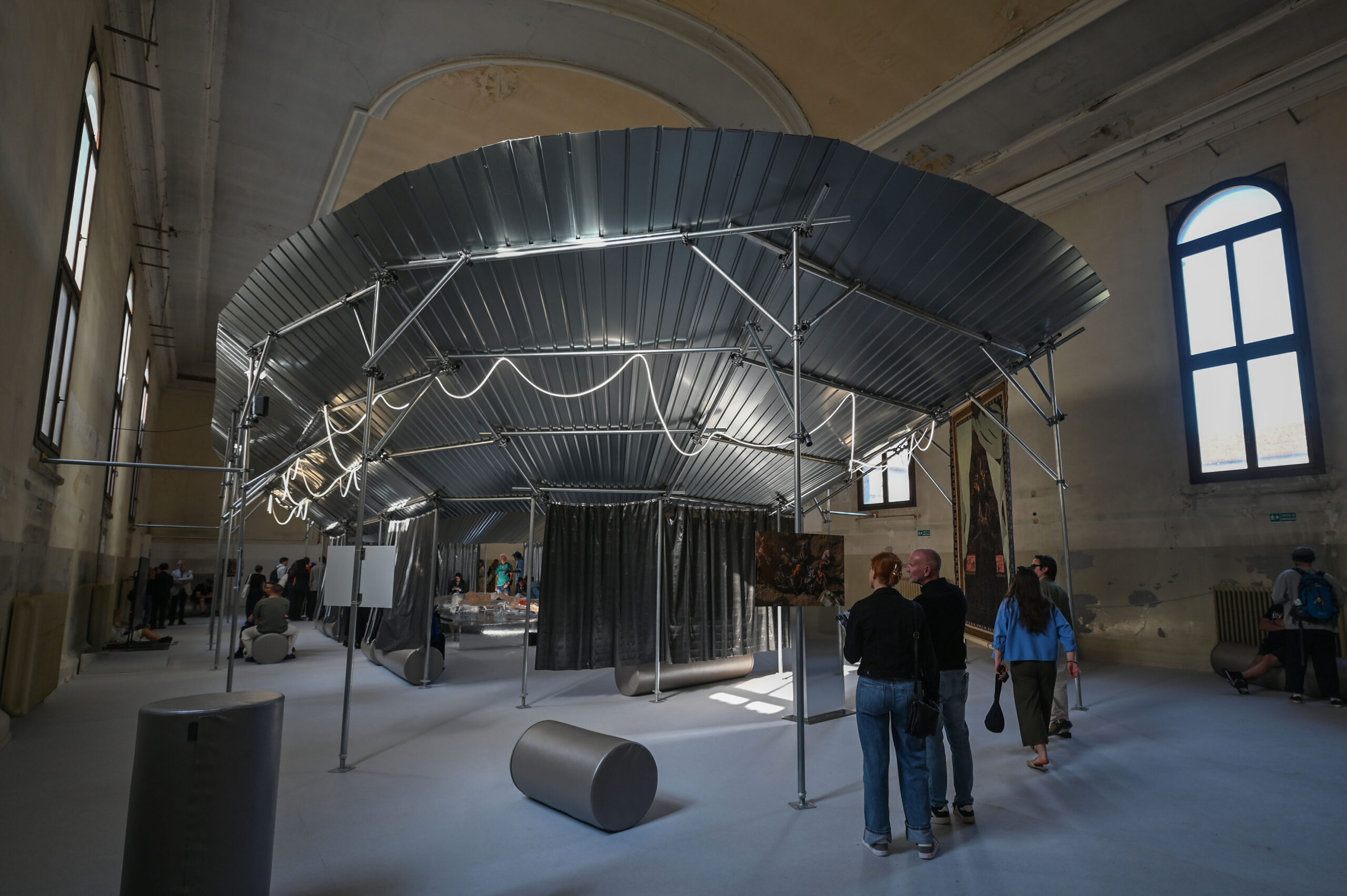
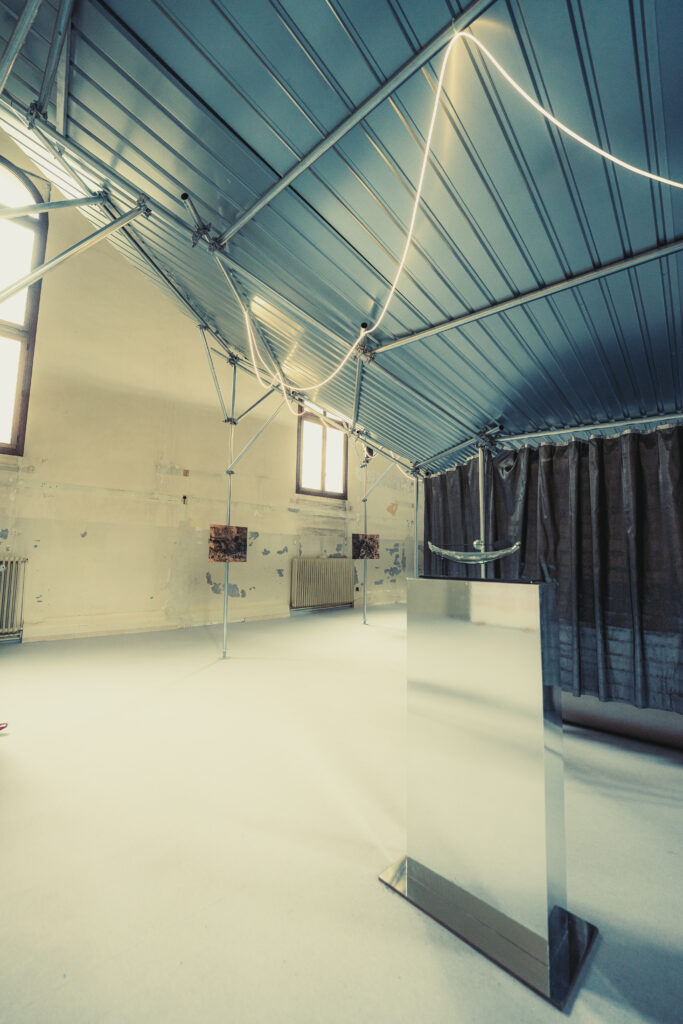
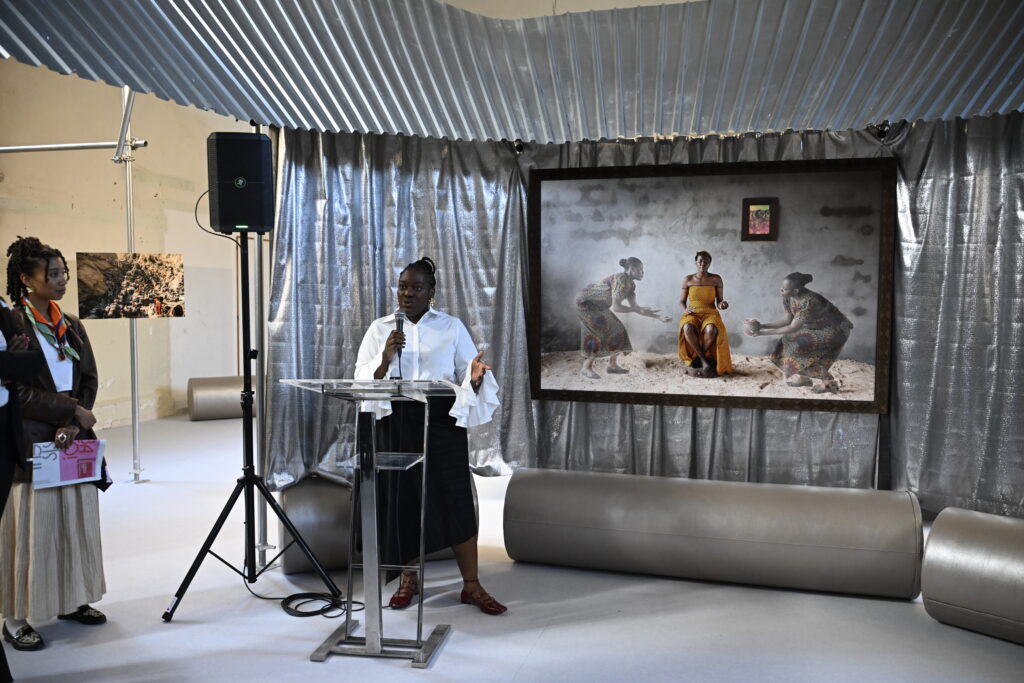
The circular metal structure stands at the center of the hall, welcoming the nine artists. It is a forge, where traditionally the blacksmith masters the fire. This is the curatorial concept behind the exhibition, titled Simba Moto! Seize the fire! Saisis le feu! deliberately translated into three languages, curated by Nadia Yala Kisukidi, alongside the MOKO Collective, a curatorial collective comprising Aimé Mpané, Jean Kamba and Johnny Leya. The flame creates, shapes, and releases energy. It is the very momentum of the artists.
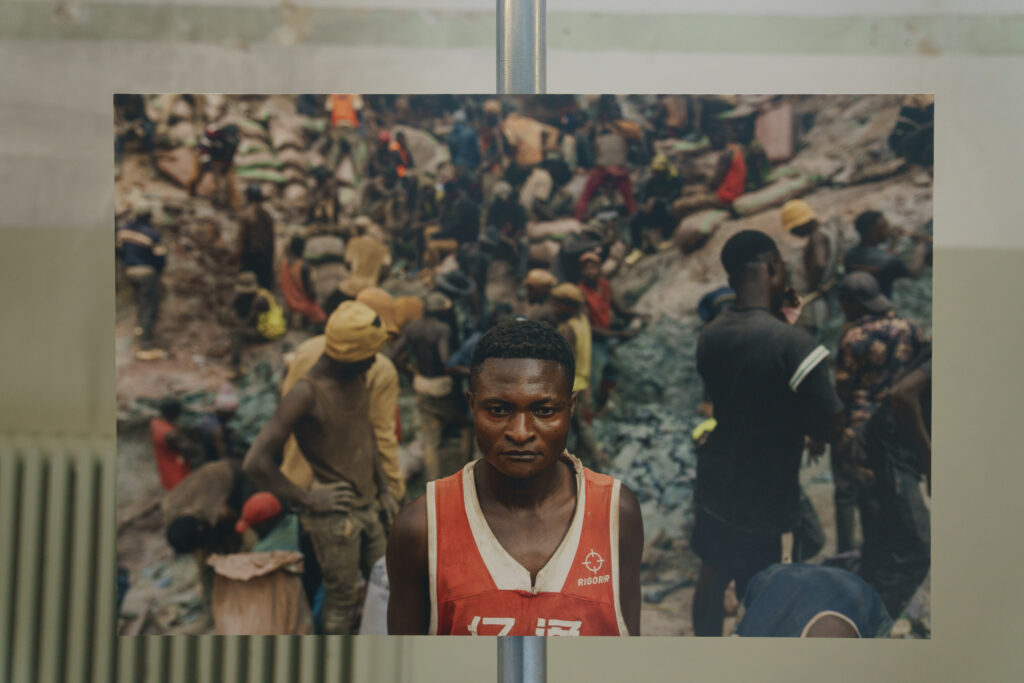
Arlette Bashizi surrounds the forge with the photographic series Price of Technology. A Requiem for the Mineral Body, 2023. A work that brings to light the eastern Democratic Republic of the Congo and the extractive violence that pervades it.
At the Arsenale, Alfredo Jaar’s work enters into an implicit dialogue with Bashizi’s. The list of materials extracted from the Earth, with the indication of the countries of extraction and destination, makes it clear how much this extractive chain is at the center of a global condition. Cobalt, a true poison for miners; coltan, used in the production of computer and phone chips, as well as in wind turbines and electric vehicles; germanium, used in semiconductors and satellite systems; and tin, essential both for food preservation and for soldering in power grids.
Price of Technology. A Requiem for the Mineral Body, 2023, on the other hand, highlights this invisible and structural dimension through images that address the safety conditions of miners and the health, environmental, and social crises faced by the local communities involved.
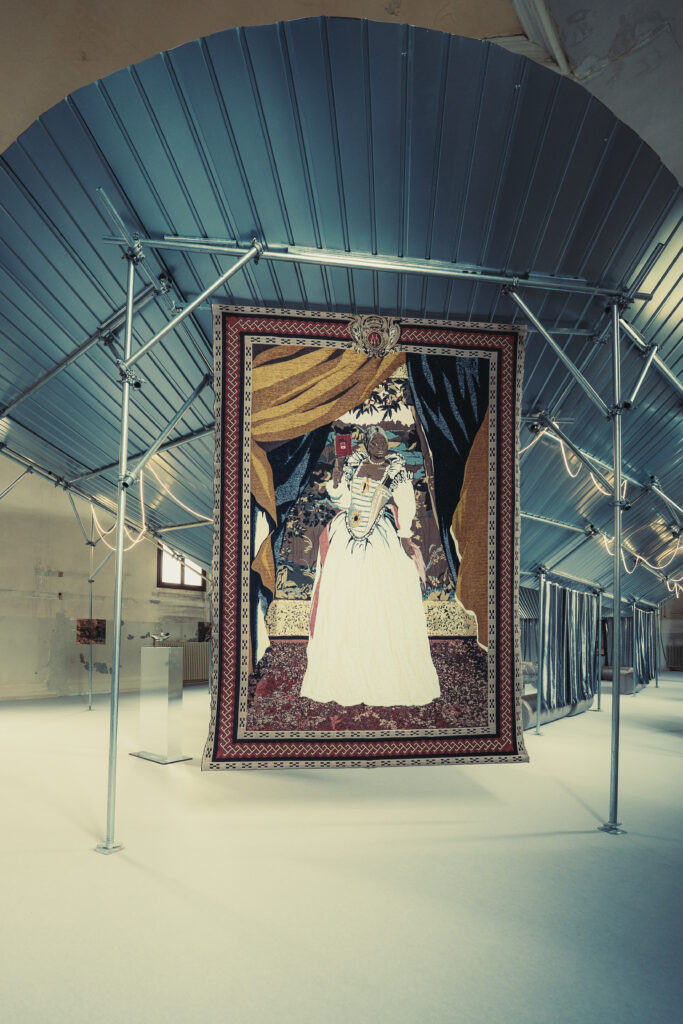
Alongside his installation along the outer circle of the metal structure is Sammy Baloji’s textile work, Seeing Katharina, 2026. The work is inspired by Dürer’s painting depicting Katharina, a Black woman reduced to a slave. Here, her figure is reinterpreted and rendered in a new iconographic dimension. The young woman appears noble, symbolically reclaimed through a reversal of the historical and colonial gaze.
Léonard Pongo presents Mbanza Tapestry, 2020, a textile work that translates photographic images from the Democratic Republic of the Congo. This transition from the photographic to the textile transforms the landscape into a tactile material.
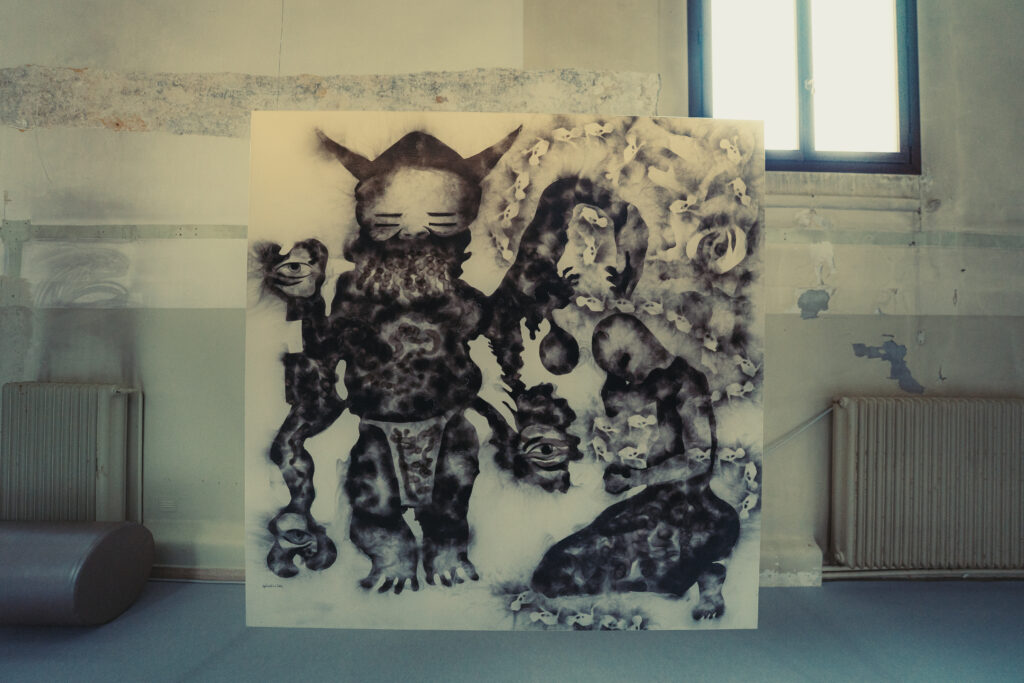
Géraldine Tobé paints using the black smoke from a handmade kerosene lamp crafted from recycled metal cans. Her dreamlike and surreal figures, such as the half-naked human figure surrounded by eyes like in Le chemin de la mémoire (The Way of Memory), 2018, emerge from the canvases, connecting to themes such as African ancestral heritage.
Patrick Bongoy’s sculptures Stagnation, 2026, made of recycled rubber, reflect on environmental pollution and, in this exhibition, highlight the difficulties and barriers that many young Congolese continue to face even when pursuing higher education.
Damso presents Le Bureau des Futurs Ajournés, (The Office of Postponed Futures), 2026, an elegant sculpture composed of blown glass, black pigment, volcanic sand, water, lichens, and mosses. The artist, originally from Kinshasa and raised in Brussels, extends his practice beyond music here, through a work that reflects on suspension and uncentain future.
Gosette Lubondo, with the series Please Carry It!, 2026, weaves together photography and memory. Known for her works on abandoned and forgotten places, she reactivates their complex stories alongside those of the people of whom the artist herself becomes the guardian. The works presented draw on family archives and the matriarchal transmission of Kongo culture, where the female presence emerges as both strong and elusive in her photographs. This transparency is at once nostalgic and forward-looking. Her works continually open up new trajectories and collective memories to be passed down.
Three figures of children lie on a transparent inflatable mattress: they are Le Souffle (The Breath), 2026, the sculptures made of matches by Aimé Mpane, the Congolese artist occupying the center of the room. His work intertwines with the sound installation created by aza, amplifying a sensation of suspension. Mpane’s work often addresses the social injustices affecting childhood, through a reflection on Belgium’s penetration of Kinshasa, then called Léopoldville. The historical relationship between the Congo and Belgium, the artist’s adopted country, becomes an instrument of collective consciousness. The mattress itself seems to breathe. A slow movement that introduces lightness into history, traversing it.
Ntemo Nkengo (State of Awakening), 2026, is a video installation capturing moments of intimacy and testimony. The artist Nelson Makengo depicts Kinshasa at night as the river slowly floods the city. Homes and residents are in the throes of suffering. The river becomes a symbol of uncontrollability, a force that overwhelms everything, leaving the city in a fragile state of resistance.
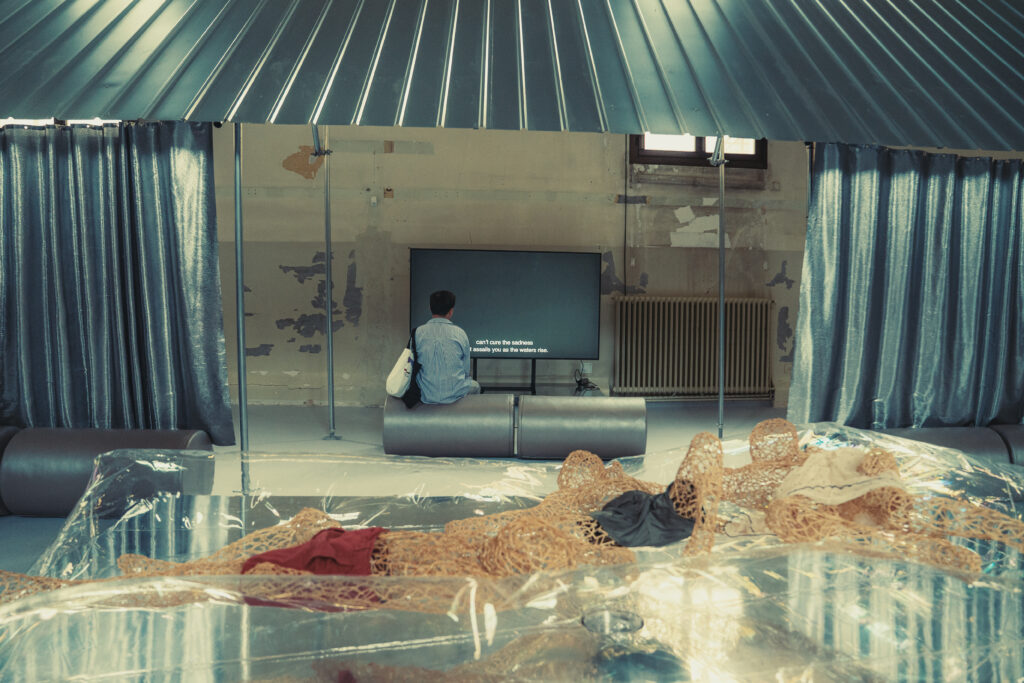
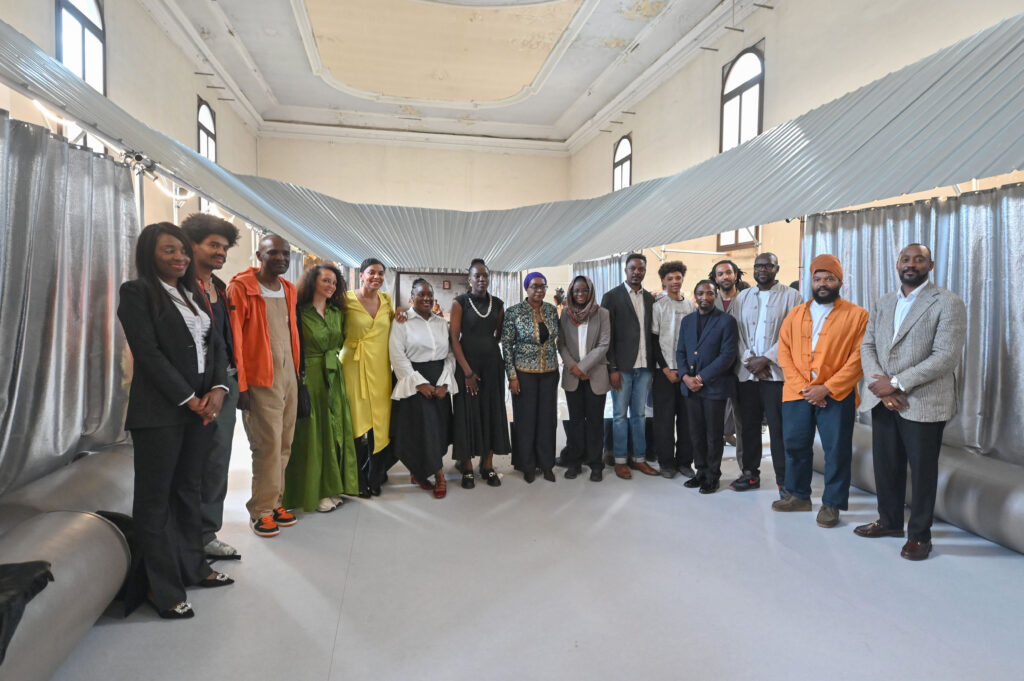
The artists, with multifaceted and multisensory visions, explore themes of imagination, care, relief, healing, and rebirth. The atmosphere is that of a forge in the making. The artists shape imaginations, memories, and possibilities. They experiment, document, challenge, and resist a single, linear language. A multifaceted language, just like the country they represent.
Born in 1978 in Brussels, Belgium, Nadia Yala Kisukidi is a novelist and philosopher, and Associate Professor of French literature, thought, and culture at New York University. Daughter of a Congolese (DRC) father and Franco-Italian mother, she works across the disciplines of philosophy, fiction, and curatorial practice, tracing the cartographies of global Blackness and dedicated to the mobilization of African radical imaginaries. A specialist in Africana philosophy and contemporary Western theory, she develops a mode of writing that challenges established boundaries, where logic and narration are held in constant tension.
The Moko collective, named after the word “moko” in Lingala which means “unity,” is a curatorial collective founded in June 2025 to support the curatorial work of the inaugural DRC Pavilion at the 61st Venice Biennale in 2026. The group is composed of Jean Kamba, Nadia Yala Kisukidi, Johnny Leya and Aimé Mpane. Supported by the commitment of the DRC Ministry of Culture, arts and heritage and the initiatives of Cindy Makiana, the Commissioner of the DRC Pavilion, the Moko collective aims to promote, within the DRC Pavilion, the Congolese art scene, both national and diasporic, in all its geographical, historical, and aesthetic diversity, in accordance with its curatorial vision. The group is attuned to the continuities, ruptures, and reinventions that permeate Congolese artistic practices. Its aim is less to freeze a narrative than to reveal its vitality, its multiple voices, and its internal dynamics. It actively draws upon Congolese thought, humanities, literature and poetry, both national and diasporic, past and present. This curatorial group constitutes a living archive reflective of a constantly evolving creative process, shaped by the DRC’s rich heritage and its future development, and intended to be shared with the world.
Translation by Luigina D’Introno
Simba Moto! Seize the Fire! Saisis le feu!
Pavilion of the Democratic Republic of Congo
61st International Art Exhibition – La Biennale di Venezia
Curated by Nadia Yala Kisukidi and the MOKO Collective
09/05/2026 – 22/11/2026
Antico Refettorio – Scuola Grande di San Marco, Venezia

Alessia D’Introno is Editor-in-Chief of the African contemporary art magazine Equator Echoes, registered in the Special List of the Lombardy Journalists’ Association. She holds a Master’s degree in Visual Arts and Curatorial Studies from NABA, Milan, and has completed a postgraduate course in Demoethnoanthropological Heritage at the University of Milano-Bicocca. She has published articles in Juliet Art Magazine and ArtsLife. Her critical and curatorial research focuses on the deconstruction of classical art history and the decolonization of the contemporary European art system.
N. May 5, 2026