By Arianna Leva
In his new exhibition, the Atlantic Ocean meets the Mediterranean Sea. Through cartographies, suspended figures, and incandescent colours, the history of migration is transformed into an emotional geography of the present.
Standing before the paintings of Arjan Martins (Rio de Janeiro, 1960), one has the impression that history does not unfold in a straight line. His images seem to drift within a suspended dimension where different centuries touch one another and distant routes unexpectedly converge. With O Estrangeiro. 35º30’54” N, 12º34’48” E, his solo exhibition at Fondazione ICA Milano, the Brazilian artist brings to the heart of Europe a reflection on migration that avoids the language of current events and instead embraces the more complex terrain of memory.
The Coordinates
The coordinates featured in the exhibition title lead to Lampedusa. Yet what interests Martins is not geography itself, but the symbolic value of the place. The island becomes a threshold, a space crossed by presences, absences, and expectations. For years, the artist has explored the connections between Africa, the Americas, and the Black diaspora; here, his gaze extends towards the Mediterranean, transforming it into a new site of confrontation between colonial histories and contemporary mobility. The “stranger” evoked in the title is not merely someone crossing a border, but an existential condition that touches upon identity, belonging, and recognition.
In Martins’ work, the figure of the stranger does not simply coincide with someone moving across geographical borders. It is a deeper condition, that addresses how bodies are welcomed, rejected, or rendered invisible within a community. The stranger inhabits a space without ever fully possessing it, suspended between memory and future, belonging and distance. In this sense, their presence challenges the very notion of identity as something stable and definitive. Martins suggests that every society is shaped also by what it considers outside of itself, turning the stranger into a mirror capable of revealing its contradictions and fears. Rather than a marginal figure, the stranger becomes a privileged vantage point from which to reread both history and the present.
Cartographies of Unease
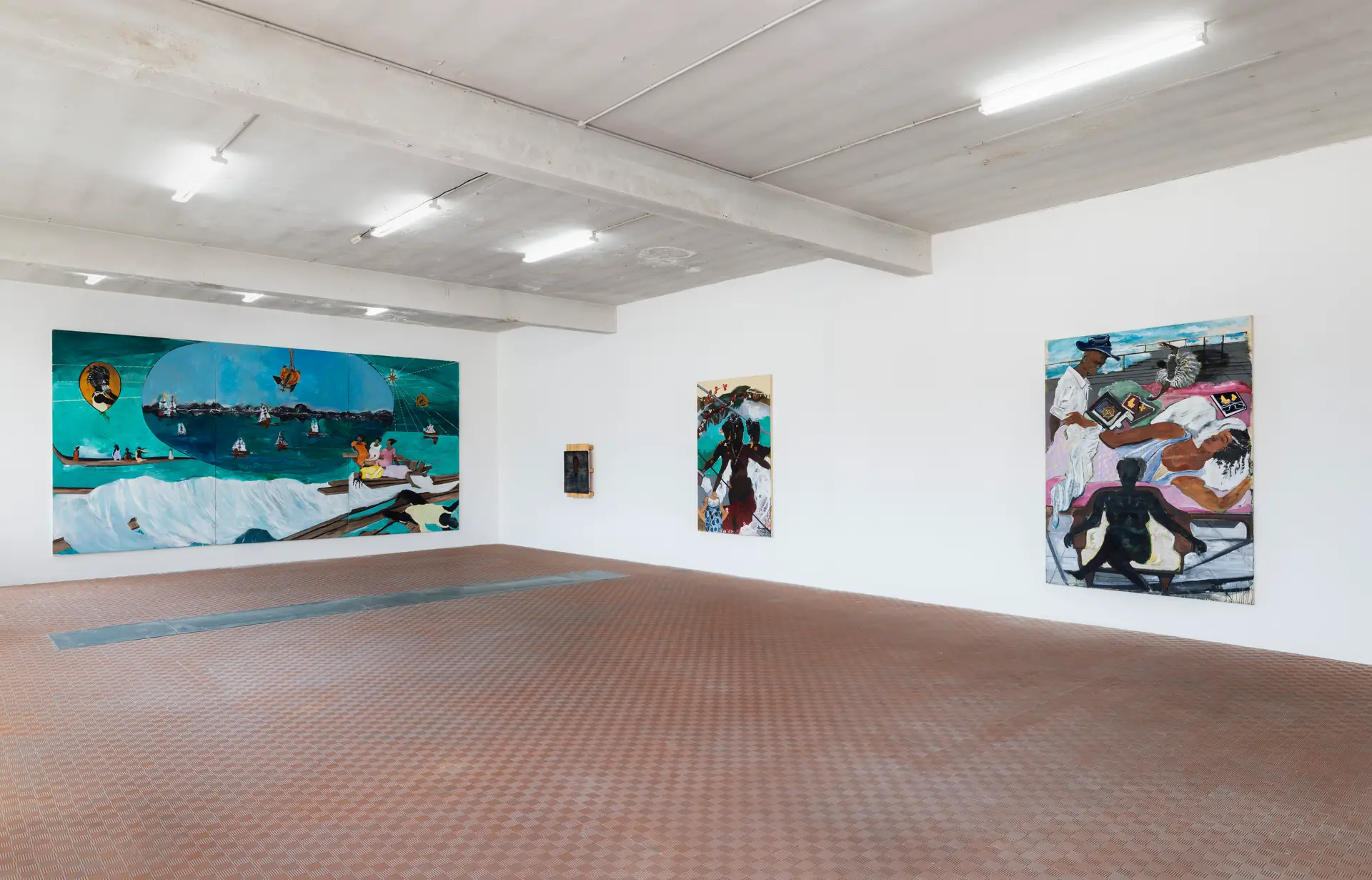
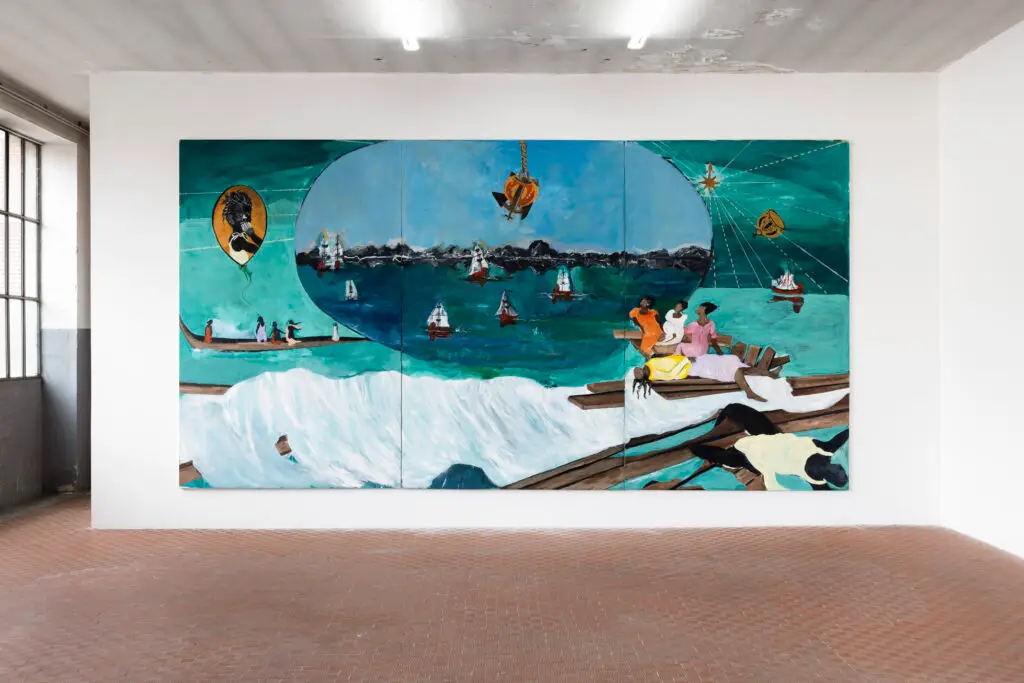
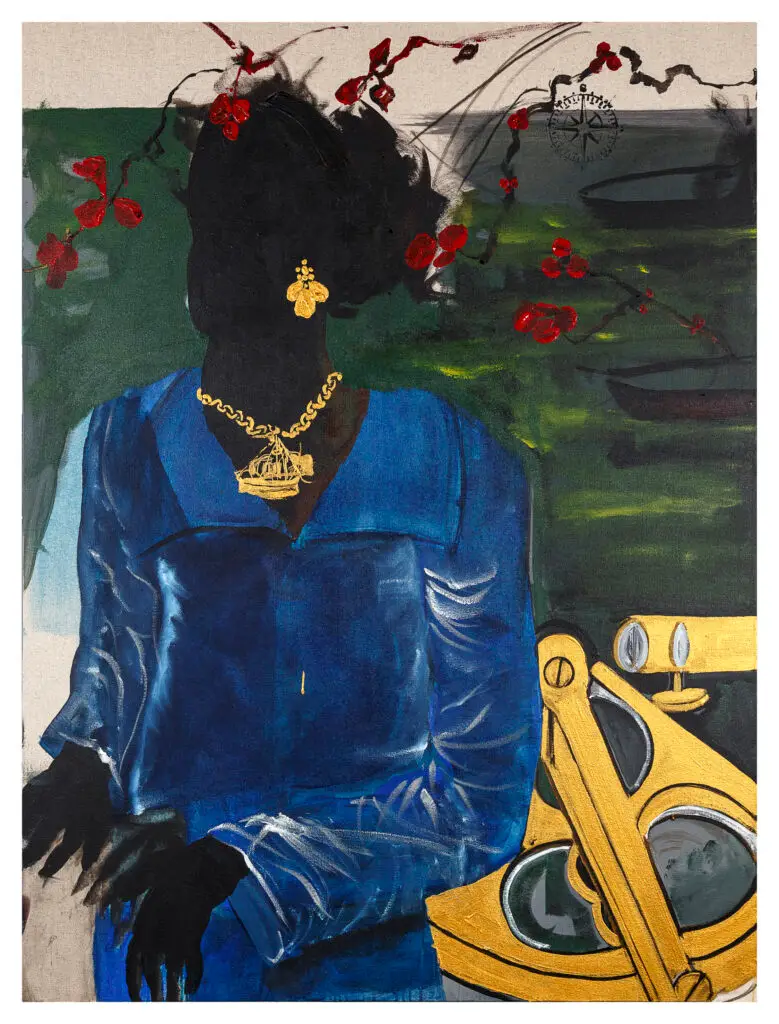
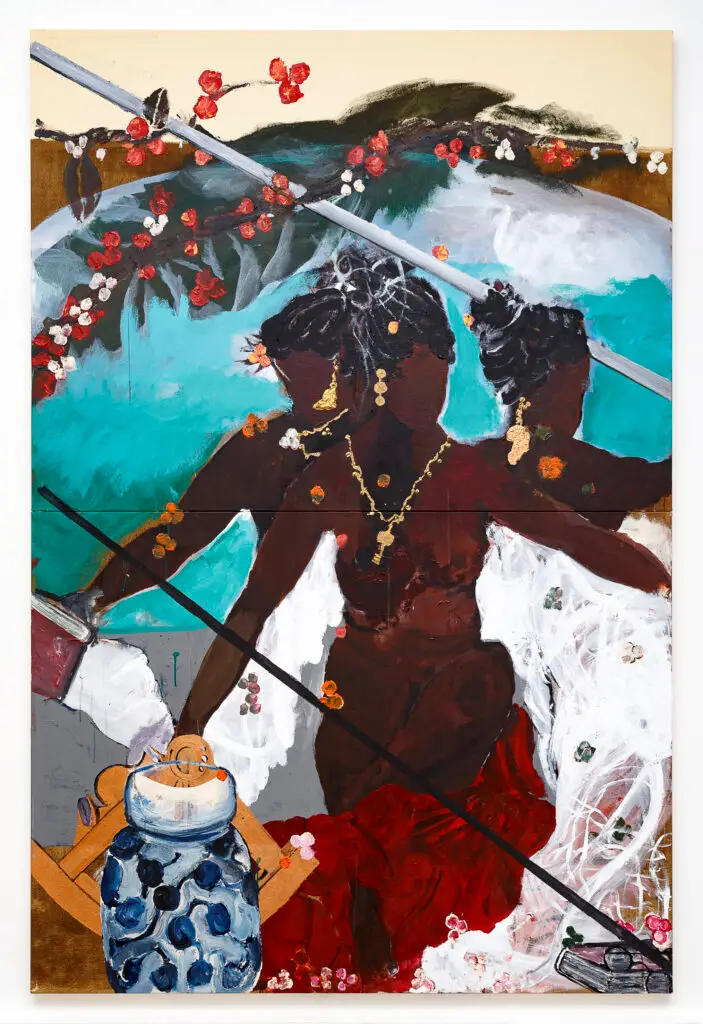
The works displayed revisit key elements of Martins’ visual vocabulary: boats, maps, navigational instruments, fragments of territory, and human figures. Yet nothing assumes a documentary function. Martins’ cartographies are unstable, crisscrossed by temporal and geographical shifts. Borders fade away, while the trajectories of bodies become more important than their destinations. Painting thus becomes a space where history can be rewritten, escaping the constraints of official narratives.
Particularly striking is the intensity of the colour palette. Deep reds, electric blues, incandescent yellows, and saturated greens create vibrant surfaces retaining tension and vitality. Figures emerge from these chromatic fields like apparitions, never fully defined, suspended between dream and testament. It is a form of painting that does not illustrate trauma but records its aftereffects, transforming collective memory into a sensory experience.
Beyond Representation
The strength of the exhibition lies in its ability to hold together painterly quality and political urgency. Martins does not use history as a mere iconographic repertoire, nor painting as a simple tool of denunciation. Instead, he constructs dense and layered images that interrogate the present through the lens of the past. At a historical moment in which migration is often reduced to statistics or emergencies, O Estrangeiro restores complexity to human journeys, reminding us that every crossing is also a story of loss and transformation. Faced with these images, the question remains: Who is truly the “foreigner”, the one who crosses the border, or the one who continues to regard it as impassable?
Arjan Martins, O Estrangeiro. 35º30’54” N, 12º34’48” E, Fondazione ICA Milano, June 11 – July 24, 2026. Curated by Alberto Salvadori
Translation by Luigina D’Introno
N. June 20, 2026
One of the leading figures of contemporary Brazilian art, Arjan Martins has spent the last two decades developing a distinctive and deeply political practice centred on the African diaspora and the legacies of colonialism. Born in Rio de Janeiro in 1960, he has exhibited at major international institutions including the Kunstmuseum Basel, the Museo Madre in Naples, and the Pérez Art Museum Miami, while also participating in the 34th São Paulo Biennial and the Dakar Biennale. His works are held in the collections of the Centre Pompidou, Instituto Inhotim, and the Pinacoteca do Estado de São Paulo, confirming a relevance that extends far beyond the Brazilian context. His relationship with Fondazione ICA Milano is not new: Martins previously took part in the institution’s inaugural exhibition The Historian’s Craft in 2019 and later contributed to a project developed for the Massimo De Carlo Virtual Space. This new solo exhibition, however, represents his first extensive presentation in Italy, offering an opportunity to engage with one of the most compelling painterly practices currently rethinking the relationship between history, memory, and identity
Alberto Salvadori is curator and director of Fondazione ICA Milano. Throughout his career, he has led institutions such as the Museo Marino Marini in Florence and curated numerous exhibitions devoted to both Italian and international artists. His curatorial approach is characterised by an interdisciplinary perspective that brings together visual arts, architecture, design, and cultural research. Since 2019, he has directed ICA Milano’s exhibition programme, contributing to the institution’s growing international profile. He has curated projects with some of the most significant figures in the global contemporary art scene.