By Alessia D’Introno
In this conversation with Ghanaian artist Jeffrey Otoo, the power of his work emerges through materials, unexpected relationships with nature, and instantly recognizable forms. Painting becomes an innovative medium of expression, shaped and continuously questioned to build new relationships with time and the surrounding elements of life. At the core of his research are recurring themes such as religion, the thin line between life and death, and the relationship with technology, all addressed through images of strong visual intensity. While rooted in painting, his practice also extends to sculpture and installation, where organic and industrial materials help shape an ever-evolving imaginary. Attentive to global iconography, Otoo is also an active figure in the Ghanaian art scene. Through his involvement with collectives like blaxTARLINES Kumasi and Asafo Black Collective, he develops a broad and conscious perspective on the contemporary art landscape. His work has already been featured in major international contexts, from the 15th edition of Documenta (Kassel, 2022) with blaxTARLINES Kumasi, to the 61st Venice Biennale (2026), and the group exhibition Fragments of a World After Its Own Image at Apalazzo Gallery in Brescia (2025). However, his research expands beyond the visual arts into the world of fashion. With him, we delved deeper into the themes, materials, and imagery that span his work.
When you work with themes such as life and death, religion or technology, do you start from personal experiences, social observations, or broader reflections?
I first start with a mix of all three but the entry point usually depends on what is moving me at the time. Usually with personal experience I look back at what I have lived through, conversations I had with people that have stuck with me long enough to inspire a piece. A moment of doubt, a picture I came across on the internet or random magazine page can spark a lot in my mind and just push me to the studio to create. Through social observation I notice how these themes also affect the lives of other people. With tech and religion especially, you see contradictions playing out publicly people doomscrolling and praying, using Ai to write prayers, posting funerals on Instagram. I try to create these contradictions in my work in a totally different way with the idea that several different things can exist at the same time. Reflecting on a much broader scale I look at everything in life.
Technology is often described as something new and future-oriented. In your paintings, however, it seems to become a way of engaging with memory, ancestors, and things that are not visible. Is that a reading you relate to?
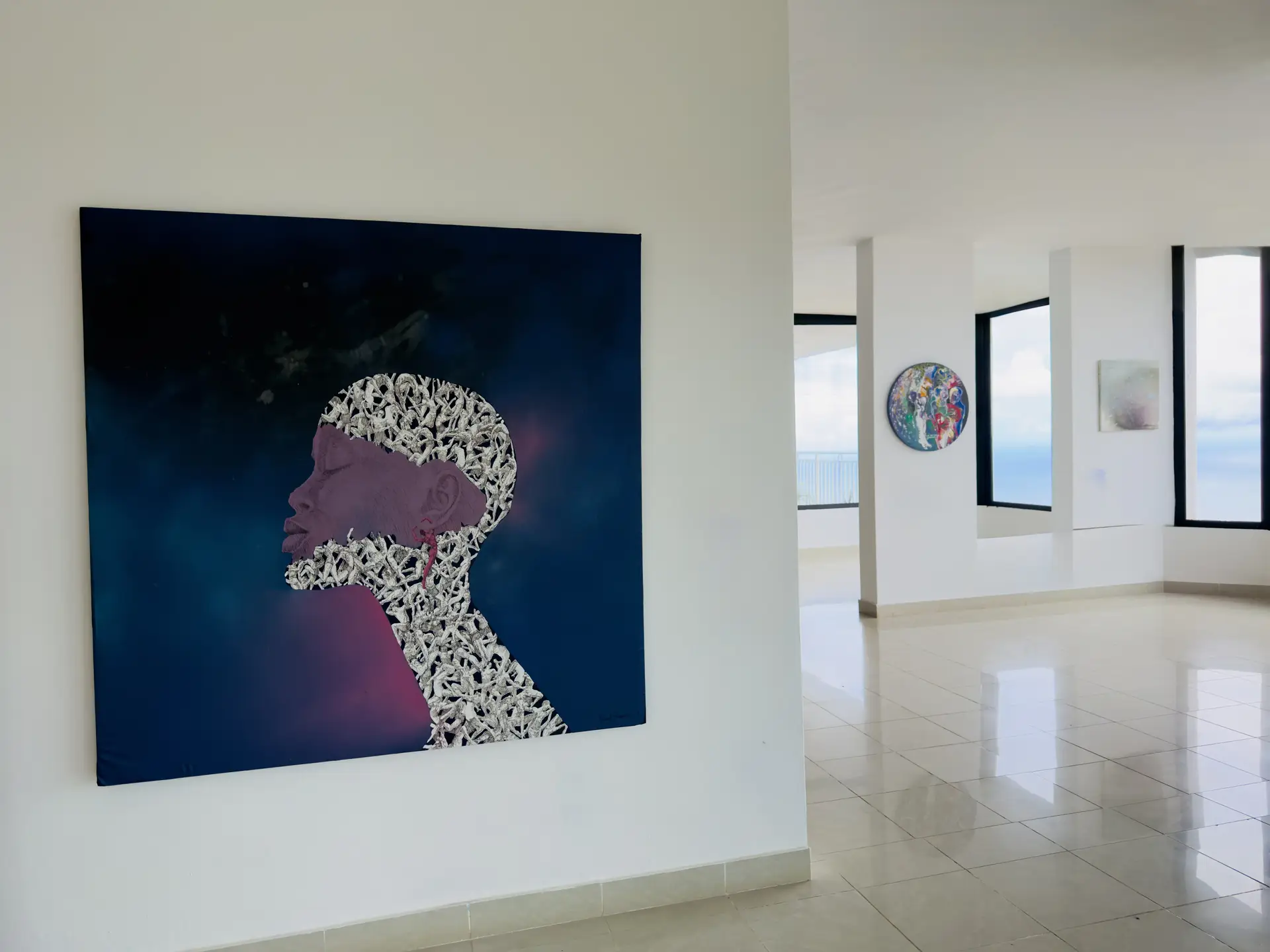
In my paintings, technology is used to communicate with the past, present and future because I see my work as a time capsule where characters in the painting exist in an infinite space moving through voids of time, memory, and space. I relate to the reading of my work in that regard. Technology in my work engages with forces, systems, and realities that are not always visible. It serves as a means of exploring the unseen, encouraging viewers to look beyond the surface and inwardly reflect in order to grasp the intangible aspects of human existence.
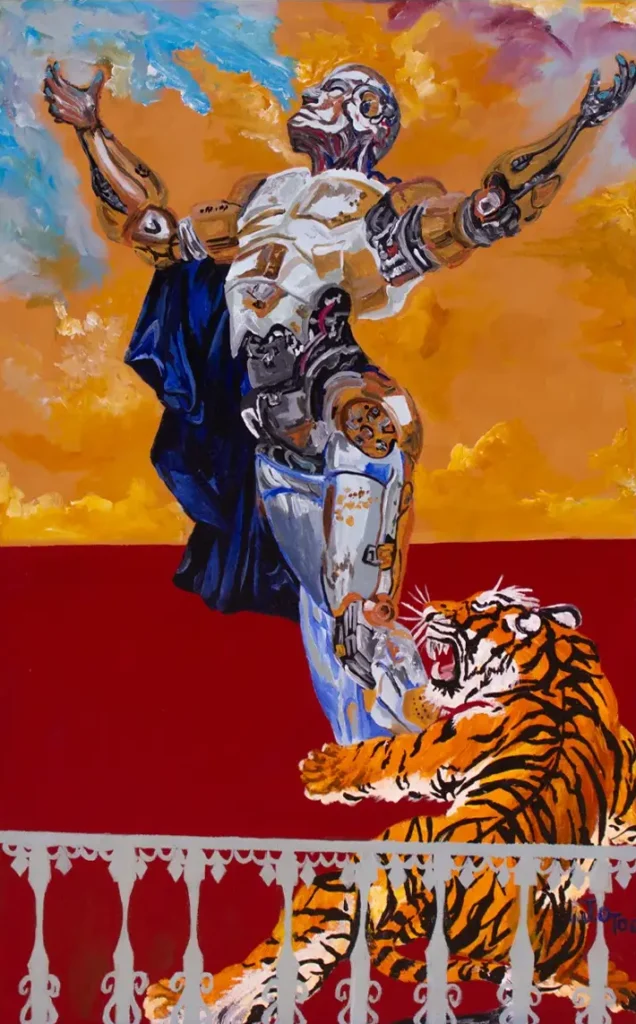
Looking at your work, I’ve often wondered how you choose your materials. I can see insects, leaves, gold dust, pieces of plastic or rubber, and then this recurring layer of resin. Where does this choice come from? Does each material carry a specific meaning, or does it change depending on the work?
Great question, spontaneity informs my choices when it comes to material usage. With the leaves, insects and pieces of plastic rubber I was thinking about the title of the group exhibition ‘Fragments of a world after its own image” at the Apalazzo gallery. I added these materials as pieces of fragments of the time and place when I was making the work. The inclusion of the insects emerged by chance when I placed the work outside my studio to hasten the drying of the resin. Drawn to the flowers represented in the painting, insects and flies became embedded in the resin’s surface. This unexpected collaboration with nature fascinated me and subsequently informed my decision to incorporate real leaves into the work, further blurring the boundaries between the natural world and artistic intervention. The plastic wrap became part of the work through an unexpected accident. I normally use it to protect my paintings from dust, but when I tried to remove it from the board, I found that heat had caused parts of it to stick permanently to the surface. Intrigued by the result, I decided to leave it as part of the composition. The resin adds a tactile quality, protecting the work while creating depth that pushes the painting into a sculptural dimension.
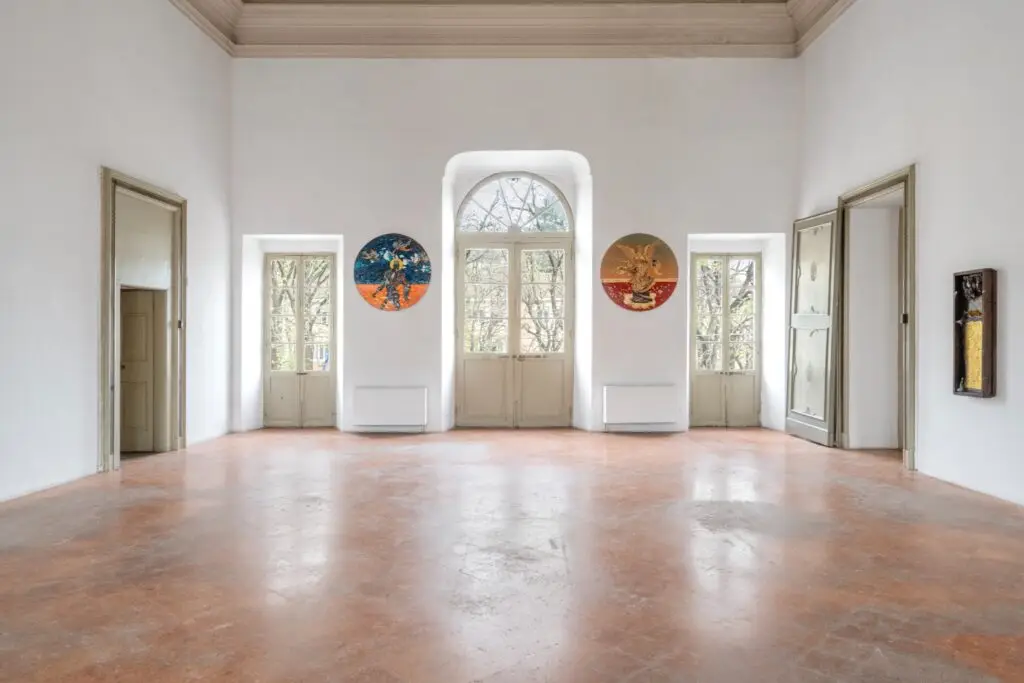
One form that seems to return often in your work is the medallion shape. I was wondering where it comes from. Is it an aesthetic choice, a symbolic one, or both?
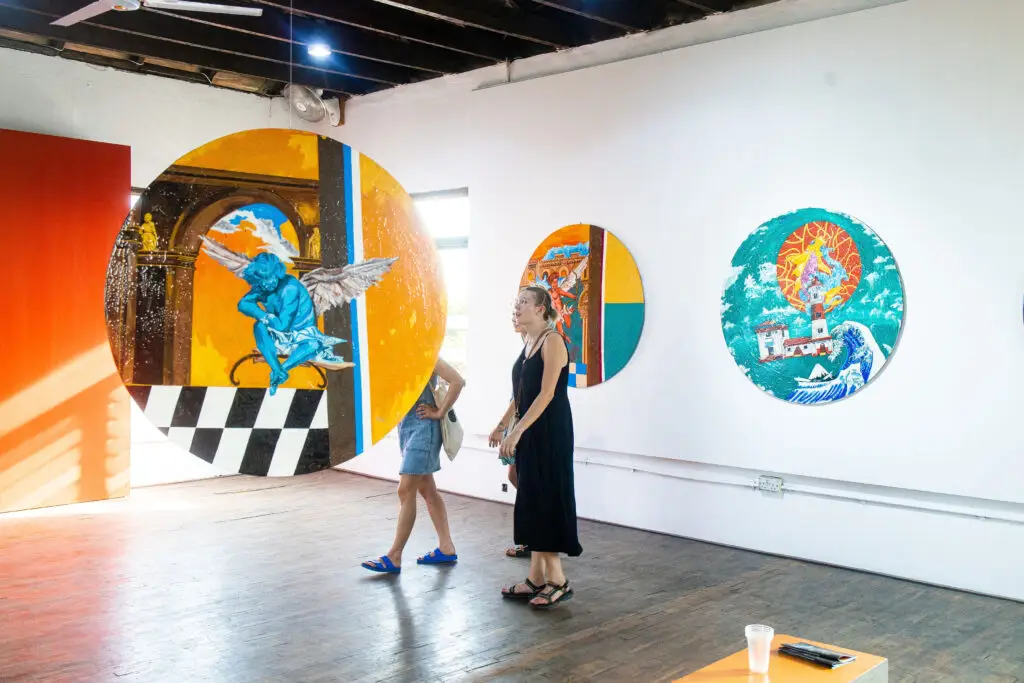
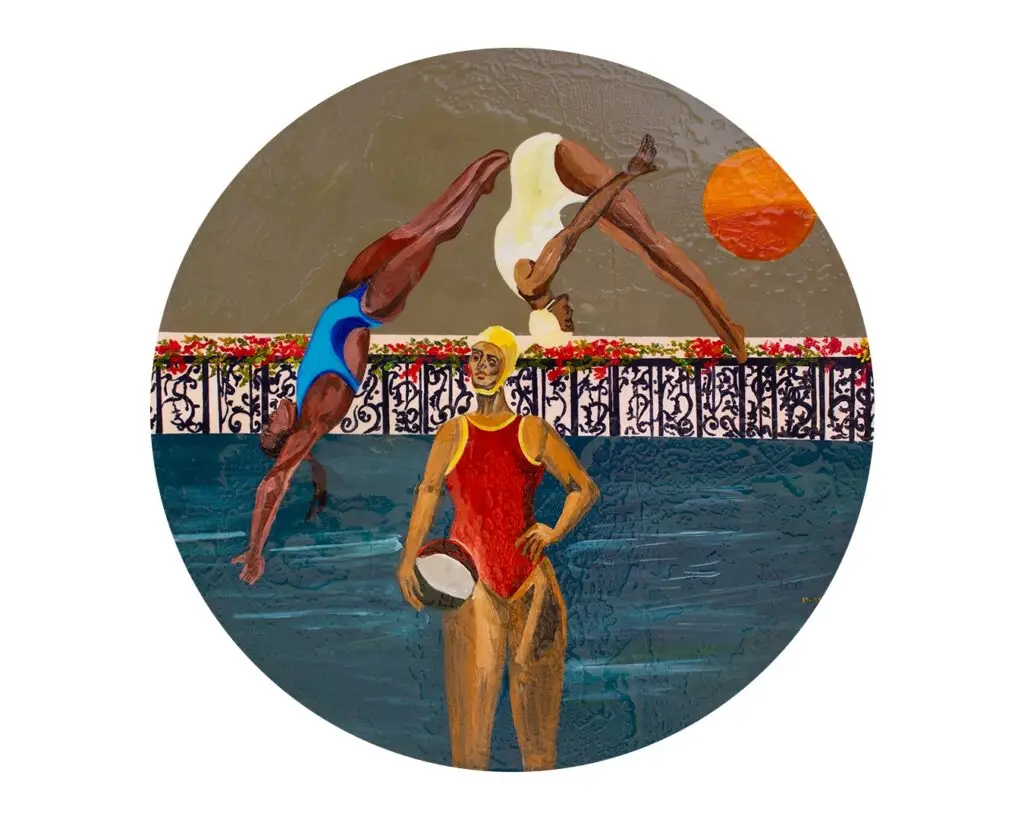
The circular forms in my work are inspired by planets in the cosmos, reflecting my view of each artwork as a distinct world. The pieces are installed using thin fishing lines, creating the impression that they are suspended in space like planets in orbit. These circular forms serve as a symbolic element that embodies the central themes and ethos of my practice.
You are part of Asafo Black Collective as well as blaxTARLINES Kumasi. What kind of space is AsafoBlack Collective for you? What are the main ideas or activities that bring the collective together?
Asafoblack will always feel like family. The main ideas that bring us together are guerilla-style art exhibitions that have the ability to happen anywhere at any time. Projects like the Asafoblack mobile library, art parties and deep art conversations.
What are you working on at the moment? Are there any new works, projects, or upcoming exhibitions you can tell us about?
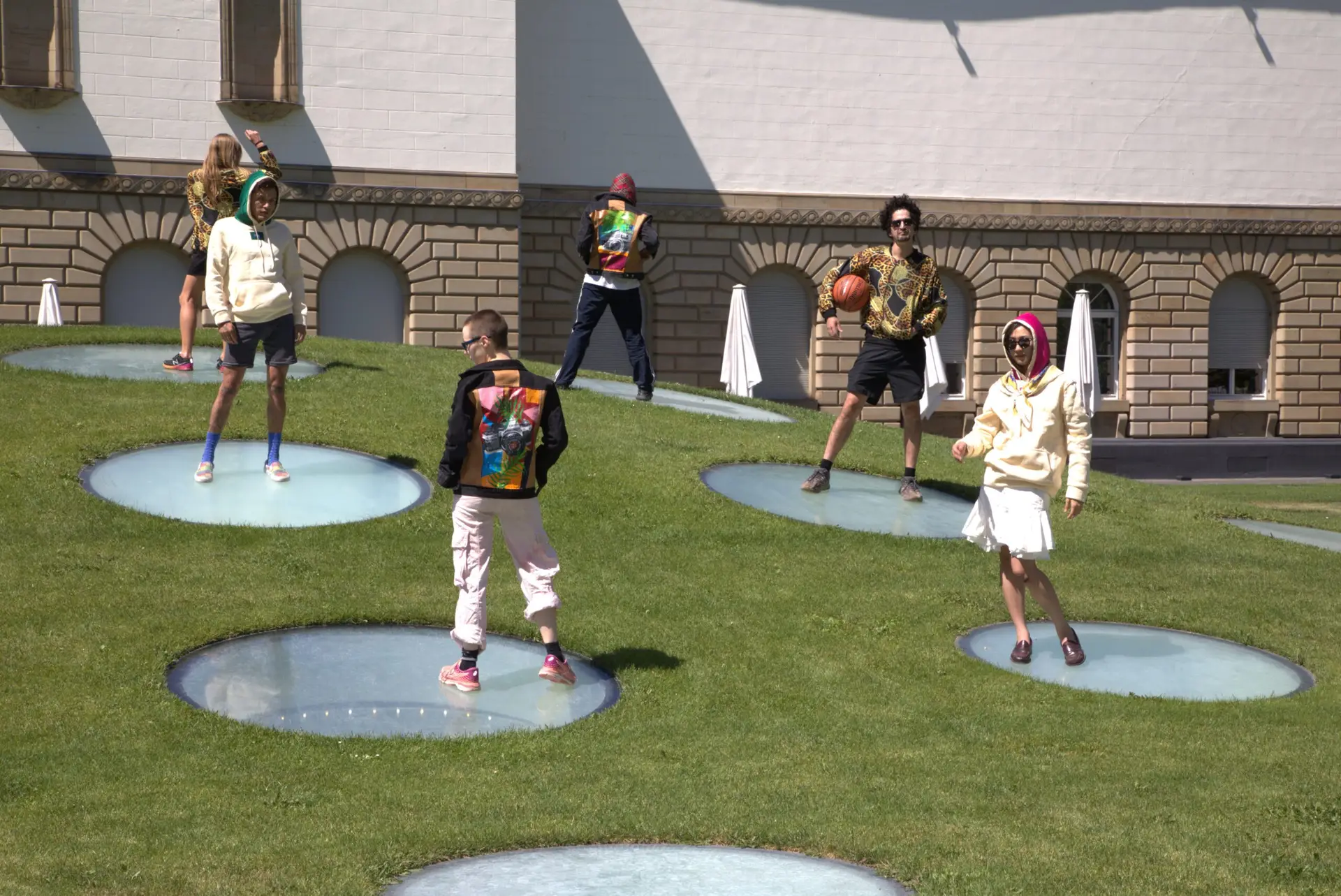
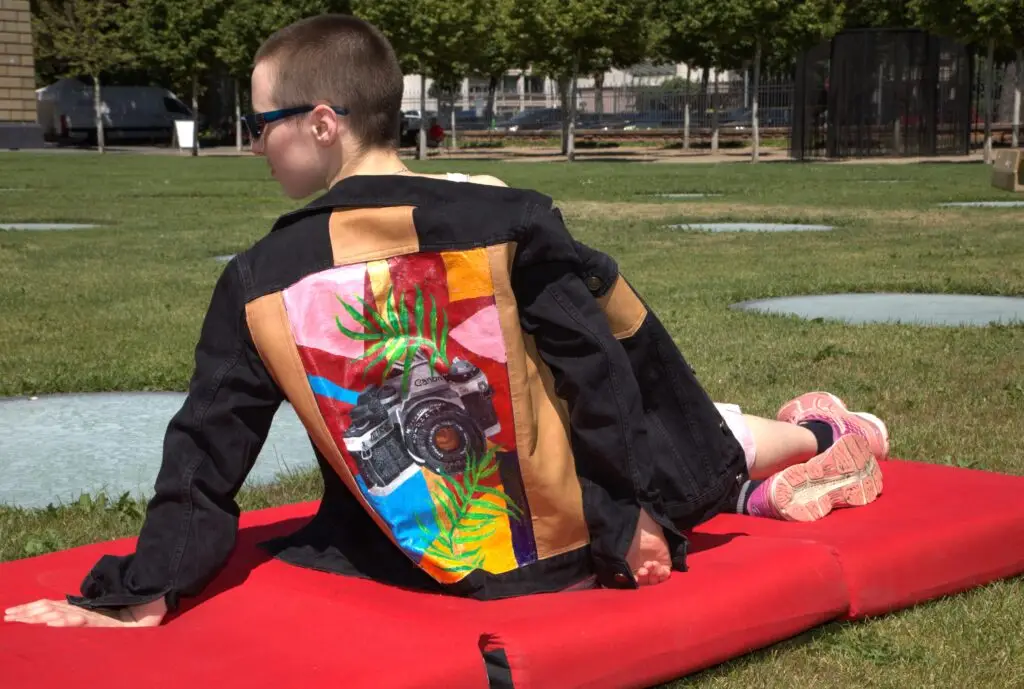
I am currently working on several projects, including Gustavo Luxury, my fashion brand, which serves as an extension of my art practice and which I am developing for a broader international audience. I am also creating a new body of paintings that explores fresh subject matter, some of which I am excited to share. Beyond my studio practice, I am focused on building connections with fellow artists, curators, and cultural practitioners. With upcoming solo exhibitions in Europe and museum projects scheduled for this year and next, I look forward to collaborating with new curators and gallerists, as I believe meaningful partnerships are essential for artistic growth and development.
Jeffrey Otoo (b. 1994, Accra, Ghana) is a multidisciplinary artist who lives and works in Ghana. His practice explores the intersection of humanity, power, and technology by bringing together ideas and visual languages from diverse cultures to construct new narratives. Working across painting, sculpture, installation, fashion, and disc jockeying, Otoo’s work reflects a deep engagement with contemporary global society and its shifting identities.
Otoo has executed fashion campaigns in Paris (France) and Frankfurt (Germany) under his brand Gustavo Luxury, and has performed as a DJ at the Gasthof event in Frankfurt, Germany. He also served as a judge at the KFC art prize and a panelist at the Nkabom art festival.
He has participated in major international exhibitions including 2026 In Minor Keys 61 st La biennale di Venezia Venice Italy (as part of blaxTARLINES KUMASI collective) Documenta 15 (Kassel, Germany, 2022 as part of blaxTARLINES KUMASI collective), Stellenbosch Triennale (South Africa, 2020), ARX Africa at Kunst Museum (Germany), and Baitball (Italy, 2019). Otoo has delivered artist talks and lectures at the Kwame Nkrumah University of Science and Technology (KNUST) and the Foundation for Contemporary Art (FCA). He is also an active member of the Blaxtarlines Collective.

Alessia D’Introno is Editor-in-Chief of the African contemporary art magazine Equator Echoes, registered in the Special List of the Lombardy Journalists’ Association. She holds a Master’s degree in Visual Arts and Curatorial Studies from NABA, Milan, and has completed a postgraduate course in Demoethnoanthropological Heritage at the University of Milano-Bicocca. She has published articles in Juliet Art Magazine and ArtsLife. Her critical and curatorial research focuses on the deconstruction of classical art history and the decolonization of the contemporary European art system.
N. July 4, 2026