By Barnabas Muvhuti and Lifang Zhang
Since its debut in 2011, Zimbabwe’s presence at the Venice Biennale has evolved from a quest for visibility into a sophisticated exercise in positioning. While several African nations continue to grapple with the logistical and political fragilities of national representation, Zimbabwe has maintained a remarkable eight-edition streak, driven by the institutional commitment of the National Gallery of Zimbabwe (NGZ) and the support of the Ministry of Sport, Recreation, Arts and Culture.
For the second time in its history, this year’s Biennale has an African artistic director in Koyo Kouoh, albeit posthumously, following the late Okwui Enwezor in 2015. In a lateral conversation with Kouoh’s overarching framework “In Minor Keys”, the Zimbabwean pavilion anchors macro-histories in micro-materialities and presents Second Nature | Manyonga. To explore the nuances of this year’s theme and the shifting impact of Zimbabwe’s participation over the last decade, researchers Barnabas Ticha Muvhuti and Lifang Zhang caught up with Fadzai Veronica Muchemwa, the curator of the Zimbabwean Pavilion and the Curator of Contemporary Art at the National Gallery of Zimbabwe. In this conversation, Muchemwa unpacks this edition of the national pavilion and hints at the materiality of histories, the politics of visibility, and the challenges of navigating the “Olympics of Art” from a critical position.
First of all, congratulations on curating this edition of the Zimbabwe Pavilion. The exhibition is titled “Second Nature | Manyonga” and features five distinct artists. Could you introduce us to the conceptual core of this theme and tell us what drew you to this specific group of artists for this year’s presentation?
The title emerged from a sustained preoccupation with how conditions; historical, ecological, political, become internalised to the point of appearing inevitable. Second Nature gestures toward the sedimentation of structures: how violence, adaptation, and survival become embodied, rehearsed, even banal. Manyonga, evoking bones, fragments, or the residual architecture of what remains, introduces a counterpoint, insisting on material traces, on what refuses to disappear. Together, the title frames the pavilion as a space of tension between what is inherited and what is constructed, what persists and what erodes.
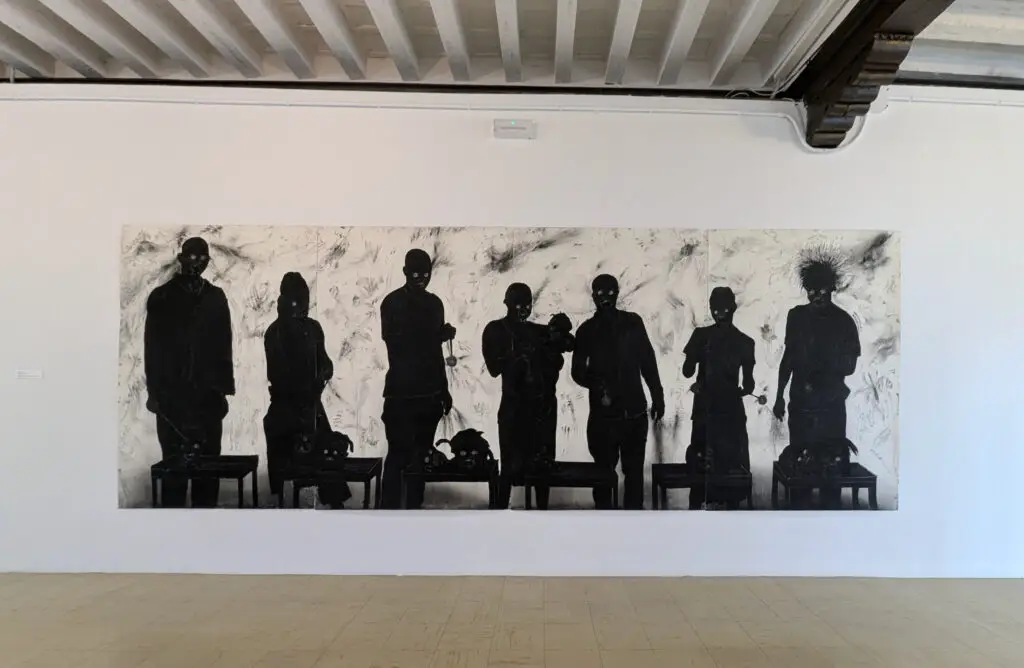
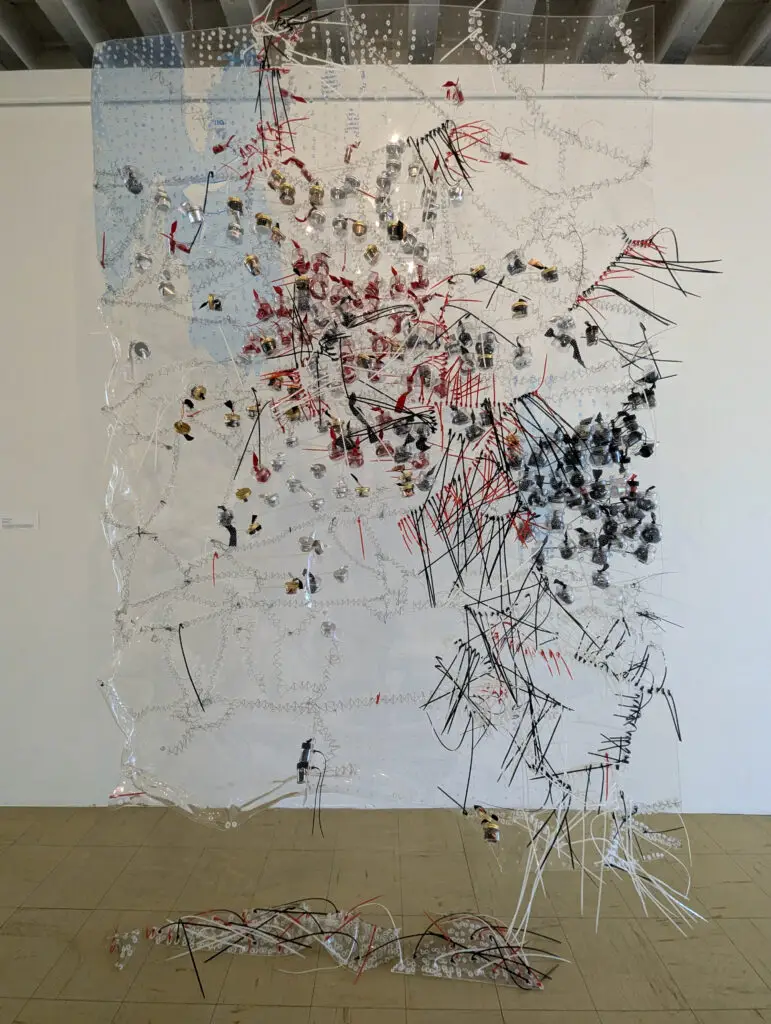
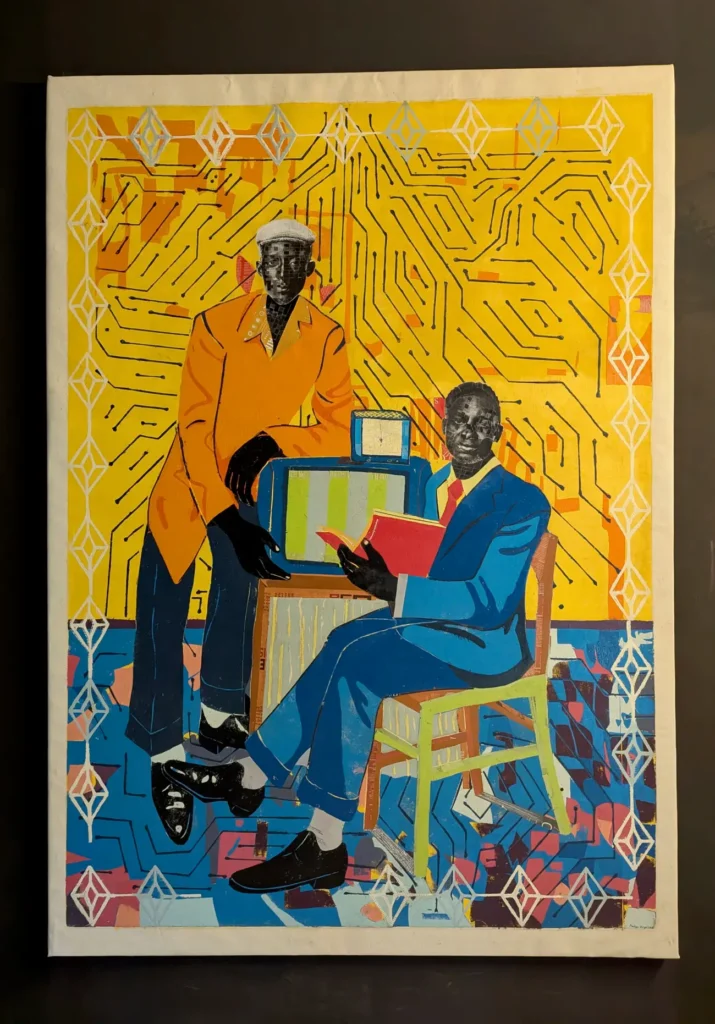
The pavilion brings together Eva Raath, Felix Shumba, Franklyn Dzingai, Gideon Gomo, and Pardon Mapondera. What drew me to these artists is not a shared aesthetic, but a shared insistence on material as a site of thinking, material that carries pressure, memory, and contradiction. The featured artists each approach this tension from distinct positions; working across installation, painting, sculpture, and textile, but are united by a shared attentiveness to material as a carrier of memory and transformation. Their practices are not illustrative of a single narrative; rather, they operate as propositions that trouble stable readings of place, body, and history. There is a strong emphasis on process, on making as a form of thinking through entanglement.
Eva Raath’s practice engages states of suspension and instability, often through forms that appear provisional, as though they could collapse or reconfigure at any moment. Felix Shumba’s work, with its dense painterly surfaces, navigates the psychological and social textures of contemporary life, where figuration becomes a site of both recognition and distortion. Franklyn Dzingai approaches the body as a contested terrain, where representation is never neutral but always entangled in histories of looking and being seen. Gideon Gomo’s sculptural language is attentive to process and transformation, allowing materials to retain a sense of their own agency. Pardon Mapondera works with found and discarded materials, assembling structures that speak to accumulation, precarity, and the afterlives of consumption. Their practices do not cohere into a single narrative of Zimbabweanness, and this is important. They produce a field of tension in which questions of inheritance, adaptation, and residue can be encountered from multiple, sometimes conflicting, positions.
Moving from the internal logic of the pavilion to its place within the wider Biennale, how did you approach the dialogue between your exhibition and Koyo Kouoh’s overarching framework, ‘In Minor Keys’? Were you looking for a particular resonance or perhaps a point of departure from her central premise?
Koyo Kouoh’s curatorial framework opens a space for thinking about presence and persistence beyond fixed categories, there is a refusal of closure that I find both politically and intellectually generative. What interested me was not to respond in a way that mirrors or illustrates her premise, but to enter into a kind of lateral conversation with it. If her approach operates at the level of broader epistemic and historical structures, Second Nature | Manyonga attempts to track how those structures become lived, how they are absorbed into the body, into gesture, into material practice. I am interested in what happens when the macro collapses into the micro, when large-scale histories become intimate, almost imperceptible conditions. In this sense, the pavilion does not attempt to mirror or illustrate the central exhibition, but to resonate with it obliquely, offering a set of works that complicate and localise its concerns. There is a shared interest in the instability of categories, but our approach is perhaps more materially grounded, attentive to the textures of making and the ways in which histories are held within objects and bodies. There is also, for me, an underlying question of refusal. Refusal to stabilise meaning, refusal to resolve contradiction too quickly. In that sense, the pavilion aligns with Kouoh’s framework through a shared commitment to complexity and opacity.
The featured artists work across an incredibly diverse range of media, from sculpture and painting to textiles and installation. In your curatorial process, how did you manage these different languages, mediums and materials, to create a cohesive experience while still respecting each artist’s practice?
I tend to resist the idea of ‘managing’ difference; it suggests that diversity is a problem to be solved. For me, the task was to identify a set of conceptual and material urgencies that could sustain proximity without collapsing into sameness. From the outset, I was not interested in assembling a pavilion around medium, generation, or a singular aesthetic. I was attentive to how each artist engages with processes of translation, between states, between materials, between histories. There is a shared sensitivity to transformation: how something becomes something else, and what is lost or retained in that shift. What connects these artists is an attentiveness to transformation: how materials shift, how meanings are produced and destabilised, how forms carry histories that exceed their immediate appearance. There is also a shared sensitivity to precarity, not as a socio-economic condition, but as an ontological one. Things are not fixed; they are always in the process of becoming something else. The diversity of media is therefore not a challenge to be resolved, but a condition that allows these questions to unfold across multiple registers. Installation might hold space differently from painting; sculpture might insist on weight and tactility in ways that textile cannot. Curatorially this becomes a matter of choreography and thinking spatially about how works speak to, interrupt, or echo one another. On a personal level, it also required a degree of letting go, allowing the artists’ practices to lead, rather than imposing a rigid framework that would flatten their differences. It is also about trust. Trusting the artists to hold their own conceptual ground, and trusting that the frictions between works will be productive rather than reductive. How do works inhabit space in relation to one another? How do they create intervals, frictions, moments of resonance or dissonance? The exhibition is less about harmony and more about holding these tensions open.
This brings us to the broader nature of your role this year. Curating a national pavilion is a very specific kind of institutional undertaking. Based on your experience, what do you find most particular—or perhaps most challenging—about the mandate of representing a nation within the historical and political structure of the Venice Biennale?
Curating a national pavilion in Venice is a very particular kind of negotiation. The national pavilion is, in many ways, an inherited structure, one that carries the logic of the nation-state into the exhibitionary form. This is both its condition of possibility and its limitation. On one hand, there is the weight of representation, the expectation that the pavilion will somehow stand in for a nation, its culture, its politics. On the other hand, there is the reality that contemporary artistic practice often resists precisely this kind of containment. To curate within this framework is to engage a paradox: you are positioned as representing a nation, while working with practices that often resist representation in any straightforward sense. The risk is that the work becomes instrumentalised and read primarily through the lens of identity or geopolitics, rather than on its own terms. The challenge, then, is to work within and against the frame simultaneously. To acknowledge the pavilion as a national platform, because it is one, while refusing to reduce the artists’ practices to illustrative or representative functions. There are also very practical particularities: the intensity of the Venice context, the temporal compression of the exhibition, the diversity of audiences, and the heightened visibility that can both enable and distort reception. What becomes crucial is maintaining conceptual integrity amidst these pressures, ensuring that the work does not become overdetermined by the context in which it is shown. At the same time, one cannot ignore the political stakes of that framing. For countries like Zimbabwe, the pavilion is also a site of assertion, a way of entering a global conversation from which many have historically been excluded. My approach has been to hold that tension rather than resolve it. To neither fully embrace nor fully reject the representational mandate, but to work within its contradictions. This means allowing the pavilion to be legible as Zimbabwean in some ways, while also exceeding and complicating that category.
Looking back, Zimbabwe has maintained a remarkably consistent presence in Venice since its debut in 2011. After more than a decade of participation, how do you see the dynamics of this involvement evolving? In your view, has the ‘politics of visibility’ or the meaning of participation shifted for Zimbabwean artists over that time?
The establishment of the Zimbabwe Pavilion in 2011 marked a significant shift in terms of visibility and access. It created a sustained platform through which Zimbabwean artists could enter into a global conversation that has historically been uneven in its inclusions. The 2011 debut was, undeniably, about entry, about visibility within a system that had largely excluded Zimbabwean artists. That moment carried a certain urgency: to be present, to be counted. Over time, however, the dynamics have shifted. Visibility is no longer the only question; it is the terms of that visibility that matter. Who is looking? Through what frameworks? And what is being made legible or illegible in the process? Now, the question is less about entry and more about positioning: how Zimbabwean artists engage critically with the structures of the biennale itself, and how they negotiate the expectations placed upon them. There is also a growing awareness of the politics of visibility, that visibility is not neutral. It can open opportunities, but it can also impose frames that simplify or exoticise. The challenge is to inhabit visibility without being fully captured by it. In this sense, the pavilion becomes a site of negotiation, where questions of authorship, context, and reception are continually in play. There is a persistent risk that African pavilions are read through reductive lenses, either as sites of crisis or as repositories of authenticity. Navigating this requires a careful balancing act: engaging the global platform without being subsumed by its expectations. For me, the impact of Zimbabwe’s continued participation lies not only in exposure, but in the ability to intervene in these frameworks, to produce work that complicates, unsettles, and resists easy consumption.
Finally, considering the global ‘biennial boom’ and the shift toward more decentralized art landscapes, how do you perceive the current significance of Venice? For Zimbabwean artists, does it remain a definitive center of gravity, or has its role evolved into something else within the broader network of contemporary art?
The proliferation of biennales globally has undoubtedly expanded opportunities for artists to show their work across different contexts. It has also diversified the geographies of contemporary art discourse, which is a positive shift. However, Venice still occupies a particular symbolic position. It carries a historical weight and a certain visibility that is difficult to replicate. For Zimbabwean artists, participation in Venice can still serve as a significant platform of amplification, opening doors to further exhibitions, collaborations, and institutional engagement. At the same time, the growing biennale landscape allows for a more distributed form of visibility. It means that Venice is no longer the sole or even the primary site through which artists must pass to be recognised. What interests me is how artists move between these contexts, how they adapt, resist, or reframe their practices depending on where they are situated. In that sense, Venice becomes one node within a larger network, rather than the definitive centre. The expansion of biennales has created a more dispersed and, in some ways, more equitable landscape for contemporary art. It allows for multiple centres of discourse, rather than a single dominant axis. However, Venice retains a particular symbolic and historical weight. It is still a site where visibility is intensified, where attention is concentrated in ways that can be both enabling and distorting. For Zimbabwean artists, this means Venice operates as both an opportunity and a pressure point. It can amplify practices, but it can also fix them within certain narratives. What interests me is how artists move across these different biennial contexts, how they adapt, resist, or strategically engage with each one. In this sense, Venice becomes one node within a broader network, rather than the ultimate destination. At a more critical level, I think we also need to ask what it means that the biennale form continues to proliferate. What kinds of cultural economies does it sustain? What kinds of labour does it rely on? And who ultimately benefits from its expansion?
*Barnabas Muvhuti is Nancy and Robert J. Carney Postdoctoral Associate in the Department of Art History at Rice University, Houston Texas. He is a member of the Rice University Academy of Fellows.
*Lifang Zhang is currently a research fellow at Tsinghua Institute for Advanced Study in Humanities and Social Sciences (TIAS), Beijing.
– Both focus their research on contemporary African art.
Fadzai Veronica Muchemwa is a curator, researcher, and writer based in Harare, Zimbabwe, where she serves as Curator of Contemporary Art at the National Gallery of Zimbabwe. Her practice moves fluidly across contemporary art, sound, and archival work, rooted in decolonial methodologies, ecological justice, and Pan-African cultural exchange. She has recently curated projects such as They Still Owe Him a Boat, The Oxymoronic Tea Party and Nyami Nyami: Ancestral Frequencies, which explore ritual, resistance, and the politics of memory. Her writing traces the intimate intersections of art, activism, and social transformation, often centering small acts of care and solidarity as radical gestures of survival. Fadzai’s research spans food and seed sovereignty, embodied dissent, and the politics of exclusion, asking how art can disrupt dominant narratives and open space for alternative ways of being. Through both curatorial and scholarly work, she treats art as a method of repair, a site of relation, and a tool for imagining otherwise. She is a founding member of Practice Theory Collective, a fellow of the British Museum ITP program, and a collaborator of Independent Curators International.
Second Nature | Manyonga – Pavilion of Zimbabwe (Republic of)
61st International Art Exhibition – La Biennale di Venezia
Curated by Fadzai Veronica Muchemwa
09/05/2026 – 30/09/2026
Santa Maria della Pietà, Venezia
N. June 20, 2026