By Rashida James-Saadiya
Can a word keep its wisdom if we are no longer attentive to what it asks of us?
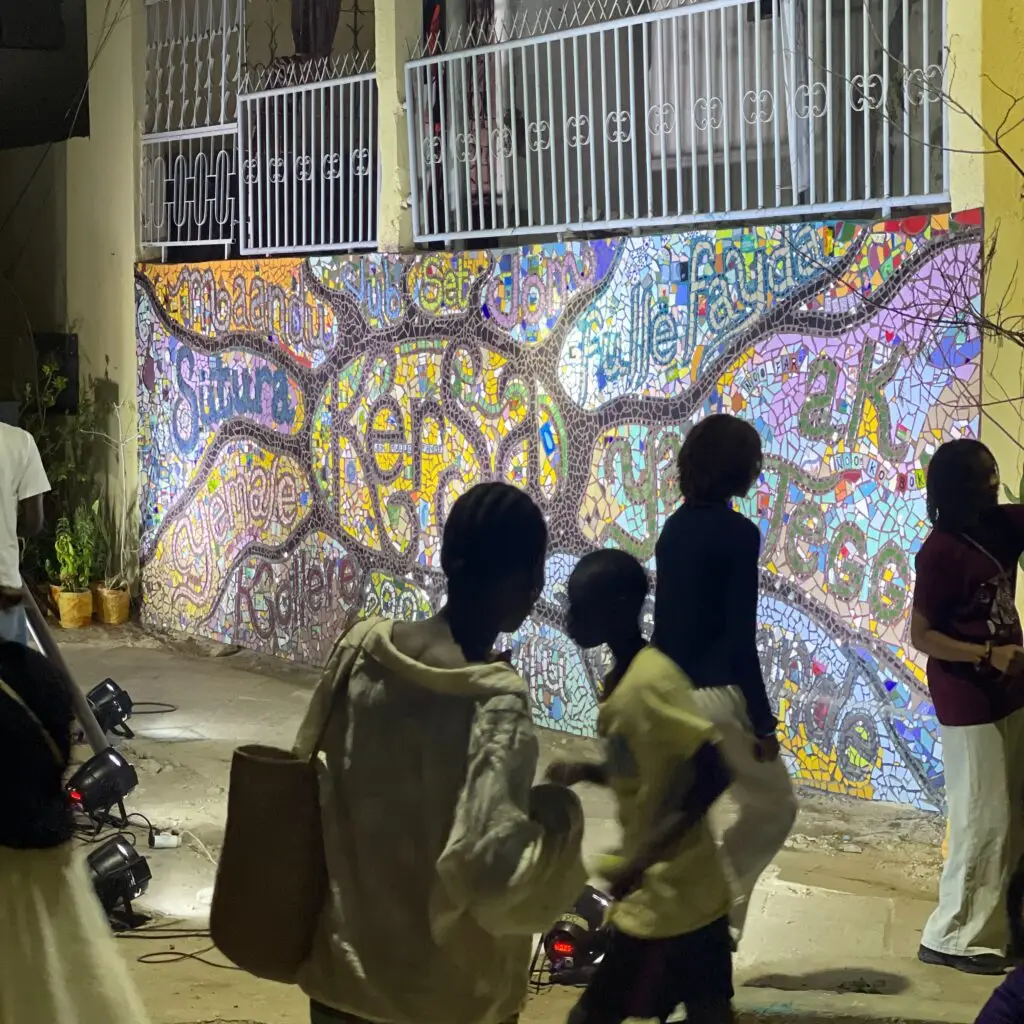
Amid the exhibitions, installations, and creative workshops of the 16th edition of the Dakar Biennale, multidisciplinary artist Muhsana Ali brings this question into the fabric of everyday life. Beyond the walls of museums and galleries, her mosaic mural transforms the facade of a residential building in Dakar’s Mermoz neighborhood. At its center is a single Wolof word: kersa.
Language holds the architecture of how we have learned to be human. It preserves what we have forgotten, protects what we hold sacred, and conceals what is slowly slipping away. A single word can carry generations of knowledge: how to honor our elders, protect the land that sustains us, and extend care beyond ties of kinship.
Yet the ways of living held within language are as vulnerable to change as the societies that give them meaning. Migration, economic pressures, and shifting social and cultural aspirations reshape not only the worlds we inhabit but the foundations on which we imagine belonging and build community. Far too often, we hold on to words without noticing that the practices that once gave them life have begun to fade.
The relationship between cultural memory and lived practice is central to Ali’s work. Born in Philadelphia, she has made Senegal her home for more than two decades. Her artistic practice draws on spirituality, African and diasporic histories, ecological consciousness, and the intimate rhythms of daily life. Through her alternative mosaics, created in collaboration with local communities, she reimagines public space as a canvas for shared histories, experiences, and aspirations to take visible form.
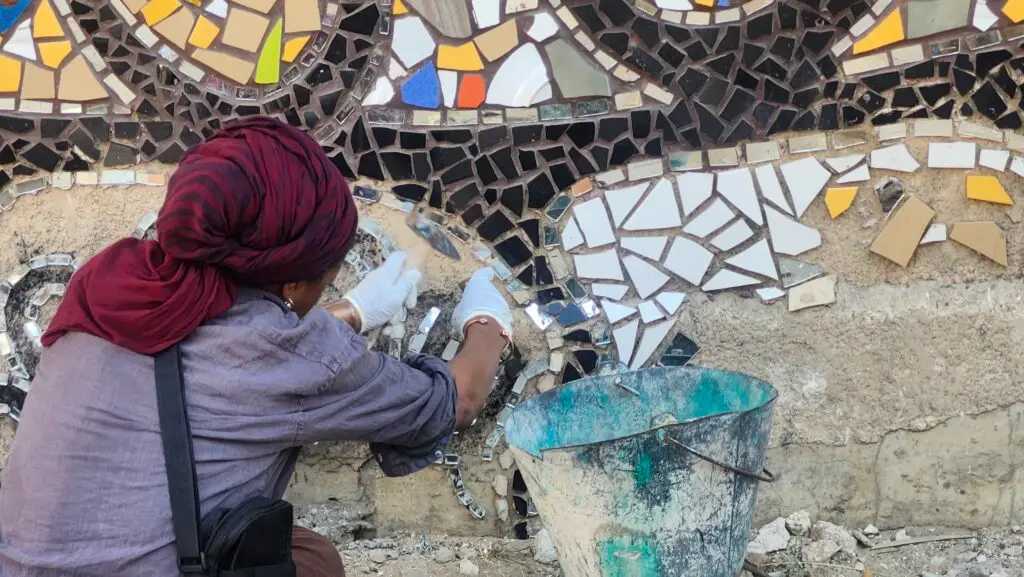
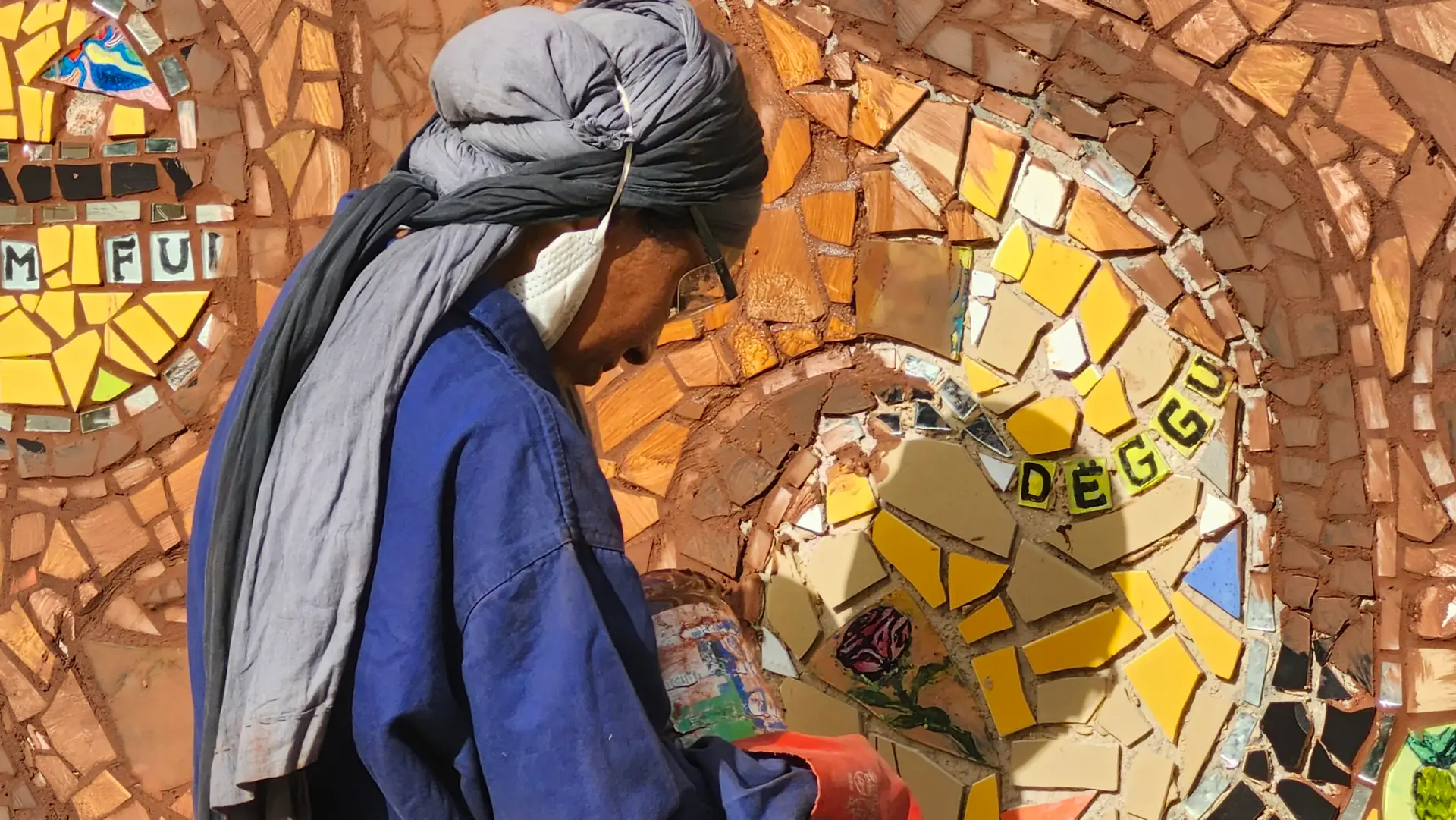
Rather than adhering to traditional conventions of the medium, she embraces the irregularities of her materials and the histories they carry. Broken ceramics, mirrors, metal, painted glass, and discarded objects find new expression alongside words, poems, and names. By inviting communities into the making, she turns ordinary corners of public life into places where neighbors meet, remember, and decide what they value.
Often translated as decency, modesty, restraint, or respect, kersa resists any single definition. To say that someone lacks kersa, Ali notes, is an insult. “You cannot go without kersa. It helps you comport yourself in society.” It is a social ethic grounded in attentiveness to our own dignity and that of others, an awareness of how our actions shape the lives around us. Its wisdom is revealed less in what we say than in what we choose to do and what we refrain from doing. Kersa lives in small acts of consideration, repeated until they become a way of life.
The mural grew out of her concern for the gradual erosion of the social and ethical values that have long shaped Senegalese life and sustained its communal ecosystems. “If people don’t know the words, they won’t put them into practice,” she explains. “So I decided to put kersa on the wall. It’s a reminder.”
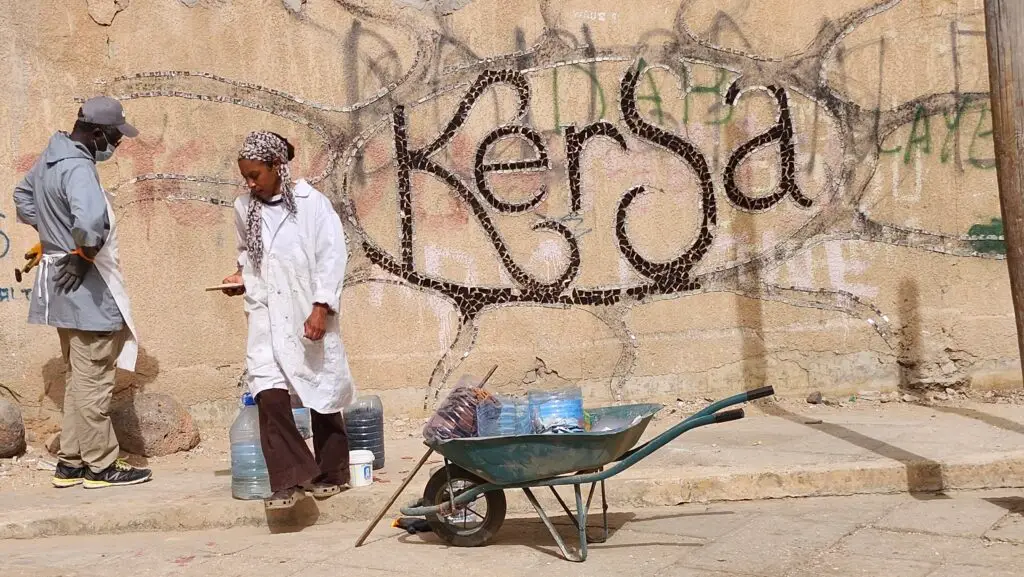
Her concerns emerge against the backdrop of a changing Dakar, where rising housing costs, limited economic opportunities, and competing demands for land place increasing pressure on the conditions that sustain communal life. Here, she chose to transform the lower facade of a residential building that had fallen into disrepair. Its deteriorating appearance had become a source of concern for neighbors, who were troubled not only by what it reflected about their neighborhood but also by the living conditions of those inside. By bringing color and attention to a site of neglect, the mural raises a larger question about whose surroundings are deemed worthy of investment, beauty, and care. Facing a communal court where young people gather to play football and basketball, it brings the ethic of kersa into the shared spaces where belonging is negotiated.
Against the pale yellow exterior of the building, fragments of turquoise, amber, violet, green, and terracotta come together in an intricate mosaic. Surrounding kersa is a constellation of Wolof words that give language to the responsibilities of living together. Sutura calls for discretion and the protection of another’s dignity, while kollere reminds us to honor the bonds we share through gratitude, acknowledgment, and fidelity. These relational values sit alongside jom, which speaks to dignity, courage, and moral resolve, an yemale, which extends the mural’s ethical vision to questions of justice and equality.
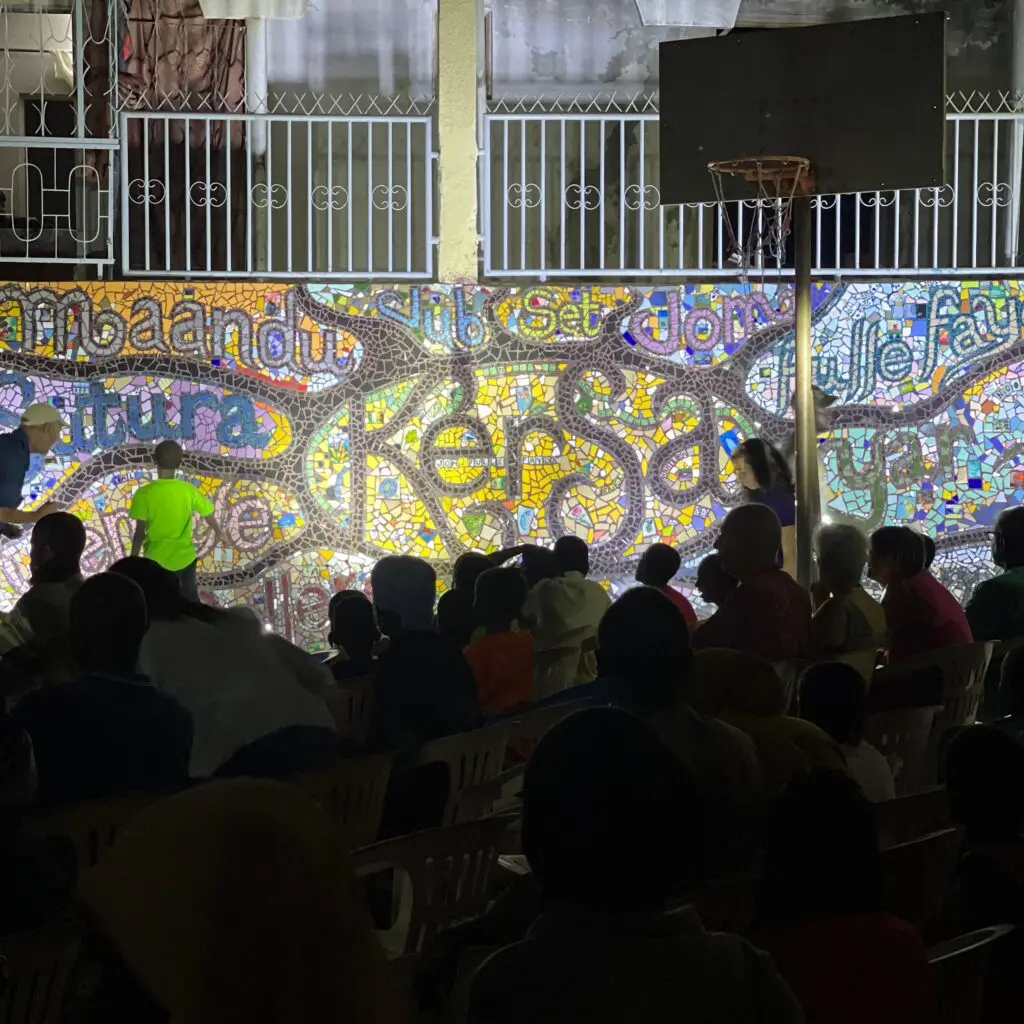
The making of the mural was itself a communal act. In workshops led by Ali, children from the neighborhood painted pieces of glass that were later incorporated into the mosaic. Neighbors and friends arranged tiles, mixed binder, and finished the surface, while people of all ages helped carry materials. She describes the process as “the opportunity to remember and imagine.”
Children passing by stopped to ask questions, opening a dialogue about what it means to respect and care for others and to move through the world with dignity. These exchanges were as integral to the work as the fragments embedded in its surface. The mural bears the imprint of many hands, holding within it both the values it names and the relationships forged through its creation.
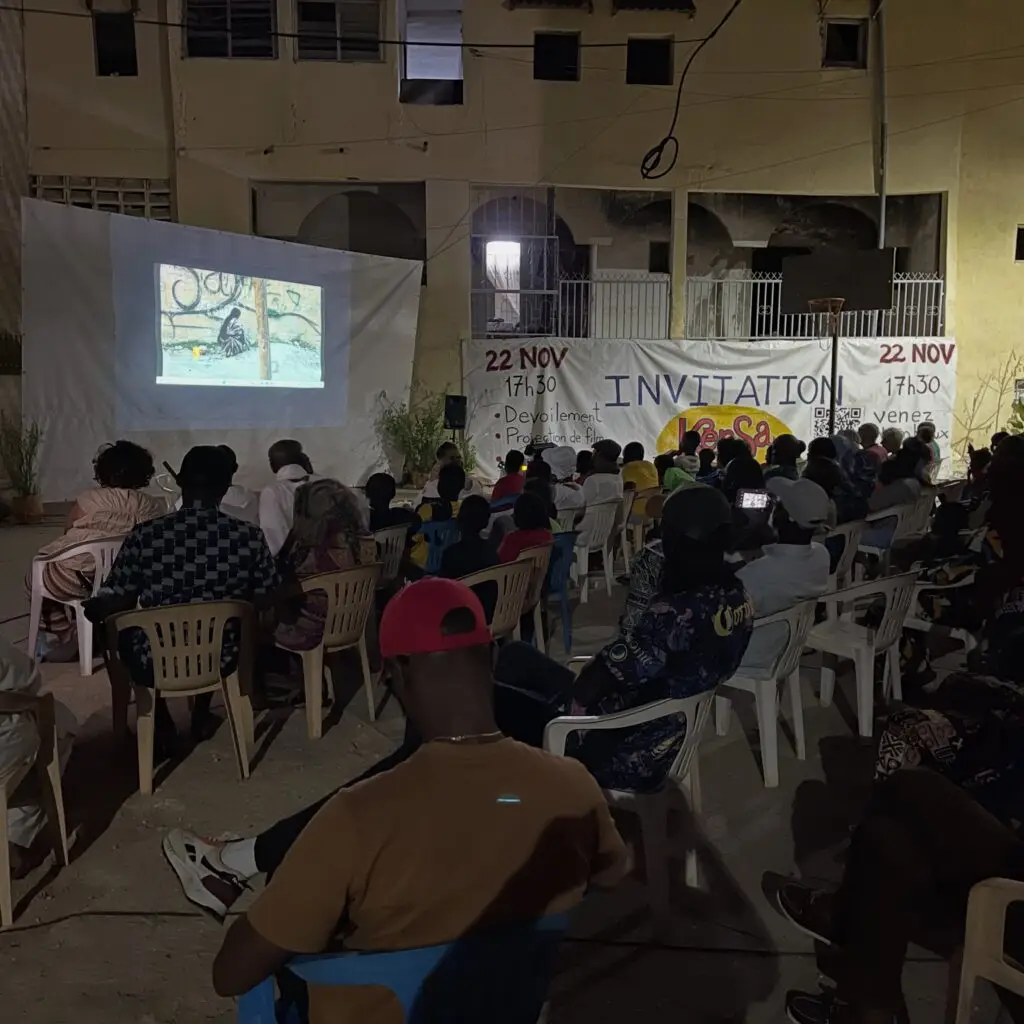
Nearly two years in the making, the mural was officially unveiled at a community gathering that included a screening of Kersa, a film project by Muhsana Ali, directed by Ismaila Thiam.
The conversation that followed was not an appeal to return to the past, but an invitation to consider what inherited wisdom offers us in the present.Ali’s work asks what we lose when the everyday practices that bind us to one another go untended. But it offers more than a lament. Built tile by tile, it reminds us that the bonds that hold us together are not simply inherited. They must be continually created, repaired, and sustained.
Kersa. Muhsana Ali
16th Edition of the Dakar Biennale. Dak’Art 2026
22/11/2026 – 19/12/2026
Mermoz, Dakar, Senegal
Muhsana Ali is a Philadelphia-born multidisciplinary artist and educator based in Senegal. Her artistic practice spans painting, sculpture, installation, photography, video, and alternative mosaics. A recipient of Fulbright and Pew fellowships, she has exhibited across Africa, Europe, and the United States.
Together with Senegalese artist Amadou Kane Sy (Kan-Si), she co-founded Portes et Passages du Retour, an initiative dedicated to artistic creation, community engagement, and holistic development. Her work explores spirituality, cultural and historical memory, African and diasporic identities, and the relationship between artistic practice and social transformation.
N. November 16, 2026