by Alessia D’Introno
Observing an artwork from every angle, only partially, or from a certain distance places us in relation to a perception that inevitably changes. The availability of our gaze, the point from which we observe, the light, time, and space all play a major role in shaping our interpretation.
This concept is not so far removed from the position we occupy in society and the value we assign to things. Perception changes according to our social and economic status, our culture, and the privileged or marginal position from which we scrutinize the world.
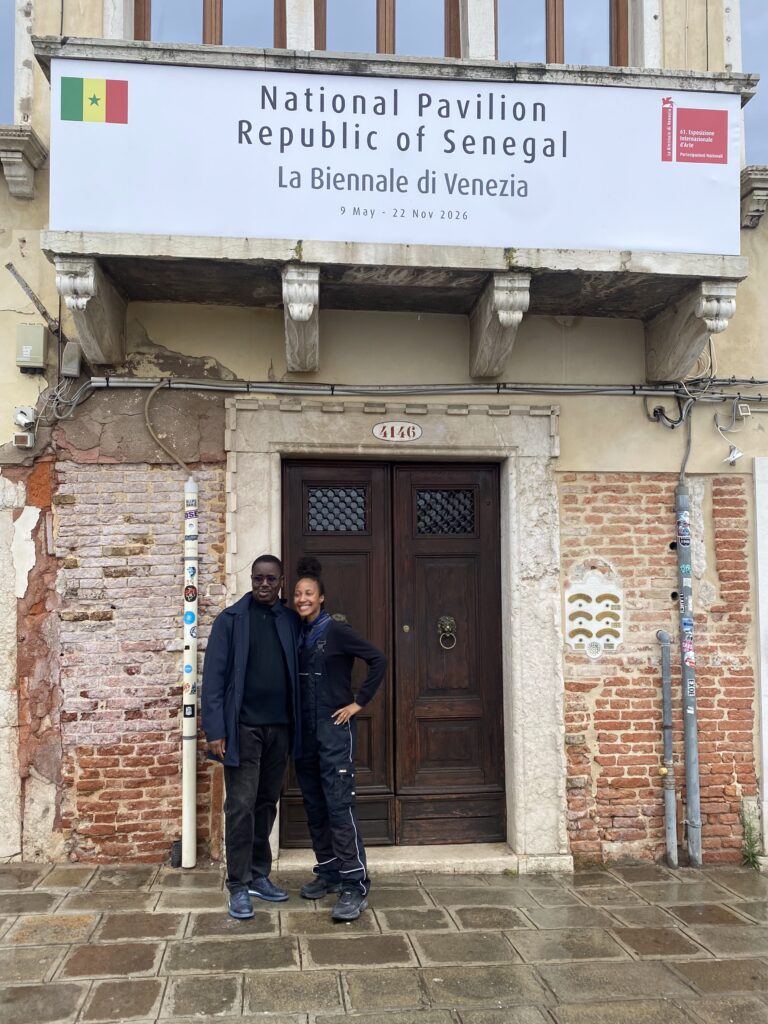
One of the pavilions not to be missed at this year’s 61st International Art Exhibition of the Venice Biennale is undoubtedly the Senegal Pavilion, located at Palazzo Navagero. Artist Caroline Gueye deconstructs the visitor’s static perception. She invites viewers to move around the works, to pass through small openings, following soft light and areas of shadow. The exhibition unfolds through a series of open chambers to be crossed or discovered in darkness, where one is constantly searching for a new orientation. Space becomes an integral part of the installation—not merely a container, but an active element.
This is the artist’s approach: to encourage visitors to question their way of seeing the world, as well as their assumptions about others, hierarchies of value, and the perspectives through which they interpret reality.
As Gueye herself explains:
“In WURUS, I do not simply place works within a space; I construct the conditions through which they become visible. Perception depends on position, movement, and distance. Value is not given; it is formed within this relationship.”
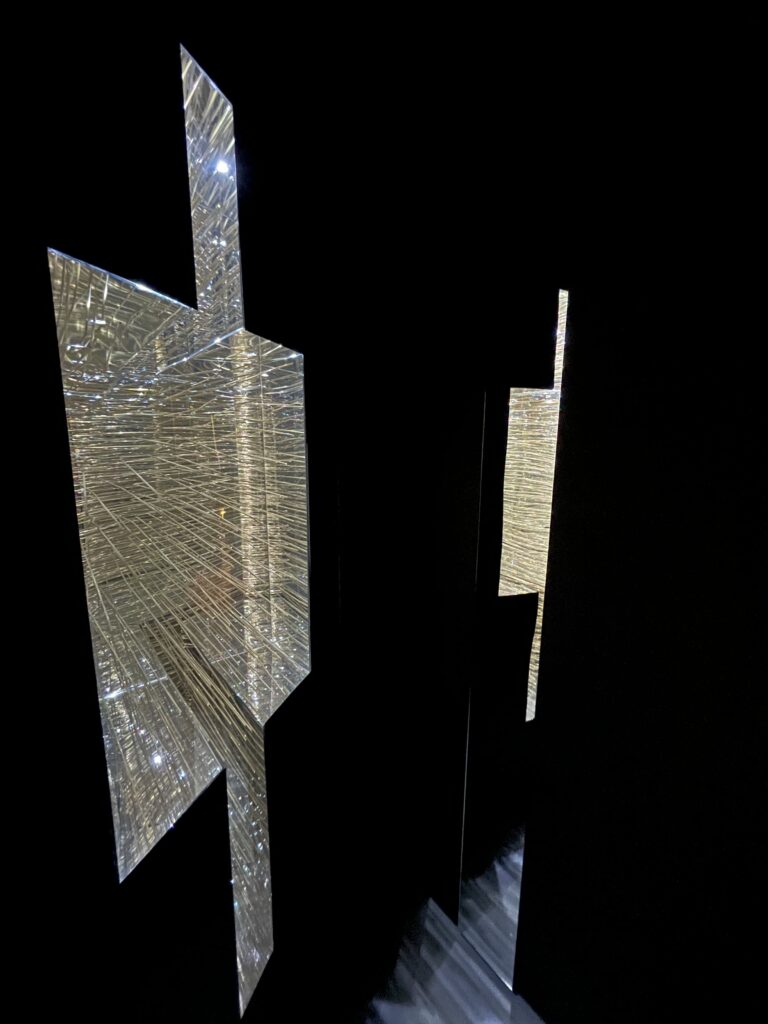
The viewer’s movement thus becomes a fundamental part of the work because it alters the conditions of vision. Moving through space means changing perspective and can even become a metaphor for travel. Leaving one’s comfort zone, crossing into other contexts, and encountering others creates a different condition of listening and openness.
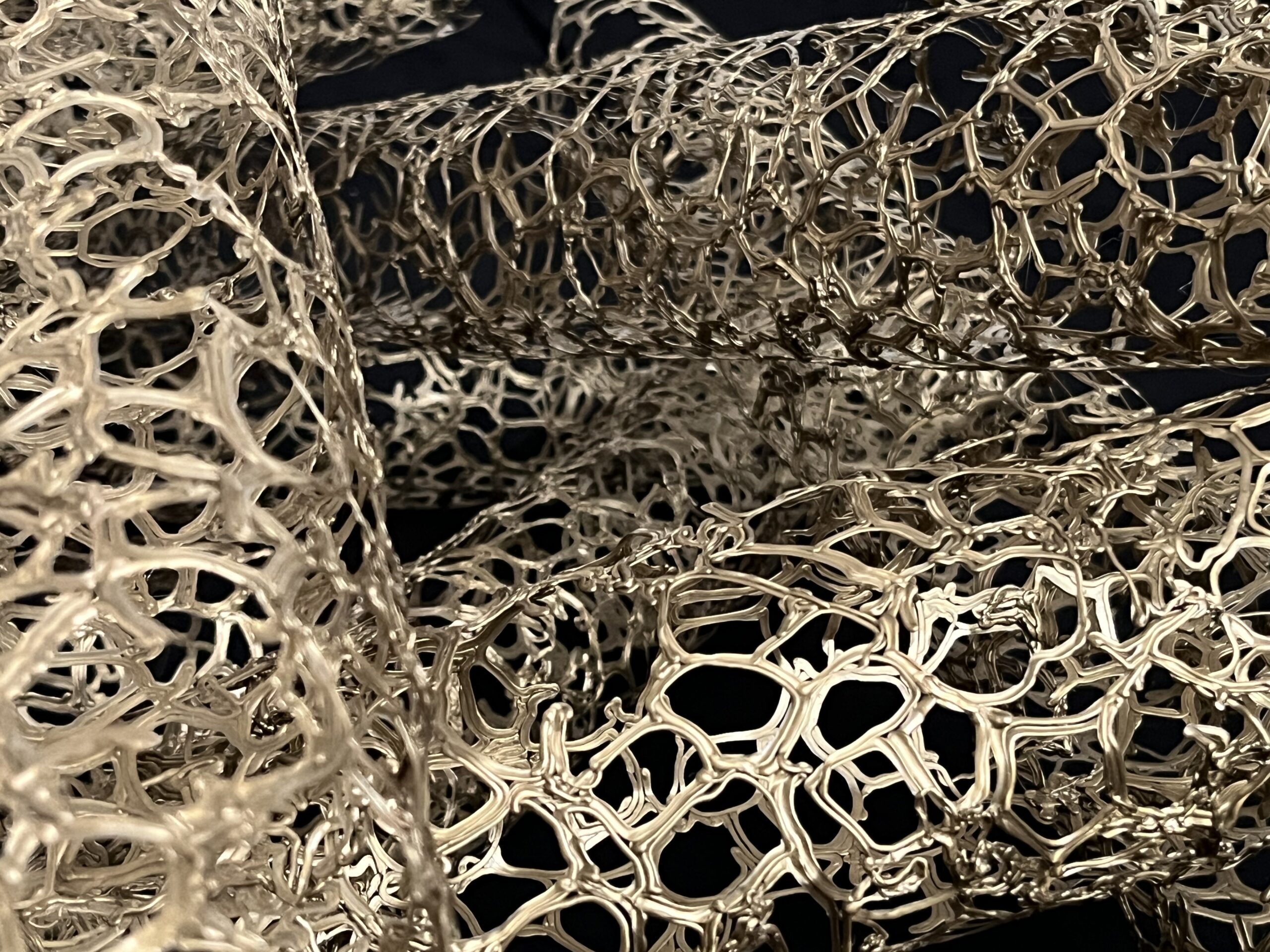
Depending on the light, distance, and angle, the reflective surfaces either mirror their surroundings, darken under targeted illumination, or almost disappear. Nothing remains fixed—just like the value we assign to things, people, and even cultures. Brass structures, polymer bronze elements, mirrors, and lighting devices create perceptual architectures that reveal themselves progressively, displaying different levels of visibility depending on the viewer’s trajectory. The work does not present itself immediately or definitively; it exists in relation to the position of the observer.
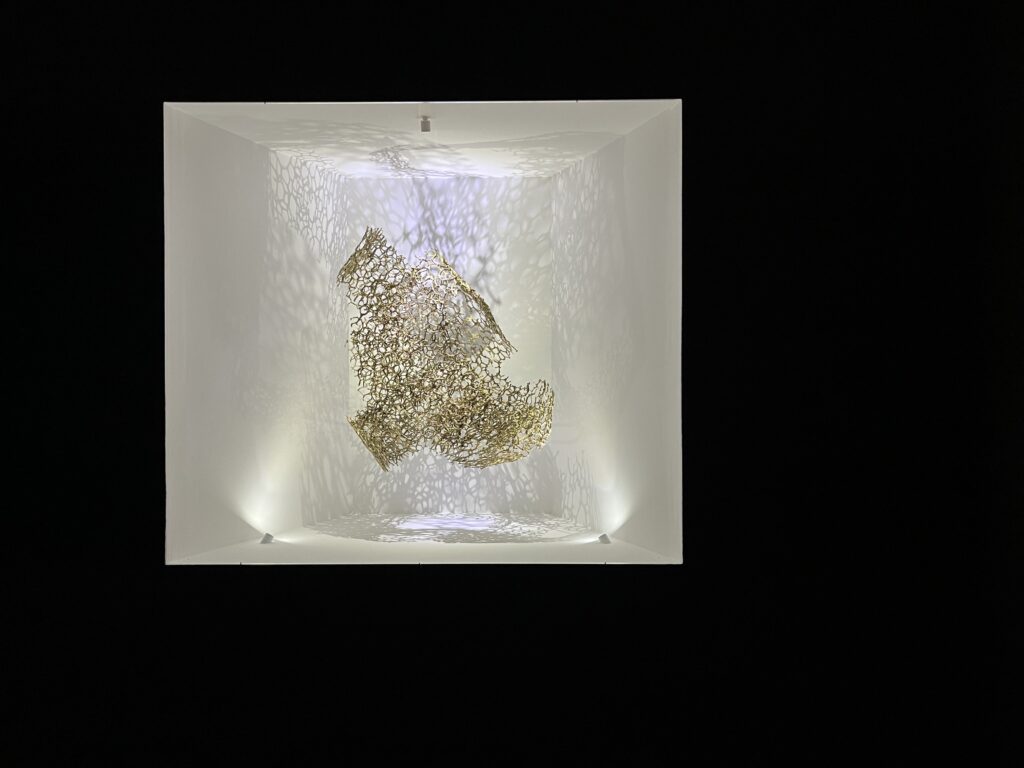
A crucial component of these spatial systems is also the artist’s background in fundamental physics and astrophysics, which profoundly influences her approach to matter, light, and perception. Space is conceived as a device capable of transforming visual experience and the relationship between body, movement, and observation.
In this sense, Gueye’s work enters into dialogue with many reflections from Black feminist and transfeminist thought, which have challenged the notion of a universal and neutral gaze. These perspectives demonstrate how every interpretation of the world is inevitably linked to relations of power, privilege, economic access, and social visibility.
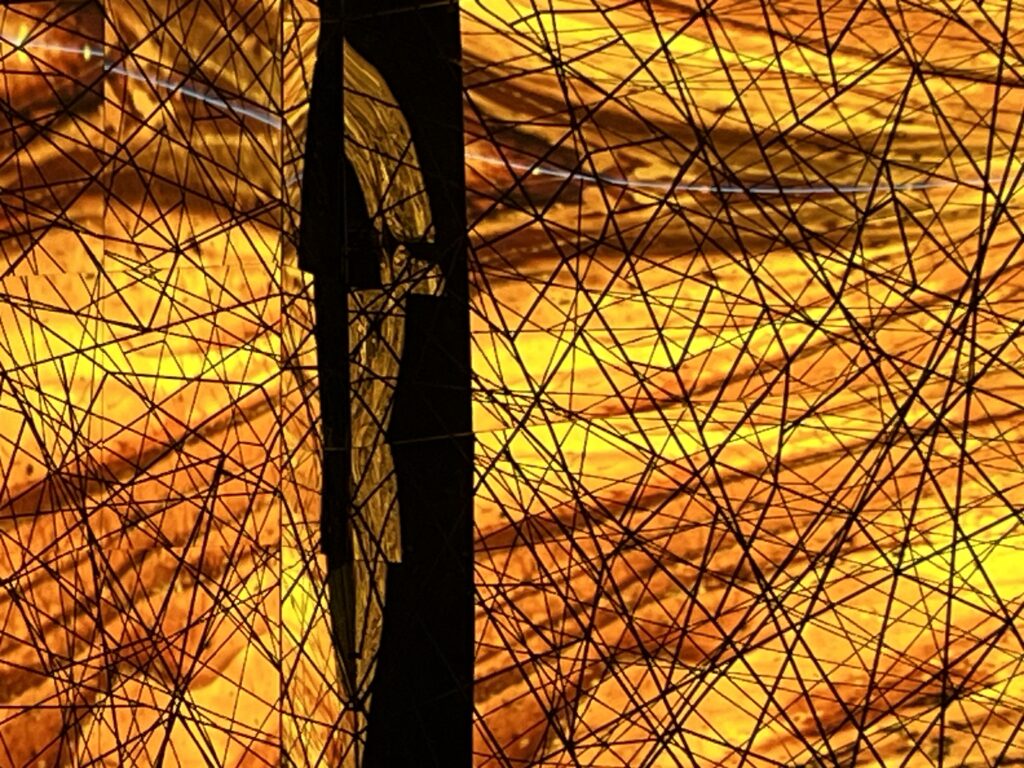
Yet Gueye’s invitation seems above all to be one of continuous decentering: not taking one’s position, opinions, or way of seeing for granted. The movement required of the viewer becomes a critical exercise, almost a political one. In the installation, value itself is generated through relationships, position, and perspective—elements that are never neutral or self-evident but are deeply intertwined with power.
The exhibition’s title, WURUS—curated by Massamba Mbaye and meaning “gold” in Wolof—echoes precisely this idea: a reflection on value as a perceptual, cultural, and social construction. Gueye’s work also seems to place the concept of money into perspective, suggesting that it is far from an innocent entity. Rather, it becomes a mutable construction, constantly shifting and transforming.
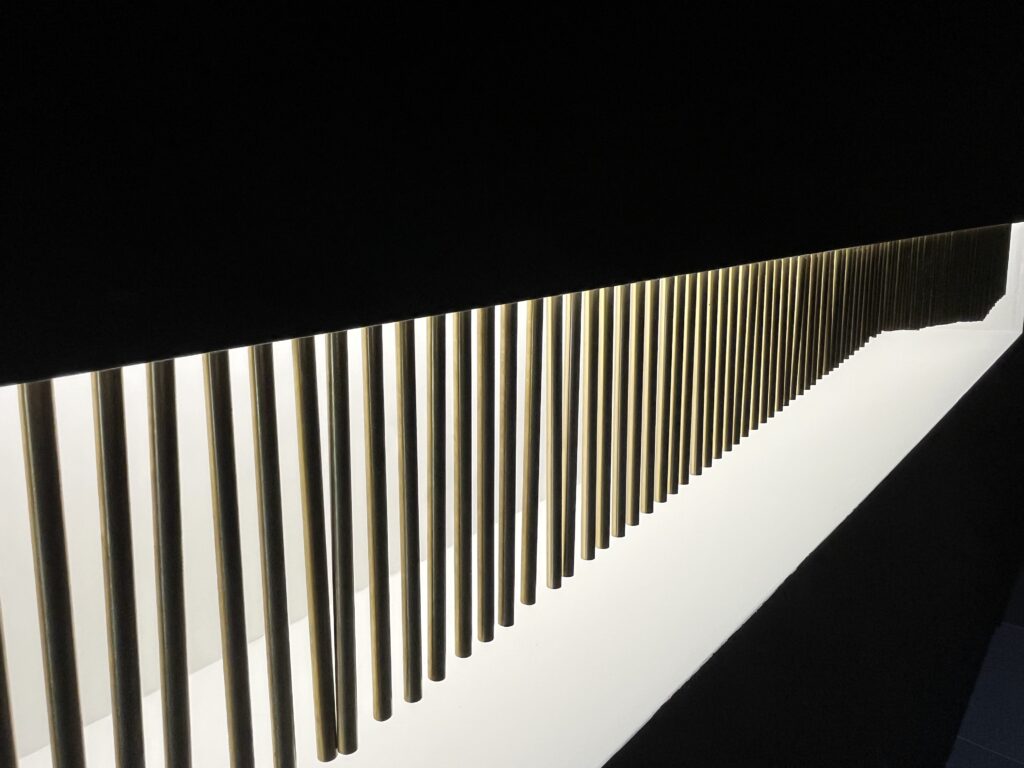
Yet the pavilion never creates a sense of threat or discomfort for the viewer. On the contrary, it invites discovery. Pointed and rounded forms emerge within the space through glass surfaces, wall insertions, and installations positioned at varying heights. Some require the viewer to bend slightly; others reveal themselves frontally, while still others appear only through the experience of moving through darkness. Following reflections, certain elements generate plays of light that multiply forms.
It is an immersive experience that stimulates curiosity and attentiveness. In this way, Gueye seems to undermine the notion that there is a single legitimate perspective from which to view the world. Perhaps her presence at the Biennale most powerfully suggests the necessity—especially today—of shifting our center, accepting that every vision is inevitably partial.
Caroline Gueye is a Senegalese artist who lives and works between Dakar and Europe. Her practice spans installation, sculpture, and spatial environments, and explores the notion of value and how it is constructed through perception and position. She develops spatial systems in which her works are experienced under variable conditions—distance, angle, reflection, and movement. The viewer’s position becomes an active component of the work, determining what is seen and how it is understood. Her installations and sculptures, made of brass and polymer materials, create precise spatial structures that unfold progressively, revealing different levels of visibility depending on the viewer’s trajectory. Value does not reside in objects, buT emerges from the conditions of perception. Her background in fundamental physics, including astrophysics, informs her approach as a conceptual tool, contributing to a rigorous and precise artistic language grounded in spatial experience. Her work has been presented internationally, notably at KINDL – Centre for Contemporary Art (Berlin) and the Musée Théodore Monod (Dakar), and she has undertaken residencies such as Villa Albertine (United States). In 2022, she was awarded the ECOWAS Prize at the Dakar Biennale. In 2026, she represents Senegal at the 61st International Art Exhibition — La Biennale di Venezia with WURUS.
Massamba Mbaye is a critic, exhibition curator, and strategic communication consultant. He has also worked in fundamental research on cybernetics and aesthetics. He is the author of numerous publications and has been documenting African aesthetics for over twenty years. He has curated several exhibitions in Senegal, Ethiopia, Canada, and France. He was Curator of the 2022 Senegal Pavilion at the Dakar Biennale, of the National Salon in 2023 and 2025, and Curator of the Senegal Pavilion at the 2024 Venice Biennale. He has taught communication and marketing management at Cheikh Anta Diop University in Dakar and currently at the Cheikh Hamidou Kane Digital University of Senegal, where he is Head of Training and a member of the scientific committee on AI and Culture within the ALIVE laboratory. He has also taught curatorial practices at the Madiba Institute and lectures at the National School of Arts. Mbaye represented Africa on the jury of the Fourth International Award for Public Art (IAPA) in Shanghai and has presented research at the symposium Culture City. Culture Scape: Art, Urban Change and the Public Sphere organised by NTU CCA Singapore. In journalism, he served as general manager of two media and communication groups after working as a field journalist, editorialist, and cultural journalist. He was President of the Senegalese Association of Cultural Press. He was also Africa’s representative for the theoretical programme of the 2024/25 Havana Biennale. He is a member of the academic committee of the International Institute for Public Art (IIPA) at Shanghai University.
Translation by Luigina D’Introno
WURUS – Pavilion of Senegal
61st International Art Exhibition – La Biennale di Venezia
Curated by Massamba Mbaye
09/05/2026 – 22/11/2026
Palazzo Navagero Gallery, Riva degli Schiavoni, Venice

Alessia D’Introno is Editor-in-Chief of the African contemporary art magazine Equator Echoes, registered in the Special List of the Lombardy Journalists’ Association. She holds a Master’s degree in Visual Arts and Curatorial Studies from NABA, Milan, and has completed a postgraduate course in Demoethnoanthropological Heritage at the University of Milano-Bicocca. She has published articles in Juliet Art Magazine and ArtsLife. Her critical and curatorial research focuses on the deconstruction of classical art history and the decolonization of the contemporary European art system.
N. May 20, 2026