By Alessia D’Introno
World cartography, as it is still understood and represented today, can be seen as one of the earliest and most influential examples of the Eurocentric view of the world and history. Published in 1569 by the Flemish cartographer Gerardus Mercator, the Mercator projection forms the basis of the most widespread representation of the world. Created to meet the needs of European oceanic navigation, its innovation was simple: drawing a line between the point of departure and the point of arrival, providing a stable route to follow during the sea voyage. As a result, 16th-century navigators and merchants had a tool that made the world more traversable, measurable, and accessible, in response to the royal demands for the exploration of distant territories and the search for new raw materials. In this way, the map specifically met European needs.
A map, therefore, is not merely a scaled image of the world. It is a constant reflection of the political, economic, and cultural relations that shaped its creation. Cartography is not neutral because it highlights which perspective makes the world more legible and simplified. It also underlines how those who created and used these maps contributed to making the world more manageable and governable.
The question that naturally arises, and which has engaged geographers and historians, is whether a map from the mid-16th century can still provide the appropriate tools for viewing the globe in the contemporary era?
The substantial consequence is that the projection tends to greatly enlarge the regions near the poles, whilst the equatorial areas appear scaled down. For instance, Africa covers approximately 30 million km², whilst Greenland appears surprisingly close in size to Africa on the map, despite actually being around 2 million km².
An alternative representation was proposed in the 20th century with the Gall-Peters projection. It prioritised the correct proportions of the continents over the accuracy of their shapes. It did not, in fact, resolve the issue of cartographic neutrality, but it helped to reopen the debate on the relationship between geographical representation and power.
This perspective of the gaze does not deal with a simple drawn line that we have carried with us for centuries.
The Berlin Conference, held from November 1884 to February 1885, regulated the terms of the partition of the African continent. The conference did not initiate this process. The partition was already underway, but the conference helped to formalise and accelerate it, according to the territorial model based on the European nation-state.
They imposed sovereignty and demarcated borders on Africa, in some cases, even impossible to delineate on the actual territory, given the limited knowledge of African geography. They rarely took into account pre-existing political, social and cultural structures (Ahmad, 2013).
In most cases, the boundaries served the rivalries and claims of the great powers, cutting across and dividing communities, trade networks, linguistic areas and shared places of worship. Populations that had inhabited the same areas for centuries found themselves separated by administrative borders, whilst others were incorporated into different entities, constructed according to colonial rather than local interests (Asiwaju, 1985 in Ahmad, 2013).
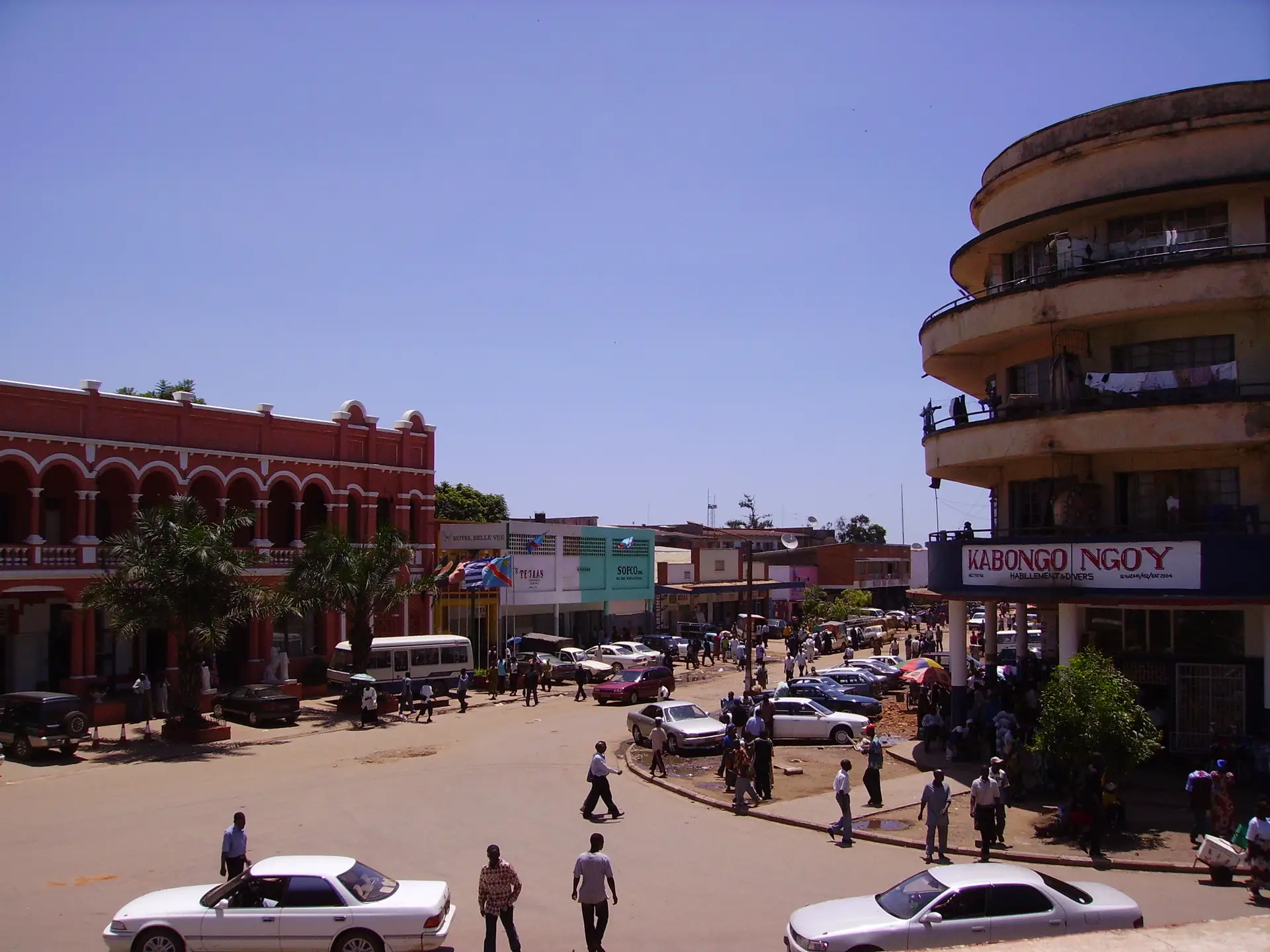
The end of colonialism did not lead to the disappearance of its sharp lines. The new postcolonial states inherited the same borders, much of the same administrative apparatus, and many of the forms of territorial organisation established during the colonial period.
These legacies, as well as the problems that have arisen from them, are part of the present. Considering these historical developments helps us to understand the tensions that still run through the continent.
What becomes evident is how the image, whether a world map or a border line, contributes to producing tangible effects on people and cultures. If art can be considered a useful tool for interpreting these dynamics, then artistic practices can be viewed as another way of telling history. Art is political. It mainly highlights, denounces, and opens our eyes to the world from both within and without. If maps have helped to organise the world, what other historical and inherited images need to be questioned?
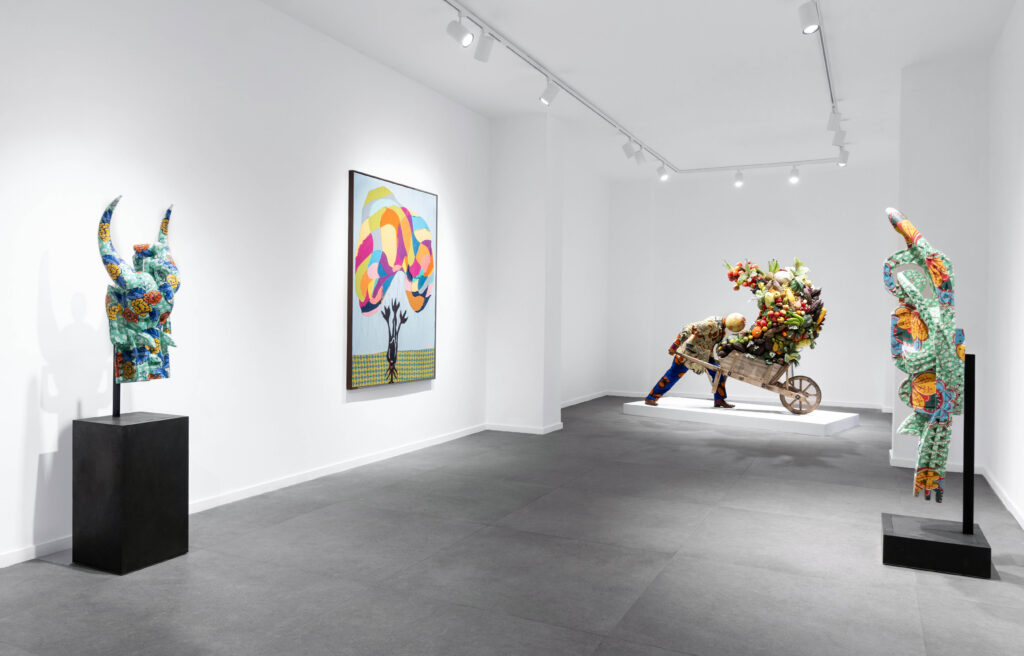
Among the artists who see the image not merely as an image, but as a visualiser of political and cultural dynamics, is Yinka Shonibare. The Nigerian-British artist frequently reflects on the still visible consequences of colonial memory.
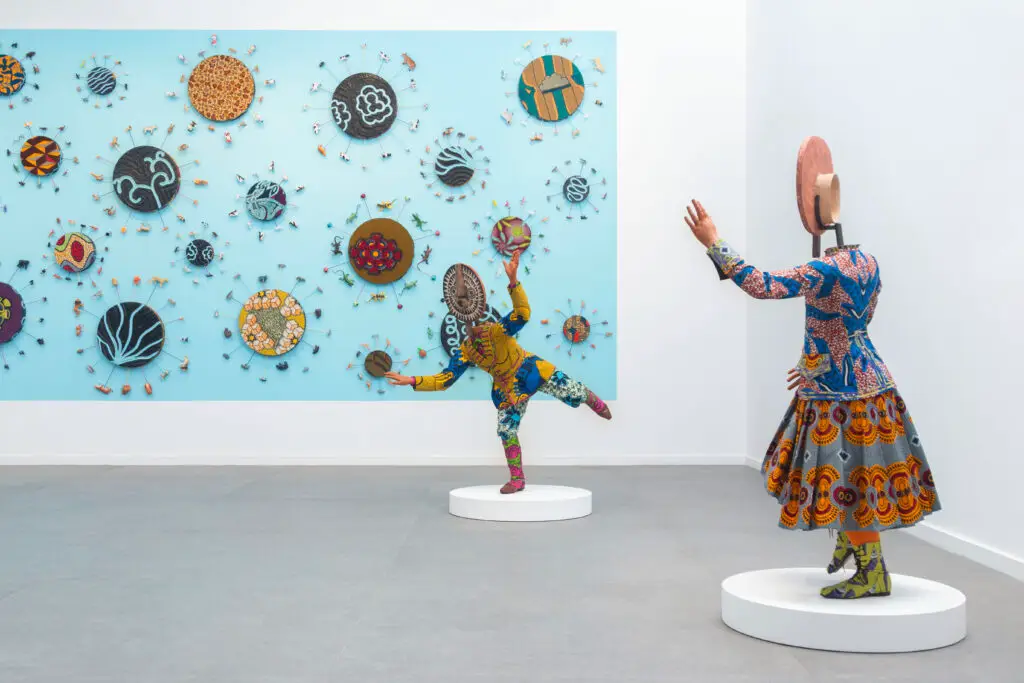
Monuments, libraries, and textiles, symbols of entire cultures, become tools through which to re-examine the power dynamics that have shaped the contemporary world. Some of his most striking and recognisable works were featured in his solo exhibition at Fondation H in Madagascar, which ended in February 2026. In the Decolonised Structures series, Shonibare engages with some of the most celebrated figures in British imperial history. On display are Decolonised Structures (Queen Victoria), 2022, Decolonised Structures (Kitchener), 2022, and Decolonised Structures (Churchill), 2023.
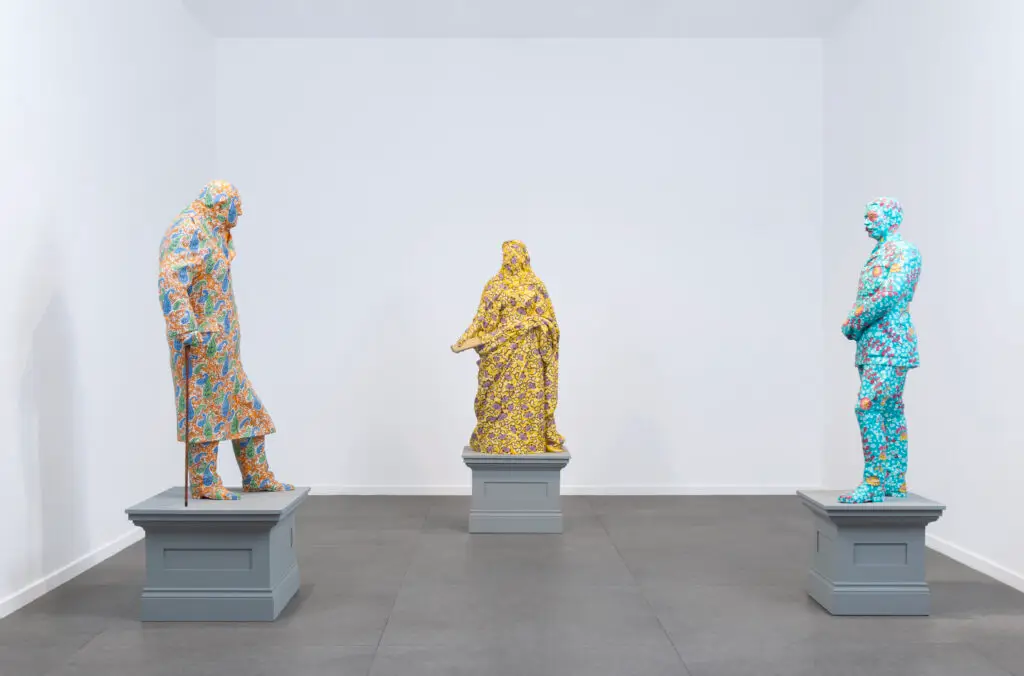
The three works form part of a series of public monuments that have been scaled down and reinterpreted by the artist. Whilst retaining the pedestal and the role of the statue, Shonibare strips them of their pompous power and their function of subjugating the citizens, bringing them down to life-size. The viewer can now engage with the historical role they represent.
Decolonised (Victoria), 2022 is inspired by the marble statue of Queen Victoria. The work reflects the ambivalence of the Queen, who contributed to the modernisation of the monarchy, and at the same time, was a symbol of colonial expansion and the subjugation of entire peoples, as in the case of India, where she proclaimed herself ‘Empress of India’.
Decolonised (Kitchener), 2022 reimagines the figure of Herbert Kitchener, the famous British general who held high-ranking military posts in colonial territories, including Egypt, Sudan, India and South Africa. During the Second Anglo-Boer War, he was responsible for brutal tactics such as the destruction of farms and the internment of civilians in concentration camps, where tens of thousands of people died, despite his return home as a hero.
Decolonised Structures (Churchill), 2023 reflects the famous statue of Winston Churchill, highlighting his role as a leader during the Second World War and his racist statements that continue to fuel the debate on the consequences of his imperial political choices. The Decolonised Structures series, in effect, questions the figures that history has chosen to celebrate in the public sphere. Shonibare brings to light aspects of history often buried or justified by dominant imperial narratives. His invitation is to reflect on the violence, hierarchies and forms of exploitation that have accompanied the construction of the world.
What kind of global citizen do we want to become today? This is Yinka Shonibare’s question. If monuments help to shape our collective memory, what other stories remain on the margins?
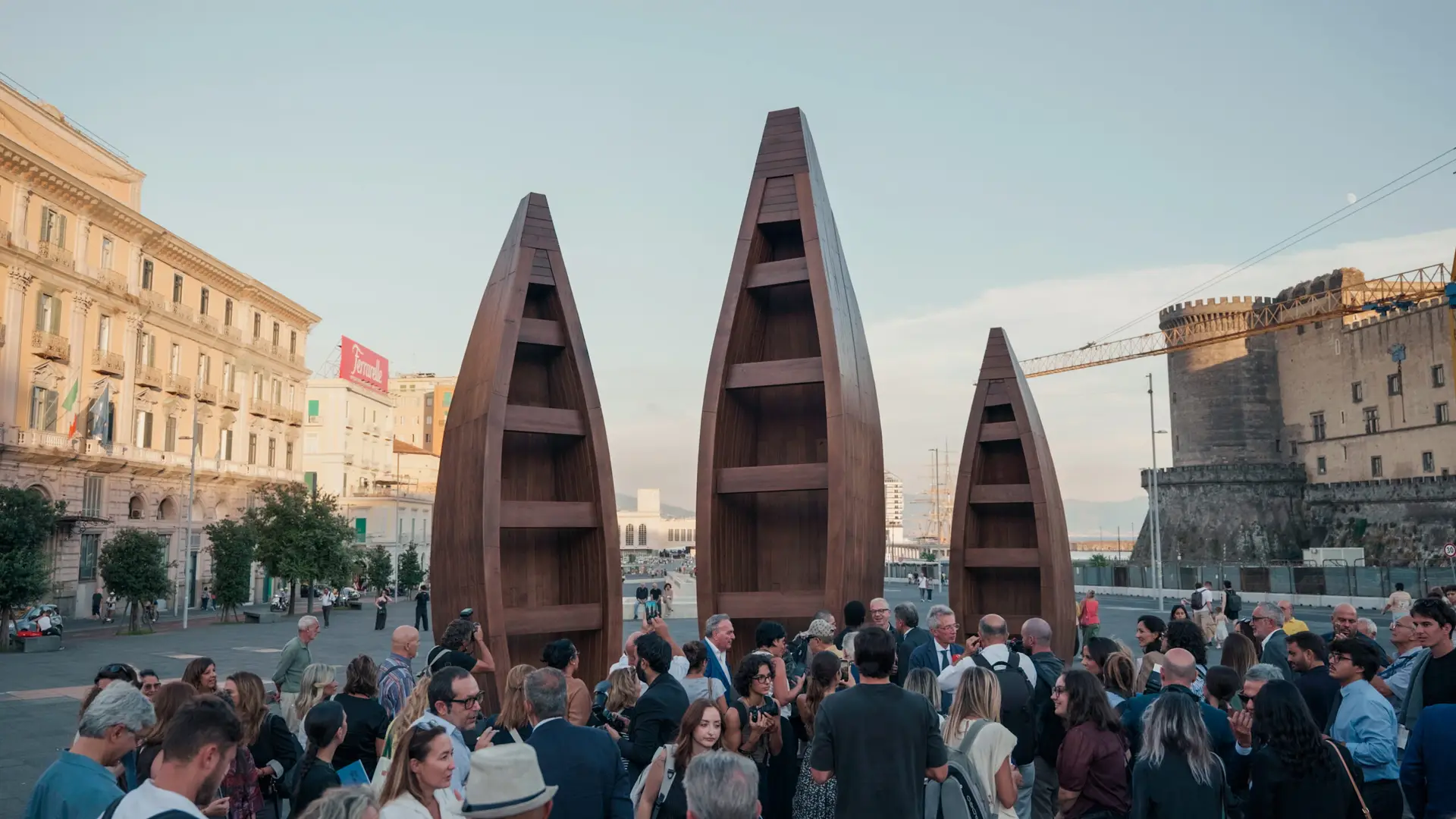
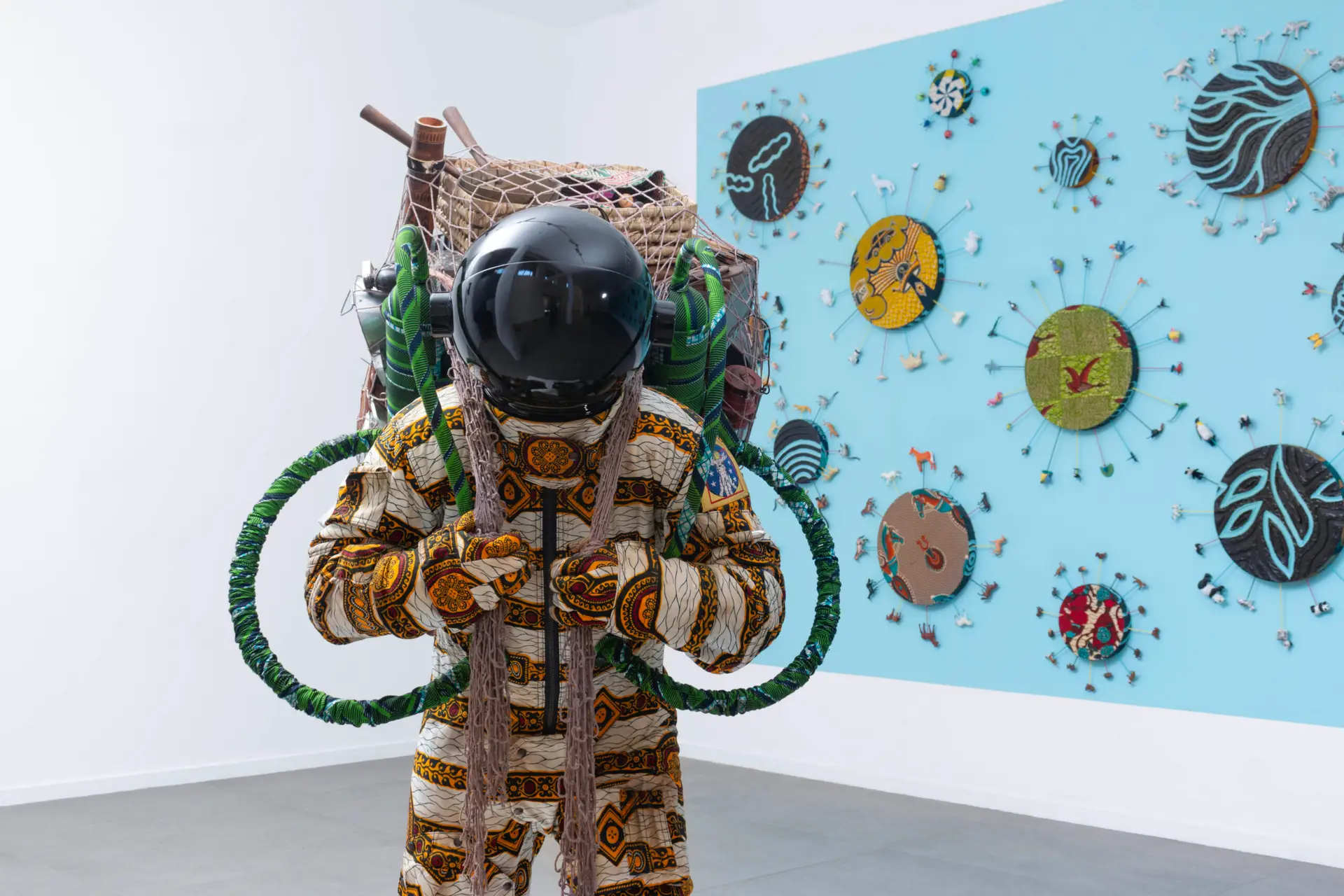
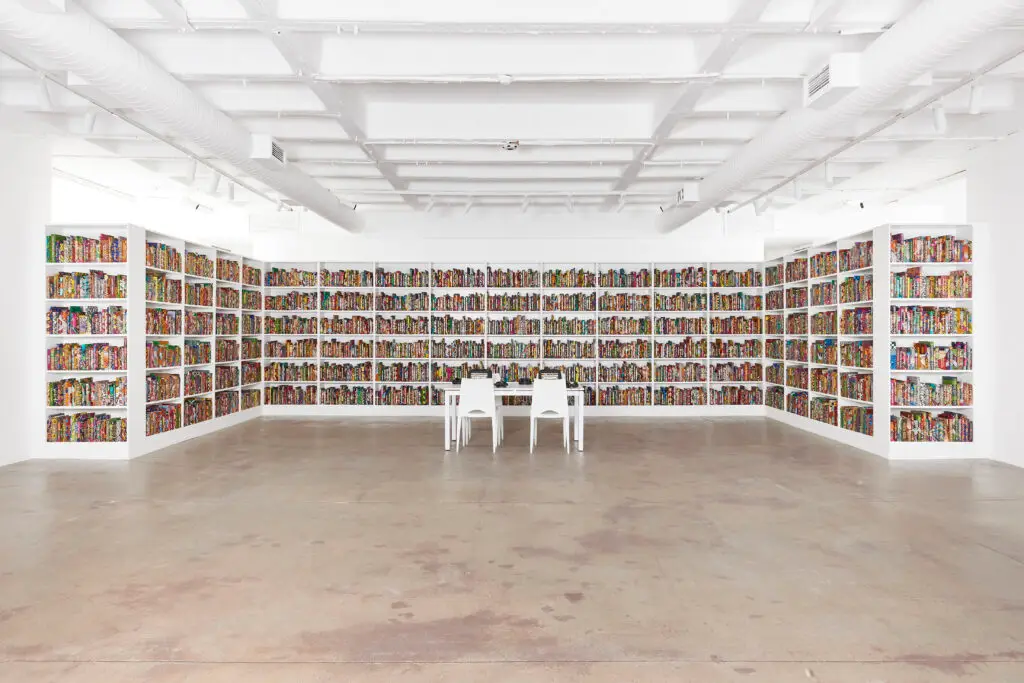
In The African Library, African figures who contributed to the struggles for African independence and the development of postcolonial thought are commemorated. Six thousand names are distributed across the books. These have been wrapped in the artist’s characteristic fabrics and bear the names of the celebrated figures in gold on their spines. An integral part of Shonibare’s work is the construction of an ironic, reflective and critical paradox: the library becomes an archive, a monument, and an instrument of counter-memory. The statues, therefore, look to the past. Libraries work on memory. Whilst the Refugee Astronaut series shifts the focus to the present. The figure of the astronaut, a series launched in 2015, was also presented at the 60th Venice Biennale and at the exhibition at the Fondation H. The sculpture, a life-size nomadic astronaut, is a curious figure: with a rucksack laden with everyday objects, he seems ready to face a world marked by ecological and humanitarian crises.
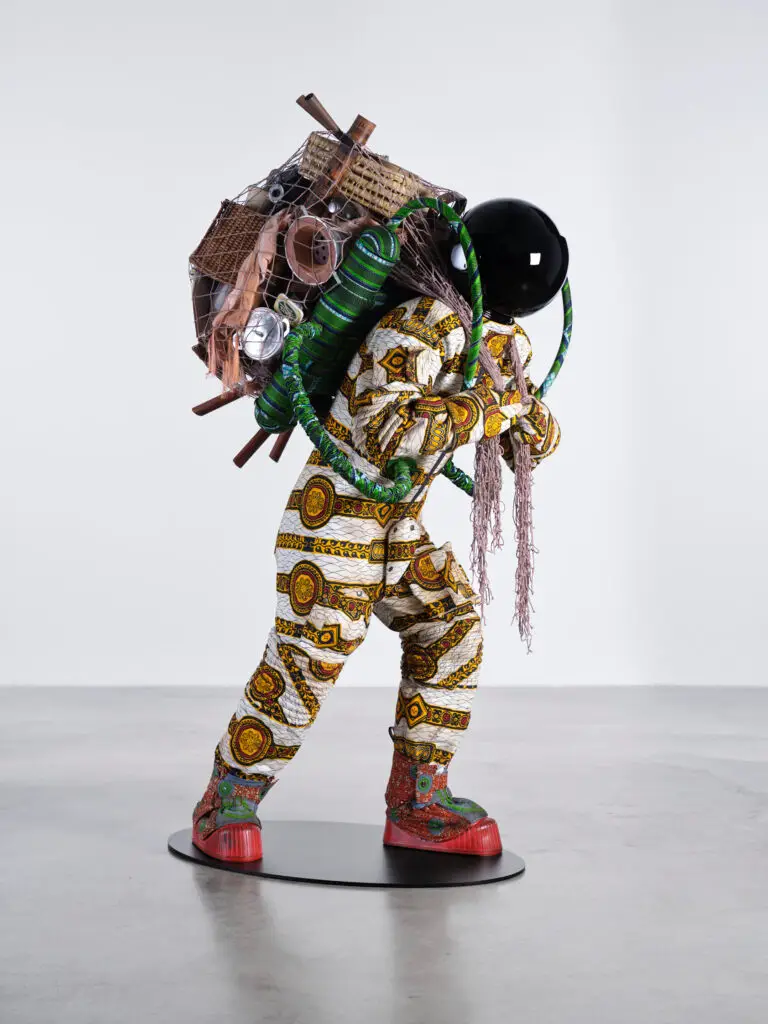
The astronaut is a powerful metaphor for forced nomadism, generated by the consequences of colonialism and exacerbated by a contemporary world that has plundered and compromised the environment. It is this that drives the astronaut to seek greener spaces. The nomadic sculpture is suspended between times and identities, questioning the notion of belonging and survival, evoking the urgency of rethinking our views on refuge, legacy, and eco-colonialism.
History is not a closed chapter; it is a structure that continues to reshape the present and manifest itself in many forms. In this context, Shonibare demonstrates how colonialism, memory, migration, and climate change are parts of the same story that continues to have an impact on the contemporary world.
AFRICAN UNION BORDER PROGRAMME, Delimination and Demarcation of Boundaries in Africa, 2013
Yinka Shonibare CBE RA (b. 1962) in London, UK, studied Fine Art at Byam Shaw School of Art, London (1989) and received his MFA from Goldsmiths, University of London (1991). His interdisciplinary practice uses citations of Western art history and literature to question the validity of contemporary cultural and national identities within the context of globalisation. Through examining race, class and the construction of cultural identity, his works comment on the tangled interrelationship between Africa and Europe, and their respective economic and political histories. In 2024, the Serpentine, London, UK, presented a solo exhibition of works in their Serpentine South gallery titled Suspended States. Shonibare’s work is also featured at the Venice Biennale 2024 as part of the Nigerian Pavilion, in the group show: Nigeria Imaginary. Shonibare’s works are in notable museum collections internationally, including the Tate Collection, London; Victoria and Albert Museum, London; Fondation H , Madagascar; National Museum of African Art, Smithsonian Institute, Washington, D.C; Museum of Modern Art, New York; Moderna Museet, Stockholm; the Museum of Contemporary Art, Chicago; National Gallery of Modern Art in Rome and VandenBroek Foundation, The Netherlands.
Traslation by Luigina D’Introno

Alessia D’Introno is Editor-in-Chief of the African contemporary art magazine Equator Echoes, registered in the Special List of the Lombardy Journalists’ Association. She holds a Master’s degree in Visual Arts and Curatorial Studies from NABA, Milan, and has completed a postgraduate course in Demoethnoanthropological Heritage at the University of Milano-Bicocca. She has published articles in Juliet Art Magazine and ArtsLife. Her critical and curatorial research focuses on the deconstruction of classical art history and the decolonization of the contemporary European art system.
N. June 4, 2026